Triangle Earrings Material Guide: Metals & Durability
Compare the best metals for triangle earrings. We analyze titanium, gold, and steel for durability, weight, and hypoallergenic properties at the vertices.

The Geometry of Stress: Why Material Matters for Triangles
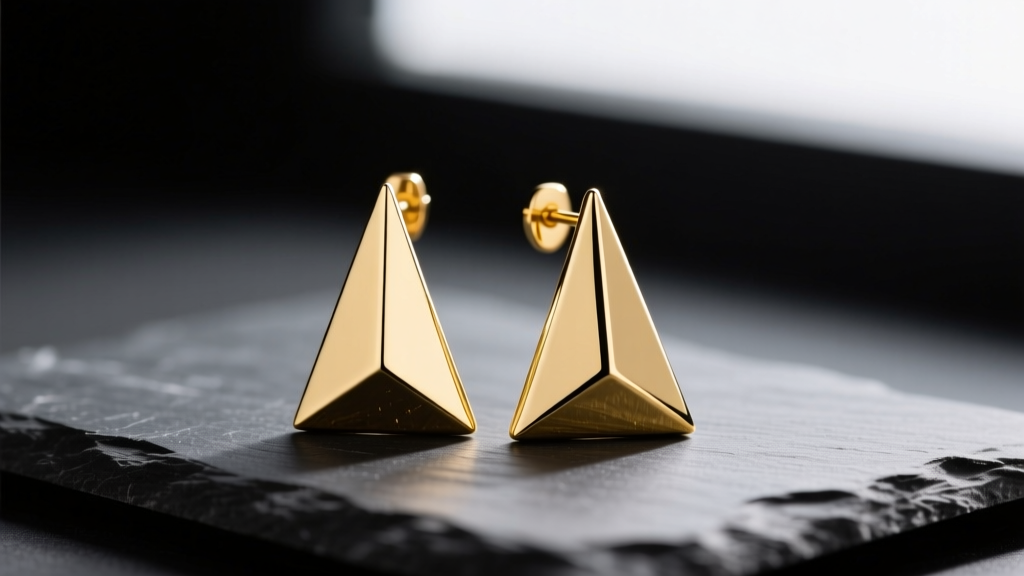
When selecting triangle earrings, the geometric shape dictates unique structural demands that round or oval silhouettes simply do not face. The defining characteristic of a triangle—its acute angles and sharp vertices—creates natural stress concentrators. In metallurgy and structural engineering, sharp corners are known to amplify kinetic energy and physical stress. When a triangular earring is dropped, snagged on clothing, or subjected to the daily friction of wear, the forces are disproportionately directed toward its three points.
If the chosen metal lacks adequate yield strength or is cast with microscopic porosity at the vertices, the earring will suffer from 'vertex blunting,' micro-chipping, or catastrophic structural failure. Furthermore, the structural integrity of the post or hinge must be carefully matched to the metal's tensile properties. In 2026, advanced CAD/CAM casting and precision CNC milling have revolutionized how geometric jewelry is produced, but the fundamental laws of material science remain unchanged. Understanding the metallurgical properties of your triangle earrings is essential for ensuring they remain sharp, safe, and structurally sound over years of wear.
Metal Hardness & Vertex Durability: The Vickers Scale
To evaluate how well a metal will maintain the crisp, sharp lines of a triangular silhouette, jewelers rely on the Vickers Hardness Scale (HV). This scale measures a material's resistance to permanent indentation and deformation. For geometric earrings where edge retention is paramount, a higher HV rating is generally preferred, though it must be balanced against malleability and skin safety.
Titanium: Grade 23 vs. Grade 5
Titanium is a powerhouse for hypoallergenic jewelry, but not all titanium is created equal. According to the American Academy of Dermatology, titanium is highly biocompatible, making it ideal for sensitive lobes and cartilage piercings. However, the specific alloy grade drastically affects its performance in triangle designs:
- Grade 23 (Ti-6Al-4V ELI): The gold standard for body jewelry. It is highly biocompatible and corrosion-resistant but has a relatively lower Vickers hardness of ~280 HV. It is excellent for triangle studs but may bend if used for thin, elongated triangle dangles.
- Grade 5 (Ti-6Al-4V): With a Vickers hardness of ~350 HV, Grade 5 is significantly harder and more scratch-resistant. It is the superior choice for large, thin geometric hoops or triangle ear cuffs that require rigid structural memory to maintain their shape without warping.
14k vs. 18k Gold: Casting Porosity at Sharp Angles
Gold remains a premium choice, but its purity dictates its structural viability for sharp geometric shapes. As detailed by the Gemological Institute of America (GIA), pure 24k gold is far too soft (HV ~60) for daily wear. Therefore, alloying is required.
18k Gold (75% pure) has a Vickers hardness of approximately 125-150 HV. While it offers a rich, luxurious color, its softer nature makes the acute vertices of triangle earrings susceptible to rounding and micro-abrasions over time. Additionally, during the lost-wax casting process, sharp corners in the CAD model can trap gas bubbles, leading to microscopic porosity right at the triangle's points. If not properly polished and burnished, these pits can harbor bacteria and weaken the tip.
14k Gold (58.5% pure) boasts a higher hardness rating of 170-220 HV (depending on the copper and silver alloy mix). For crisp, sharp-edged triangle earrings, 14k gold is structurally superior. It holds a polished edge far better than 18k and resists the 'vertex blunting' effect. However, buyers must be aware that 14k white gold is often rhodium-plated; at the sharp points of a triangle, this plating experiences the most friction and will wear away fastest, exposing the slightly yellowish palladium alloy beneath.
Weight Distribution in Oversized Geometric Drops
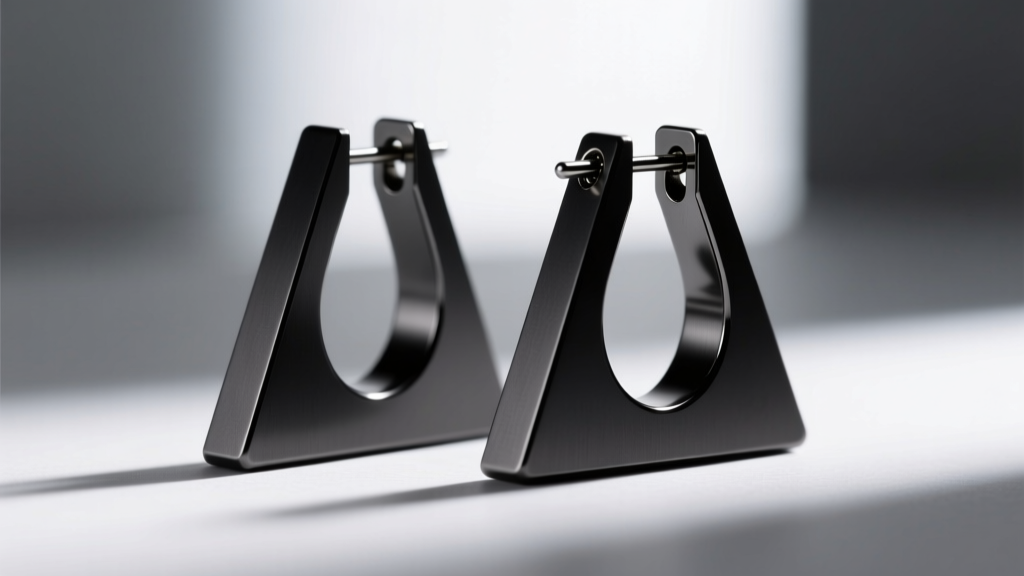
Triangle dangle earrings and statement drops present a unique challenge regarding mass distribution. Because the shape tapers to a point, the center of gravity sits higher up (closer to the earlobe) compared to a teardrop or square shape of the same surface area. However, oversized geometric triangles (e.g., 3-inch equilateral drops) can still cause severe lobe stretching if cast in solid, dense metals.
"A solid 14k gold triangle earring measuring 3 inches across and 2mm thick will weigh approximately 14 grams per earring. This exceeds the comfortable threshold for standard lobe piercings, leading to micro-tears and elongation over time."
To combat this, modern jewelers utilize several techniques:
- Hollow-Forming (Electroforming): Creates a seamless, lightweight gold shell that maintains the rigid geometric exterior while reducing weight by up to 70%.
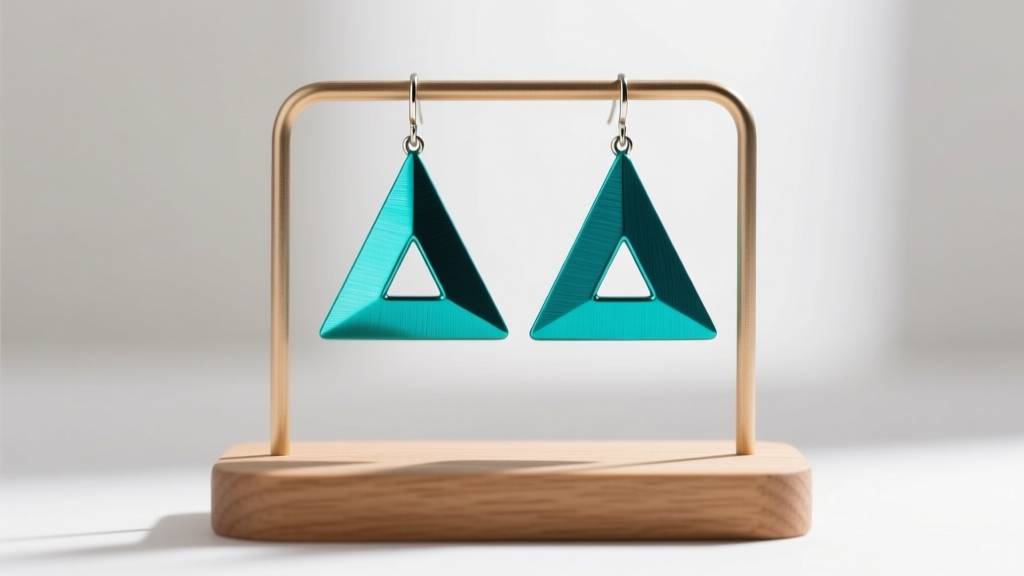
- Anodized Aluminum: With a density of just 2.7 g/cm³ (compared to gold's 15-19 g/cm³), aluminum is exceptionally lightweight. Through anodization, aluminum triangle earrings can be dyed in vibrant, fade-resistant colors without the need for paint that would chip off the sharp edges.
- Skeletal Wireframes: Using 14g or 12g wire to create the outline of the triangle, leaving the center open. This drastically reduces mass while emphasizing the geometric aesthetic.
Material Comparison Chart
The following table breaks down the metallurgical properties of common materials used in triangle earrings, providing a quick reference for buyers prioritizing durability, weight, and budget.
| Material | Vickers Hardness (HV) | Density (g/cm³) | Best Triangle Style | Avg. Price Range |
|---|---|---|---|---|
| Grade 5 Titanium | ~350 | 4.43 | Huggies, Cartilage Studs | $45 - $120 |
| 14k Yellow Gold | ~180 | 13.5 | Everyday Drops, Threaders | $250 - $800+ |
| 316L Surgical Steel | ~220 | 8.00 | Chunky Hoops, Industrial Bars | $15 - $50 |
| Anodized Aluminum | ~150 (Surface) | 2.70 | Oversized Statement Dangles | $30 - $90 |
| Acrylic / Resin | ~20 | 1.18 | Clip-ons, Bold Geometric Drops | $10 - $40 |
Gauge Thickness and Structural Failure Modes
The thickness of the metal (gauge) is just as critical as the material itself, particularly for triangle hoops and huggies. The geometric tension of a closed polygon places outward and inward stress on the wire. If the gauge is too thin, the triangle will inevitably warp into an oval or teardrop shape when the clasp is engaged or when pressure is applied.
Common Failure Modes by Style
- Triangle Studs (20g - 18g / 0.81mm - 1.02mm): The primary failure mode here is not the triangle face, but the solder joint where the post meets the flat back. If the triangle face is heavy, a standard 20g post soldered with low-temperature solder will snap off at the base. Laser-welding is required for heavy geometric faces.
- Triangle Huggies (16g - 14g / 1.29mm - 1.63mm): Huggies rely on a tension hinge. If the wire is thinner than 16g, the metal will fatigue at the hinge joint, leading to a stress fracture. Grade 5 titanium or spring-hardened 14k gold is mandatory for 16g triangle huggies.
- Triangle Threaders (22g / 0.64mm): While 22g chain is standard for threaders, the chain must transition into a thicker bail before connecting to the triangle drop to prevent the sharp top vertex from cutting through the delicate chain links.
Final Verdict: Matching Metal to Your Triangle Style
Choosing the right material for triangle earrings requires balancing aesthetic desires with metallurgical realities. For everyday, razor-sharp geometric studs that will endure years of friction without losing their crisp vertices, 14k gold or Grade 5 Titanium are the undisputed champions. Their superior Vickers hardness ensures the acute angles remain intact.
For those seeking oversized, avant-garde triangular drops that make a bold statement without stretching the earlobe, anodized aluminum or hollow-formed 14k gold provide the necessary volume without the punishing density. Conversely, if you are purchasing triangle huggies or cartilage hoops, never compromise on gauge thickness; insist on 16g or 14g wire to prevent the geometric tension from warping the shape. By respecting the structural demands of the triangle silhouette, you ensure your jewelry remains as sharp and striking as the day you bought it.


