Trinidad Gold Earrings: The Ultimate 2026 Buyer's Guide
Discover how to buy authentic Trinidad gold earrings in 2026. Learn about 18k Caribbean karatage, creole hoops, filigree motifs, and pricing.

The Allure of Caribbean Craftsmanship
When it comes to Caribbean jewelry, few pieces carry the cultural weight, historical richness, and undeniable visual impact of Trinidad gold earrings. Unlike mass-produced tourist jewelry found across the islands, authentic Trinidadian goldsmithing is a reflection of the nation’s vibrant dual heritage. The blending of Afro-Caribbean boldness and Indo-Caribbean intricacy has birthed a localized jewelry market that is entirely unique. For collectors, investors, and style enthusiasts in 2026, navigating the gold markets of Port of Spain, San Fernando, and Chaguanas requires a keen eye and an understanding of regional nuances.
Whether you are hunting for heavy creole hoops, delicate filigree drops, or the iconic "bamboo" textured studs, buying gold in Trinidad and Tobago is an experience rooted in tradition. However, the market is also saturated with imported, lower-karat alternatives and gold-plated imitations designed to catch the untrained eye. This comprehensive buying guide will equip you with the metallurgical knowledge, cultural context, and pricing frameworks necessary to invest in genuine Trinidad gold earrings.
Understanding Trinidad Gold: Karatage and Purity
The most critical mistake international buyers make is assuming Trinidadian gold adheres to the standard US or European karatage norms. In the United States, 14k gold is the benchmark for durability and retail availability. In Trinidad, however, the cultural preference leans heavily toward higher purity. According to the Gemological Institute of America (GIA), understanding the alloy composition is vital for assessing both value and wearability.
| Karatage | Purity % | Cultural Context in Trinidad | Best Earring Style |
|---|---|---|---|
| 14k (585) | 58.5% | Rare in local traditional shops; mostly found in imported mall brands or modern minimalist boutiques. | Everyday studs, clickers, and cartilage hoops. |
| 18k (750) | 75.0% | The "Trinidad Standard." Favored by Afro-Caribbean jewelers for its rich yellow hue and structural integrity. | Heavy creole hoops, bamboo motifs, and huggies. |
| 22k (916) | 91.6% | The Indo-Caribbean standard. Highly prized in Chaguanas and Penal for ceremonial and investment pieces. | Intricate filigree drops, jhumkas, and temple jewelry. |
If you are purchasing Trinidad gold earrings for daily wear, 18k is the optimal choice. It provides that signature deep, buttery yellow color associated with Caribbean gold while maintaining enough alloyed metals (like copper and silver) to prevent the earrings from bending or warping. If you are buying for cultural ceremonies, weddings, or pure investment, 22k gold is the undisputed king, though it requires careful handling due to its softness.
Signature Styles: What to Look For
Trinidadian jewelers are renowned for specific design motifs that you will struggle to find anywhere else in the world. When browsing showcases on Frederick Street or in the bustling markets of Arima, keep an eye out for these hallmark styles.
The Bamboo Motif
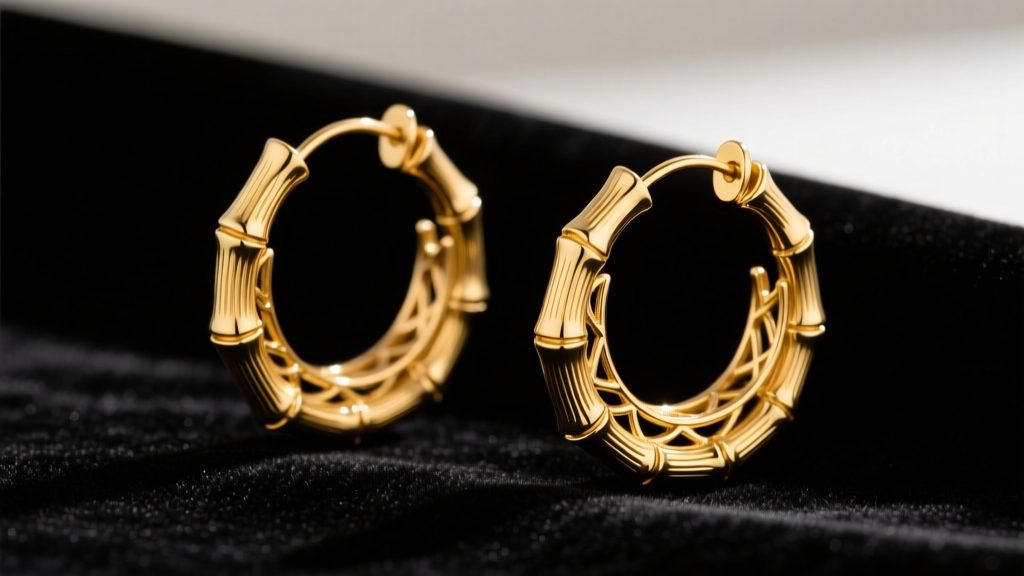
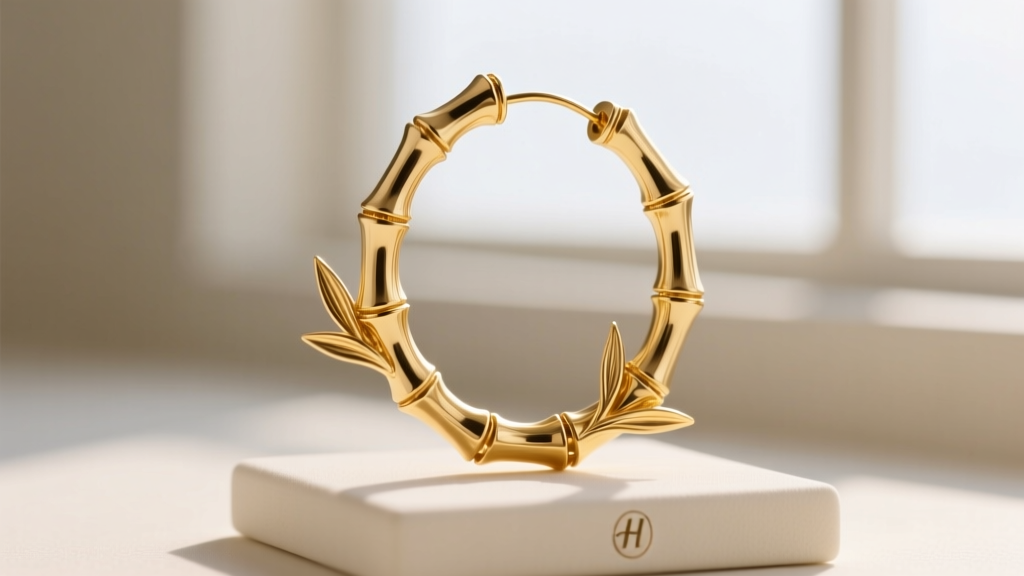
Bamboo gold is a staple of Trinidadian jewelry design. The gold is textured and jointed to mimic the stalks of a bamboo plant, symbolizing resilience, flexibility, and deep roots. Bamboo earrings are typically crafted as studs or small huggies in 18k gold. The craftsmanship required to carve and cast the microscopic nodes of the bamboo stalk separates master local goldsmiths from mass-market importers. Look for sharp, defined joints; muddy or smoothed-over textures indicate a worn-out mold or poor casting.
Creole Hoops and Wirework
The Trinidadian creole hoop is distinctly different from the standard circular hoop. These are often oval or teardrop-shaped, featuring a hollow but surprisingly heavy-looking construction. The exterior is frequently adorned with hand-engraved scrollwork or granulation. Because they are designed to catch the Caribbean light, the polishing techniques used by local artisans give these hoops a mirror-like finish that resists tarnishing.
Indo-Caribbean Filigree
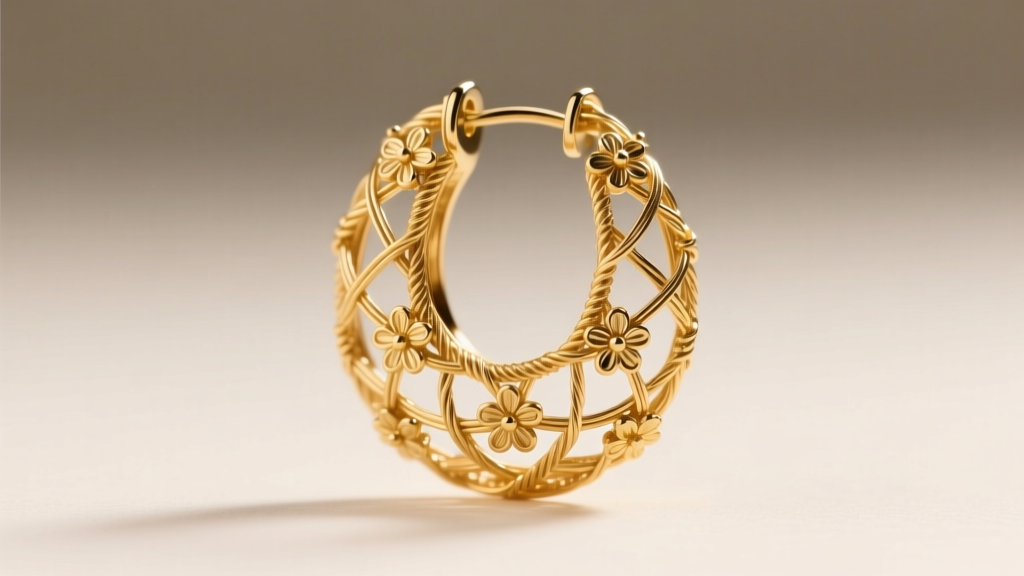
In areas with a strong Indo-Caribbean demographic, filigree work reaches museum-quality levels. This involves twisting ultra-fine threads of 22k gold into lace-like patterns, often accented with tiny gold beads (granulation). These drop earrings are masterpieces of tension and heat control. When inspecting filigree, use a jeweler's loupe to ensure the solder points are clean and that the wire hasn't been flattened by heavy-handed polishing.
Authentication and Hallmarks: Avoiding Fakes
Unlike the United Kingdom, which has a strict, government-mandated assay office system, Trinidad and Tobago relies heavily on the integrity of the jeweler and localized maker's marks. This makes authentication a crucial step in the buying process.
- The "750" or "18K" Stamp: Genuine local pieces will almost always bear a microscopic stamp indicating purity. However, stamps can be faked, so this should only be your first clue, not your final proof.
- Maker’s Marks: Established Trinidadian jewelry houses (such as those operating for generations in Port of Spain) will stamp their unique logo or initials alongside the karat mark.
- The Magnet Test: Gold is non-magnetic. If a heavy creole hoop exhibits any magnetic pull, it contains a ferrous core and is a counterfeit.
- Acid Testing: Reputable jewelers in Trinidad will gladly perform a scratch test with nitric acid on a discreet part of the earring post to verify the karatage before you purchase.
Expert Tip: Always inspect the earring post and the butterfly backing. In many counterfeit or "tourist trap" pieces, the main body of the earring might be gold-plated brass, but the post will be stamped 14k or 18k to pass a superficial acid test. Demand that the jeweler tests the actual body of the earring, not just the post.
Pricing Guide: What Should You Pay in 2026?
Pricing for Trinidad gold earrings is not based on arbitrary brand markups; it is rooted in the global commodities market combined with local labor costs. To avoid being overcharged, you must understand the "Melt Value + Making Charge" formula used by authentic Caribbean jewelers.
According to data tracked by the World Gold Council, gold prices fluctuate daily. In 2026, with raw 24k gold hovering around the $2,250 per troy ounce mark (approximately $72.34 per gram), you can calculate the baseline value of any piece.
The Pricing Formula
- Determine the Gram Weight: Ask the jeweler to weigh the earrings on a calibrated digital scale in front of you.
- Calculate the Melt Value: Multiply the weight by the current daily spot price for that specific karatage. (e.g., 18k gold is roughly 75% of the 24k spot price, so about $54.25 per gram).
- Add the Making Charge: This is the jeweler's fee for craftsmanship. For simple cast bamboo studs, the making charge might be 15% to 20% of the melt value. For intricate, hand-woven 22k filigree drops, the making charge can legally and fairly range from 35% to 50%.
Example Scenario: You find a pair of 18k gold creole hoops weighing 5 grams. The melt value is $271.25. With a 20% making charge ($54.25), the fair retail price should be approximately $325.50 USD. If a vendor quotes you $600 for this pair, you are paying a massive tourist premium.
Where to Buy: Trusted Sources vs. Tourist Traps
Location dictates the authenticity and pricing of your Trinidad gold earrings. Avoid the pop-up kiosks near the cruise ship terminals in Port of Spain. Instead, head to established jewelry districts. Frederick Street in the capital is lined with multi-generational jewelry stores that offer certified scales and transparent pricing. For Indo-Caribbean 22k gold, a trip south to Chaguanas will connect you with master artisans who specialize in ceremonial and heritage pieces. Always ask for a detailed receipt that explicitly states the karatage, the exact gram weight, and the jeweler's contact information.
Care and Maintenance for Tropical Climates
Trinidad’s high humidity, combined with salt air and sulfur-rich environments, can affect the alloyed metals in 14k and 18k gold. While pure gold does not tarnish, the copper and silver mixed into 18k gold can react to environmental factors. To maintain the brilliant luster of your Trinidad gold earrings, wash them monthly in a solution of warm water and a few drops of mild, phosphate-free dish soap. Use a soft-bristled baby toothbrush to gently clean the crevices of bamboo textures and filigree wirework. Never use ultrasonic cleaners on 22k Indo-Caribbean filigree, as the high-frequency vibrations can snap the delicate, high-purity gold wires.


