Triple Hoop Gold Earrings: The Ultimate Buying Guide
Discover how to choose the perfect triple hoop gold earrings. Our expert buying guide covers gold purity, gauge sizes, weight limits, and styling tips.

The Rise of the Triple Hoop: Maximalism Meets Structure
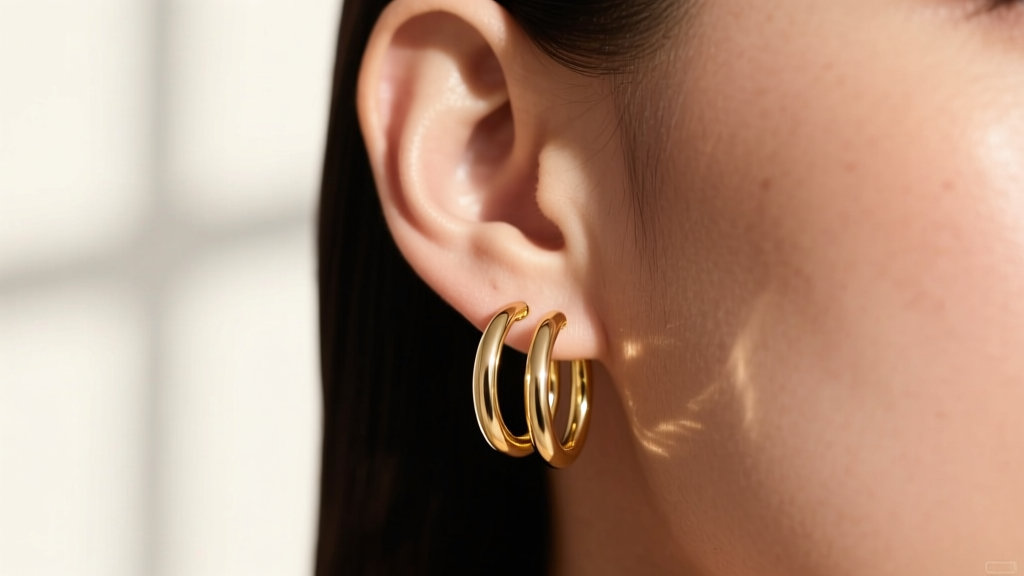
The evolution of ear styling has moved far beyond the simple stud. As we navigate the jewelry landscape of 2026, triple hoop gold earrings have emerged as a dominant force, bridging the gap between effortless everyday wear and high-impact editorial styling. Whether you are looking at a single-piercing attached triple hoop or a meticulously curated three-piercing stack, understanding the mechanics, metallurgy, and anatomy of these pieces is critical. Buying multiple interconnected hoops or stacking three separate rings introduces unique variables regarding weight distribution, fistula stress, and gold alloy durability. This comprehensive buying guide will equip you with the technical knowledge required to invest in triple hoop gold earrings that are both structurally sound and aesthetically flawless.
Attached vs. Stacked: Which Triple Hoop Style is Right for You?
When shoppers search for triple hoop gold earrings, they are generally looking for one of two distinct configurations. Understanding the difference is the first step in making an informed purchase.
Single-Piercing Attached Triple Hoops
These are engineered as a single unit. A solitary post or clicker mechanism anchors the piece, while three individual hoops dangle or are rigidly connected in a cascading, concentric, or clustered formation. Pros: You only need one standard lobe or helix piercing to achieve a complex, multi-ring look. They are highly mobile and offer a dynamic, kinetic movement when you walk. Cons: Because all the weight and kinetic energy is concentrated on a single puncture site, they are highly susceptible to causing lobe fatigue. They can also tangle easily in long hair due to the multiple moving parts.
The Three-Piercing Curated Stack
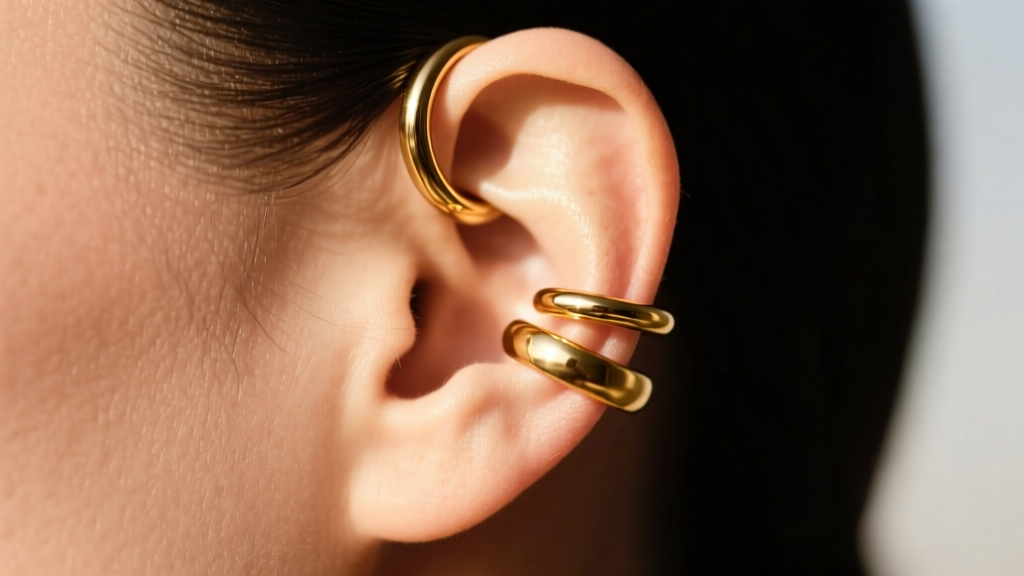
This approach utilizes three separate, individual gold hoops placed in adjacent piercings (e.g., standard lobe, upper lobe, and mid-helix). Pros: Superior weight distribution. You can mix and match diameters (e.g., a 12mm huggie, a 20mm standard hoop, and a 35mm large drop) to create a customized gradient effect. Cons: Requires three fully healed piercings, which demands time and careful aftercare. You must also purchase three separate pieces of jewelry, which can increase the overall investment.
Decoding Gold Purity and Material Grades
Not all gold jewelry is created equal, especially when dealing with the friction and tension inherent in hoop earrings. According to the Gemological Institute of America (GIA), pure 24k gold is far too soft for functional jewelry; it will bend, warp, and lose its closure tension within days. Therefore, alloying is essential.
| Material Grade | Gold Purity | Durability & Best Use | Estimated Price Range (Per Hoop) |
|---|---|---|---|
| 14k Solid Gold | 58.5% | Excellent. Ideal for everyday attached triples and clickers. Resists bending. | $120 - $350 |
| 18k Solid Gold | 75.0% | Good. Richer color but softer. Best for lightweight stacked hoops. | $250 - $600+ |
| Gold Vermeil | N/A (2.5µm+ over Sterling) | Moderate. Great for trend-driven styles, but the gold layer will eventually wear at the friction points of the clasp. | $45 - $110 |
| Gold Plated | N/A (<0.5µm over Brass) | Poor. Avoid for hoops. The plating will chip, exposing base metals that cause contact dermatitis. | $15 - $40 |
Expert Tip: If you are buying attached triple hoops that will swing and rub against each other, always choose 14k solid gold. The harder alloy (mixed with zinc or copper) will prevent the rings from scratching each other into a dull matte finish over time.
Crucial Sizing Metrics: Gauge, Diameter, and Weight
The physical dimensions of your triple hoop gold earrings dictate not just how they look, but how they interact with your anatomy. Ignoring these metrics is the leading cause of jewelry-induced ear damage.
Wire Gauge Thickness and the 'Cheese-Cutter' Effect
Gauge refers to the thickness of the wire that passes through your piercing. Standard lobe piercings are usually 20g (0.81mm) or 18g (1.02mm). However, the Association of Professional Piercers (APP) warns against the 'cheese-cutter effect.' If you wear a heavy, multi-ring attached triple hoop on a very thin 22g (0.64mm) wire, the downward momentum will cause the wire to slowly slice through your earlobe tissue, leading to permanent migration and tearing. Always insist on an 18g (1.0mm) or 16g (1.29mm) post for attached triple hoops.
Diameter and Drop Length
For a three-piercing stack, the golden rule of spacing is to increase the diameter of the hoop as you move up the ear. If your lobe piercing is 8mm from your upper lobe piercing, your first hoop should be no larger than 10mm in diameter to prevent it from overlapping and crowding the second piercing. For attached concentric triples, look for graduated diameters (e.g., 15mm, 20mm, 25mm) to ensure the rings nest properly without constantly tangling.
The Weight Factor: Preventing Lobe Fatigue
A standard single gold hoop weighs between 1.5 and 3 grams. An attached triple hoop can easily weigh between 8 and 14 grams. Human earlobes can comfortably support up to 10 grams before experiencing 'lobe fatigue'—a condition where the tissue stretches, thins, and droops. If your chosen triple hoops exceed 10 grams, limit your wear time to 4-6 hours, or invest in specialized earlobe support patches worn behind the ear to distribute the load.
Clasp and Closure Mechanisms: What Actually Works?
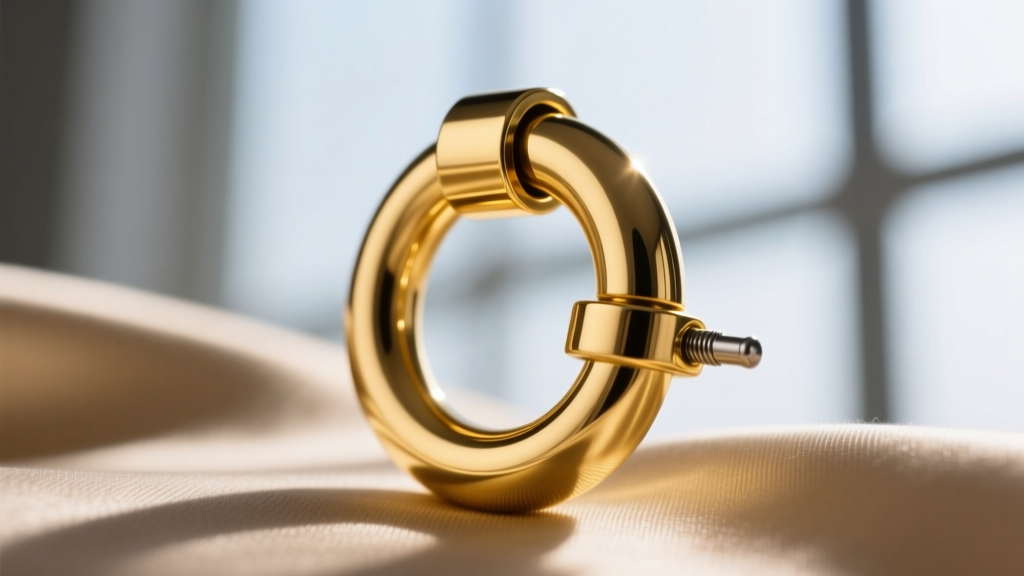
The closure is the most critical failure point on any hoop earring. When dealing with the complexity of triple hoops, a faulty clasp means losing the entire multi-ring assembly.
- Hinged Clickers: The gold standard for cartilage and heavy lobe hoops. A tiny, precision-engineered hinge snaps into a tension groove with an audible 'click.' They are incredibly secure and eliminate the risk of the post bending.
- Traditional Latch-Back: Common on classic lightweight hoops. A thin wire post loops up and clicks into a grooved saddle. While secure, the thin post is prone to bending if the triple hoops catch on a sweater or hairbrush.
- Continuous/Seamless Hoops: A continuous piece of wire that threads through the piercing and snaps into a hollow receiving tube. These offer a beautiful, unbroken aesthetic but require two hands and a specific twisting technique to open and close. They are not recommended for attached triple hoops, as the tension required to open the main ring can warp the attached secondary rings.
Price Expectations and Brand Benchmarks
When budgeting for high-quality triple hoop gold earrings, expect to pay a premium for structural engineering. Brands like Maria Tash and Anita Ko dominate the luxury space, offering 18k gold clickers and precision-set diamond triples ranging from $600 to over $2,500. For accessible luxury and high-quality vermeil or 14k solid options, brands like Gorjana and Mejuri offer excellent curated stacking hoops and attached cascading styles in the $80 to $350 range. Always verify that the brand explicitly states the gold weight and clasp mechanism in their product specifications.
Care, Maintenance, and Troubleshooting
Triple hoops require more maintenance than simple studs due to their increased surface area and moving joints. Do not use ultrasonic cleaners on attached triple hoops if they feature tension-set stones or delicate hinged joints; the high-frequency vibrations can loosen settings and warp micro-hinges. Instead, use a soft-bristled baby toothbrush dipped in warm water and a drop of mild, phosphate-free dish soap to gently scrub the inner curves of the hoops. Dry immediately with a microfiber cloth to prevent water spots. Store your triple hoops flat in a soft pouch; hanging them on a jewelry tree allows gravity to slowly pull the rings out of their circular alignment over time.
By prioritizing proper gauge thickness, selecting the right gold alloy for your lifestyle, and respecting the weight limits of your anatomy, your triple hoop gold earrings will remain a secure, striking staple in your collection for years to come.


