Troubleshooting 90's Gold Hoop Earrings for Men: Fit and Care
Fix common issues with 90's gold hoop earrings for men. Learn how to prevent lobe stretching, repair clasps, and choose the right gauge and karat.

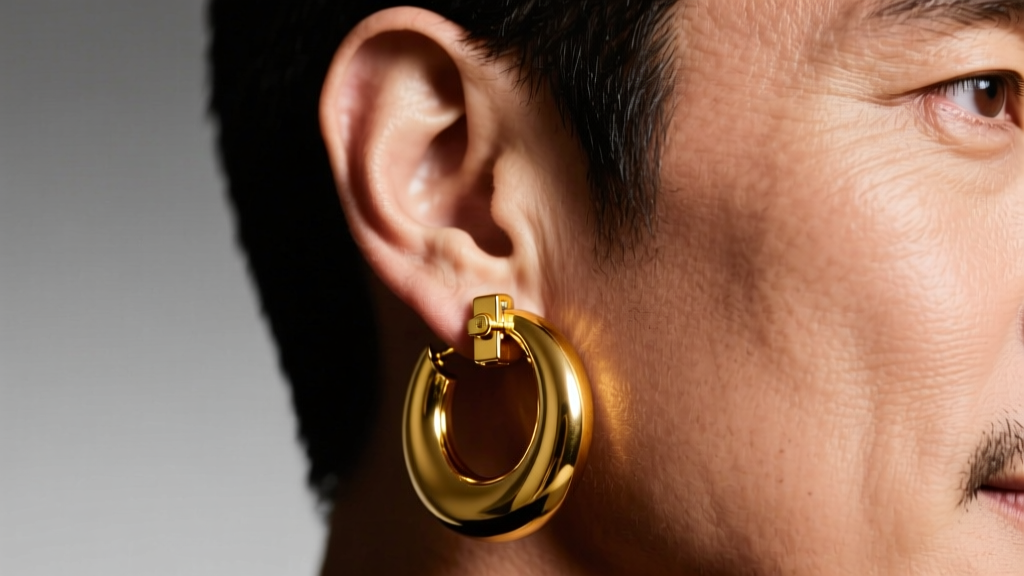
The resurgence of 90's gold hoop earrings for men has brought back one of the most iconic aesthetics in modern jewelry history. Popularized by hip-hop legends and grunge icons alike, the chunky gold hoop is a statement of cultural weight and effortless cool. However, translating this bold 90s aesthetic into a modern, daily-wear reality comes with distinct structural and anatomical challenges. Whether you are wearing vintage finds or modern reproductions, heavy gold alloys and outdated clasp mechanisms frequently lead to lobe stretching, skin irritation, and hardware failure.
As a jewelry specialist, I see men struggle with the physical toll of oversized hoops. This troubleshooting guide dives deep into the metallurgy, biomechanics, and hardware mechanics of 90's gold hoop earrings for men, providing actionable solutions to keep your earlobes healthy and your hardware secure.
The Weight Problem: Preventing Lobe Creep and Tearing
The defining characteristic of the 90s hoop is its presence. To achieve that iconic look, the wire diameter and overall hoop size must be substantial. However, solid gold is exceptionally dense (approximately 12.9 g/cm³ for 14k gold). A 30mm inner diameter hoop with a 3mm wire thickness can easily weigh between 6 and 9 grams per earring.
When heavy jewelry rests on the delicate connective tissue of the earlobe, it causes a biomechanical phenomenon known as creep deformation. Over months of continuous wear, the tissue slowly stretches, leading to sagging, thinning, and eventually, micro-tears that can result in a complete lobe split.
The Safe Weight Matrix for Men's Lobes
The Association of Professional Piercers (APP) generally advises keeping daily-wear jewelry under 4 to 5 grams to prevent long-term tissue migration. If you are committed to the heavy 90s aesthetic, you must rotate your jewelry or use supportive backing.
| Hoop Inner Diameter | Wire Gauge (Thickness) | Approx. Weight (Solid 14k) | Troubleshooting / Action Required |
|---|---|---|---|
| 20mm - 25mm | 14g (1.6mm) | 2.5g - 4.0g | Safe for 24/7 wear. Ideal for subtle 90s styling. |
| 25mm - 30mm | 12g (2.0mm) | 4.5g - 6.5g | Limit to 12-hour wear. Use silicone O-rings for support. |
| 30mm - 40mm | 10g (2.5mm) | 7.0g - 10.0g+ | High risk of tearing. Wear only for events; use hollow-core tubing. |
The Fix: If you want the visual thickness of a 10-gauge (2.5mm) 90s hoop without the destructive weight, seek out hollow-core gold tubing or U-shaped saddle hoops that distribute weight across a wider surface area of the earlobe rather than concentrating it on a single puncture point.
Clasp Mechanics: Fixing Saddleback and V-Latch Failures
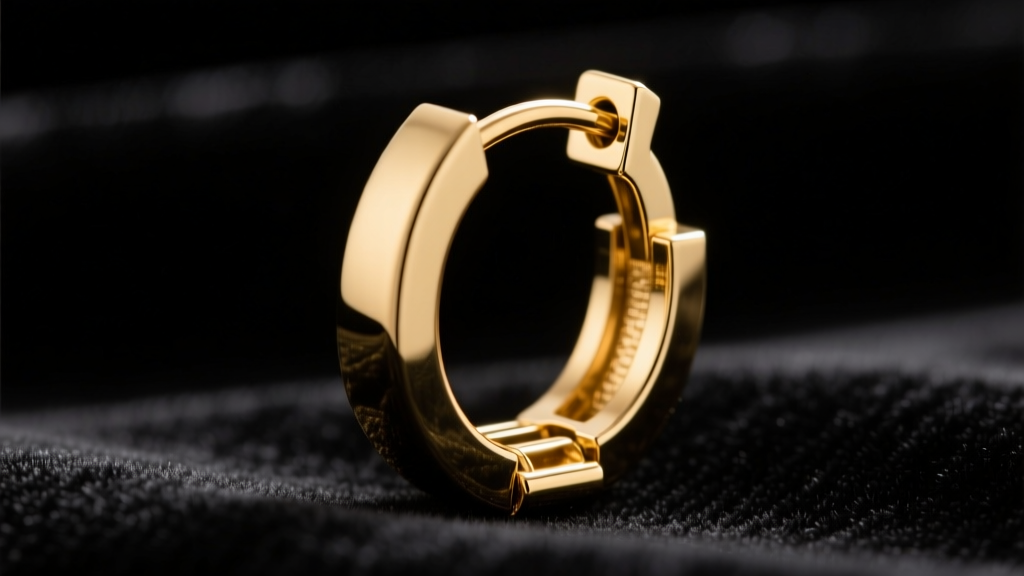
Nothing ruins the experience of wearing 90's gold hoop earrings for men faster than a failing clasp. The traditional 90s hoop relies on a V-latch (or saddleback) closure. This mechanism features a hinged post with a V-shaped notch that snaps into a corresponding groove on the opposite end of the hoop.
Why V-Latches Fail
- Metal Fatigue: Repeated opening and closing weakens the microscopic hinge pin.
- Post Thinning: Friction against the earlobe and clothing slowly wears down the V-notch on the male post, leading to a loose fit.
- Impact Bending: Catching the hoop on a hoodie or towel can slightly bend the post, ruining the alignment required for a secure snap.
Troubleshooting a Loose V-Latch
If your hoop feels loose or pops open when you tug it, do not discard it. You can often restore the friction fit at home or with a local jeweler.
Pro-Tip: Never use standard steel needle-nose pliers on gold jewelry. Steel is harder than 14k or 18k gold and will leave deep, permanent gouges in the clasp. Always use nylon-jaw pliers or wrap the tips of your pliers in masking tape.
Step 1: The Compression Method. Using nylon-jaw pliers, gently squeeze the female receiver (the hollow tube end) to slightly narrow the opening. This increases the friction against the male post.
Step 2: The Post Adjustment. If the V-notch is worn, a jeweler can use a laser welder to add a microscopic bead of gold to the notch, restoring the original 'click' sound and secure lock.
Step 3: The Upgrade. For vintage 90s hoops with irreparably damaged hinges, have a jeweler cut off the saddleback and solder on a modern clicker hinge with a seamless closure, which is vastly superior for active lifestyles.
The Karat Conundrum: Tarnish, Allergies, and 10k Gold
In the 1990s, 10k and 14k gold were the industry standards for men's hip-hop jewelry due to their affordability and durability. However, troubleshooting skin irritation and tarnish requires a basic understanding of gold metallurgy. Pure 24k gold is hypoallergenic, but it is too soft for hoops. Therefore, it is alloyed with metals like copper, silver, zinc, and sometimes nickel.
According to the Gemological Institute of America (GIA), 10k gold contains only 41.7% pure gold, meaning the majority of the metal is composed of reactive base metals. If you are experiencing green skin, itching, or contact dermatitis, you are likely reacting to the copper or nickel in a lower-karat alloy.
Solving the Green Skin and Itch Factor
- The Rhodium Barrier: If you have a vintage 10k or 14k hoop that irritates your ear, take it to a jeweler to have the post and the inner curve of the hoop plated with Rhodium. Rhodium is a platinum-group metal that is 100% hypoallergenic and creates an invisible barrier between the reactive alloys and your skin.
- Ultrasonic Cleaning: Tarnish on 90s gold is usually a buildup of oxidized copper and daily sebum. Soak the hoops in a solution of warm water and a few drops of ammonia-free dish soap, then use a soft baby toothbrush to clean the clasp hinge where debris accumulates and causes bacterial irritation.
- The 18k Upgrade: If you have the budget, upgrading to 18k gold (75% pure gold) significantly reduces the presence of reactive base metals, virtually eliminating tarnish and allergic reactions while providing that rich, deep yellow hue iconic to the 90s era.
Proportions and Gauge: Sizing the 90s Look for Modern Anatomy
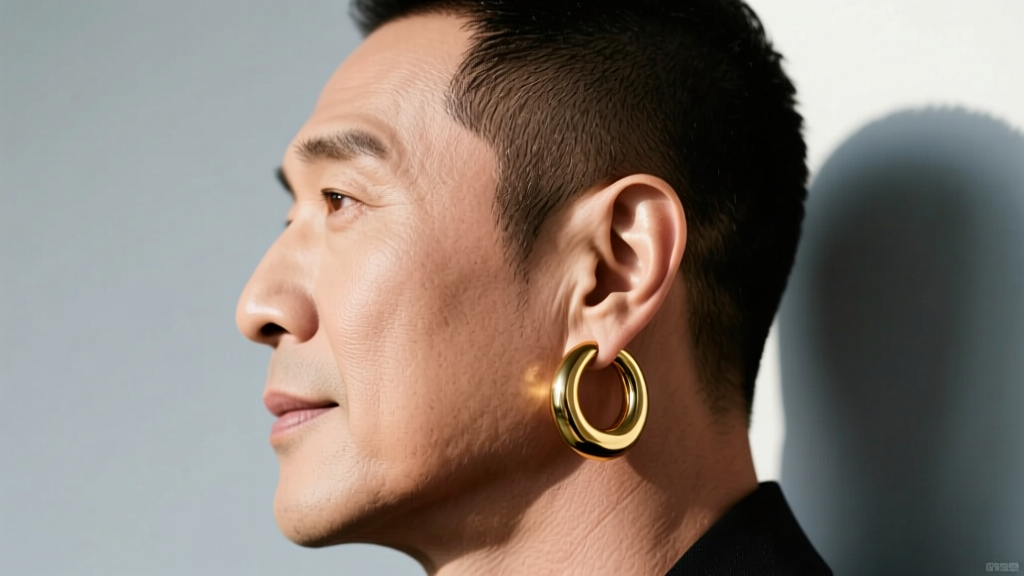
A common mistake men make when buying 90's gold hoop earrings is confusing Outer Diameter (OD) with Inner Diameter (ID). A hoop with a 35mm OD and a thick 5mm wire will actually have an ID of only 25mm, which might hug the earlobe too tightly, causing pressure necrosis or making the earring look like a modern 'huggie' rather than a classic 90s hoop.
The Masculine Proportion Framework
To achieve the correct 90s drape without looking costumey, the earring must interact correctly with the jawline and neck.
- The Sweet Spot (28mm - 35mm ID): This size allows the hoop to clear the bottom of the earlobe by about 10mm to 15mm. It frames the jawline perfectly without interfering with collared shirts or headphones.
- The Wire Gauge (12g to 8g): The 90s aesthetic demands thickness. A standard 18g (1.0mm) wire looks delicate and modern. To replicate the 90s vibe, you need a minimum of 12g (2.0mm), with 10g (2.5mm) or 8g (3.2mm) being the gold standard for that chunky, masculine profile.
- The Finish: High-polish yellow gold is the most authentic to the decade. However, if you find high-polish reflects too much light and looks flashy for your daily wardrobe, a satin or brushed finish on a thick-gauge hoop retains the 90s silhouette while offering a more subdued, contemporary versatility.
Maintenance Protocol: Preserving the Hinge and Polish
Troubleshooting isn't just about fixing what's broken; it's about preventing failure. The hinge is the most vulnerable point of any hoop earring. To extend the life of your 90's gold hoop earrings for men, implement this weekly maintenance protocol:
- Hinge Lubrication: Once a month, apply a microscopic drop of synthetic watch oil to the hinge pin using a toothpick. This prevents metal-on-metal grinding and keeps the saddleback snapping crisply.
- Nightly Removal: Never sleep in thick-gauge hoops. The pressure of your head against a pillow can bend the post, misaligning the V-latch and permanently warping the circular geometry of the hoop.
- Proper Storage: Store hoops individually in soft flannel pouches. Tossing them into a communal jewelry box allows the thick gold wires to scratch against one another, dulling the high-polish finish that defines the 90s aesthetic.
By understanding the biomechanics of your earlobes, the metallurgy of gold alloys, and the mechanical realities of vintage-style clasps, you can wear 90's gold hoops with confidence. The key to pulling off this legendary look in the modern day lies not just in the style, but in the meticulous care and precise sizing of the hardware itself.


