Troubleshooting Your Earring with Heart: Fix Droop, Spin & Snags
Learn how to fix common issues with your earring with heart designs. Expert solutions for forward droop, spinning posts, and snagging prongs.

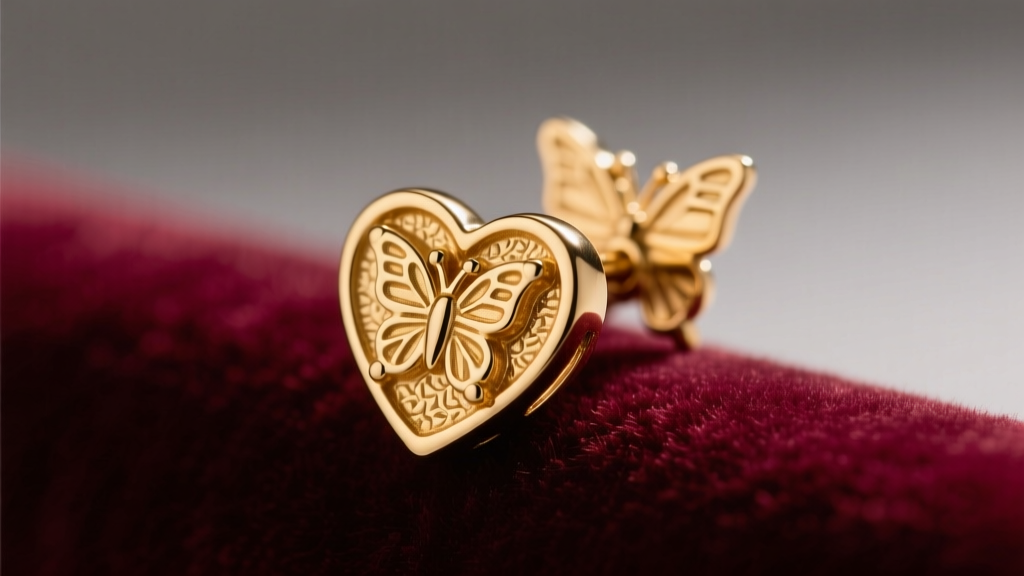
Heart-shaped jewelry is universally beloved for its romantic symbolism and timeless aesthetic. However, from a structural and engineering perspective, the heart silhouette presents unique challenges for jewelers and wearers alike. If you have ever been frustrated by a spinning post, a forward-drooping silhouette, or a sharp point catching on your favorite cashmere sweater, you are not alone. The geometry of a heart—featuring a wide, often gem-heavy top cleft and a tapered bottom point—creates an uneven center of gravity that standard earring designs simply aren't built to support.
In this comprehensive troubleshooting guide, we will dissect the mechanical failure points of the heart silhouette. Whether you are wearing a delicate 20-gauge lobe stud or a heavy 16-gauge cartilage piece, understanding the physics of your earring with heart motifs is the first step toward achieving a comfortable, secure, and perfectly aligned fit.
The Physics of the Heart: Why Your Earring Spins and Droops
To troubleshoot a misbehaving earring, we must first look at its center of mass. A perfectly symmetrical heart shape is inherently top-heavy. The dual lobes at the top (the cleft) contain significantly more metal and, frequently, larger gemstones than the tapered point at the bottom.
When a jeweler solders the earring post exactly in the geometric center of the heart's backplate, the top-heavy weight distribution causes the earring to tilt forward. This forward tilt shifts the axis of the post inside your piercing, leading to the dreaded "spin" where the heart rests sideways or completely upside down. In 2026, advanced CAD/CAM casting allows master jewelers to intentionally offset the post placement, moving it 1 to 1.5 millimeters higher toward the cleft to counterbalance the weight. If you are shopping for a new earring with heart designs, always perform the "Flashlight Test": shine a light behind the piece to verify that the post is soldered slightly above the true center line.
Troubleshooting Forward Droop and Lobe Stretching
Forward droop occurs when the weight of the heart pulls the top of the post downward, stretching the piercing hole and causing the earring to point toward the floor. This is especially common with pave-set or solid 18k gold designs, which can easily exceed 3.5 grams per earring. Here are the most effective, professional-grade solutions to restore a forward-facing posture:
1. Upgrade to La Pousette Clutch Backings
Standard friction butterfly backs rely on a simple groove, which easily slips under the weight of a heavy heart. La Pousette backs (often costing between $15 and $25 per pair) feature a mechanical locking mechanism with dual springs that grip the post securely. This prevents the backing from sliding down the post, providing a rigid scaffold that holds the heart flush against the earlobe.
2. Utilize Silicone Earlobe Support Patches
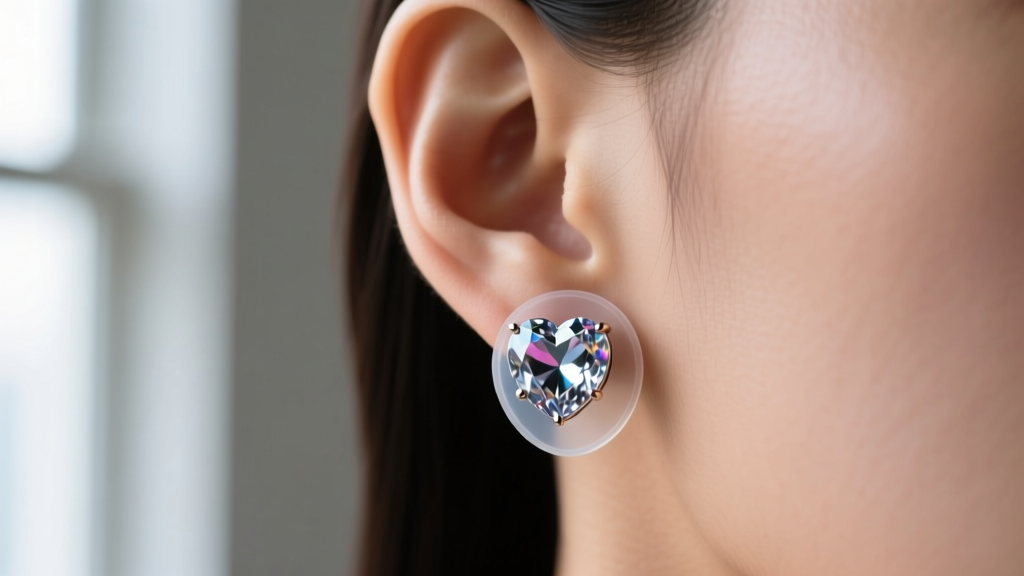
If your piercing has already stretched slightly from years of wearing heavy jewelry, the tissue itself lacks the rigidity to support the piece. Invisible silicone earring lifters (such as those by BlingWraps or generic medical-grade silicone patches) adhere to the back of the earlobe. These patches distribute the weight of the earring with heart motifs across a wider surface area of skin, instantly lifting the droop and preventing further tissue tearing.
3. Increase the Post Gauge
Many mass-market heart earrings use flimsy 22-gauge (0.6mm) or 20-gauge (0.8mm) wire for the post. This thin wire bends under the leveraged weight of the heart. Have a local bench jeweler swap the post for a sturdy 18-gauge (1.0mm) or 16-gauge (1.2mm) wire, provided your piercing can accommodate the thicker metal.
The Snagging Epidemic: Points, Clefts, and Prongs
The second most common complaint regarding heart-shaped earrings is snagging. The inferior point of the heart and the sharp angles of the superior cleft act as natural hooks for hair, silk blouses, and knitwear. Furthermore, if the heart features gemstones, traditional prong settings introduce additional microscopic hooks that catch on loose threads.
- The Bezel Solution: When selecting an earring with heart elements, opt for bezel-set gemstones. A bezel setting encircles the stone in a smooth rim of metal, completely eliminating the sharp prongs that cause 90% of hair-snagging incidents.
- Laser Polishing the Point: If the bottom point of your solid metal heart is sharp enough to scratch your neck when you lie down, a jeweler can use a laser welder to add a microscopic bead of metal to the tip, blunting it into a soft, rounded teardrop shape without altering the overall silhouette.
- The 3D Puffy Heart Alternative: Instead of flat, 2D stamped hearts with sharp edge profiles, consider "puffy" or domed 3D hearts. The rolled edges of a domed heart naturally deflect hair and fabric rather than catching them.
Support Systems and Backings Comparison
Choosing the correct backing is critical for maintaining the structural integrity of your jewelry. Below is a comparison of the most effective support systems for heart-shaped studs and drops.
| Backing Type | Hold Strength | Best For | Estimated Cost |
|---|---|---|---|
| Standard Friction Butterfly | Low | Lightweight, hollow 2D hearts under 1.5g | $1 - $3 |
| La Pousette Locking Clutch | Very High | Heavy solid gold or pave hearts (2g - 5g) | $15 - $25 |
| Silicone O-Rings (Sharkbite) | Medium | Temporary security, active lifestyles, gym | $5 - $10 |
| Flat-Back Labret (Threadless) | Maximum | Cartilage/helix placements, sleeping comfort | $12 - $30 |
| Silicone Lobe Patches | Supportive | Stretched lobes, preventing forward droop | $8 - $15 |
Cartilage vs. Lobe: Gauge, Length, and Material Grades
Placing an earring with heart designs in the cartilage (such as the helix or tragus) requires entirely different specifications than a standard lobe piercing. Cartilage tissue is dense, avascular, and highly prone to irritation bumps if the jewelry angle or material is incorrect.
According to the Association of Professional Piercers (APP), initial and sensitive cartilage piercings should only be fitted with implant-grade titanium (ASTM F136) or niobium. If you are wearing a heart-shaped stud in a healing or easily irritated helix piercing, avoid 14k or 18k gold alloys that may contain nickel or copper irritants.
Furthermore, cartilage requires a flat-back labret post rather than a traditional butterfly back. The flat disc rests flush against the back of the ear, preventing the post from being pushed forward when you sleep on a pillow. For a standard female helix, a 16-gauge (1.2mm) post with a length of 6mm to 8mm is standard. If the heart faceplate is exceptionally wide (over 10mm), ensure the jeweler has soldered the post at a perfect 90-degree angle; even a 5-degree tilt will cause the flat back to press unevenly into the cartilage, leading to localized pressure necrosis and rejection.
Long-Term Maintenance: Pave Stones and Ultrasonic Risks
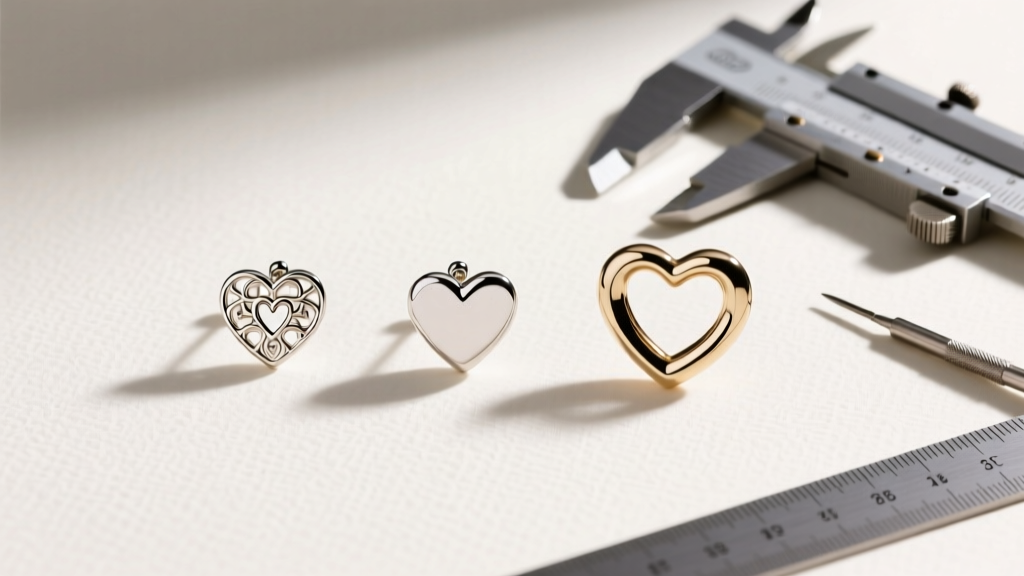
Many premium heart earrings feature micro-pave settings, where dozens of tiny melee diamonds are held in place by minuscule metal beads. While beautiful, this design requires strict maintenance protocols to prevent catastrophic stone loss.
The Gemological Institute of America (GIA) strongly advises caution when cleaning pave jewelry. Never place a micro-pave earring with heart motifs into an ultrasonic cleaner. The high-frequency vibrations can easily shake loose the tiny melee stones or fracture the microscopic prongs holding them. Instead, clean your heart earrings using a soft baby toothbrush, warm water, and a drop of mild, ammonia-free dish soap. Gently brush the back of the setting (the gallery) where skin oils and lotion accumulate, as this buildup not only dulls the diamonds but also adds hidden weight that exacerbates forward drooping.
Finally, schedule an annual "prong check" with a bench jeweler. They will use a 10x loupe to inspect the metal beads securing your stones. Catching a worn prong early is the difference between a simple $20 re-tipping service and losing a diamond forever.
Final Thoughts on Structural Elegance
An earring with heart motifs should be a joy to wear, not a source of constant adjustment and frustration. By understanding the center of gravity, upgrading your backings to mechanical locks, and choosing bezel or domed designs to prevent snagging, you can transform a problematic piece of jewelry into a flawless, everyday staple. Always prioritize structural engineering and precise post placement over sheer carat weight, and your heart earrings will sit perfectly, comfortably, and securely for decades to come.


