Troubleshooting Greek Key Earrings: Snags, Tarnish & Lobe Pull
Fix common issues with Greek key earrings. Learn expert troubleshooting for meander motif tarnish, hair snagging, and earlobe pulling.

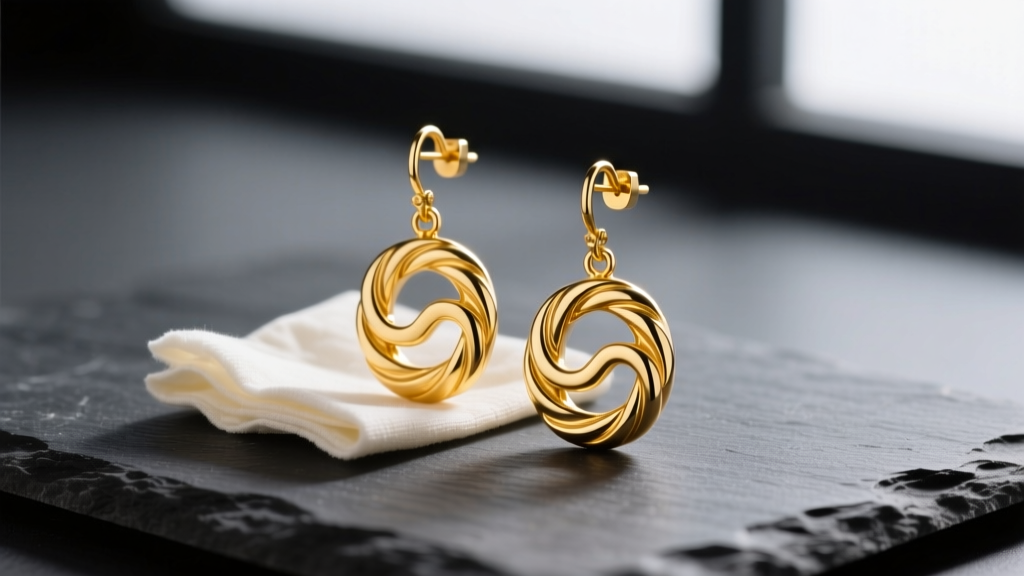
The Greek key, historically known as the Meander motif, is a hallmark of classical jewelry design. Its continuous, labyrinthine right angles symbolize infinity and unity. However, from a jewelry manufacturing and maintenance perspective, this exact geometric complexity creates a unique set of structural and care nightmares. Whether you own a pair of solid 18k gold heritage drops or sterling silver huggies, the deep crevices and angular edges of the Greek key design demand specialized troubleshooting.
This guide bypasses generic jewelry care advice to address the specific failure modes of Meander earrings: severe crevice tarnishing, fabric snagging, post bending, and the prevalence of deceptive tourist-trap alloys.
The Tarnish Trap: Cleaning Deep Meander Crevices
The most common complaint with Greek key earrings is rapid, uneven tarnishing. The continuous 90-degree grooves act as literal dirt traps, accumulating sebum, dead skin cells, cosmetic residues, and airborne sulfur compounds. Standard jeweler’s polishing cloths (like treated Sunshine cloths) only glide over the top ridges, leaving the bottom of the grooves dark and oxidized.
Ultrasonic Cleaning (With Critical Caveats)
For solid gold (14k or 18k) or plain sterling silver (925) Greek key earrings without gemstones, an ultrasonic cleaner operating at 42-45 kHz is the most effective way to cavitate debris out of the labyrinthine grooves. However, if your Meander earrings incorporate enamel (such as traditional Greek Meenakari work) or porous stones like turquoise, lapis lazuli, or opal, never use an ultrasonic cleaner. The high-frequency vibrations will shatter the enamel or fracture the porous stones.
The Chemical Dip vs. Manual Agitation
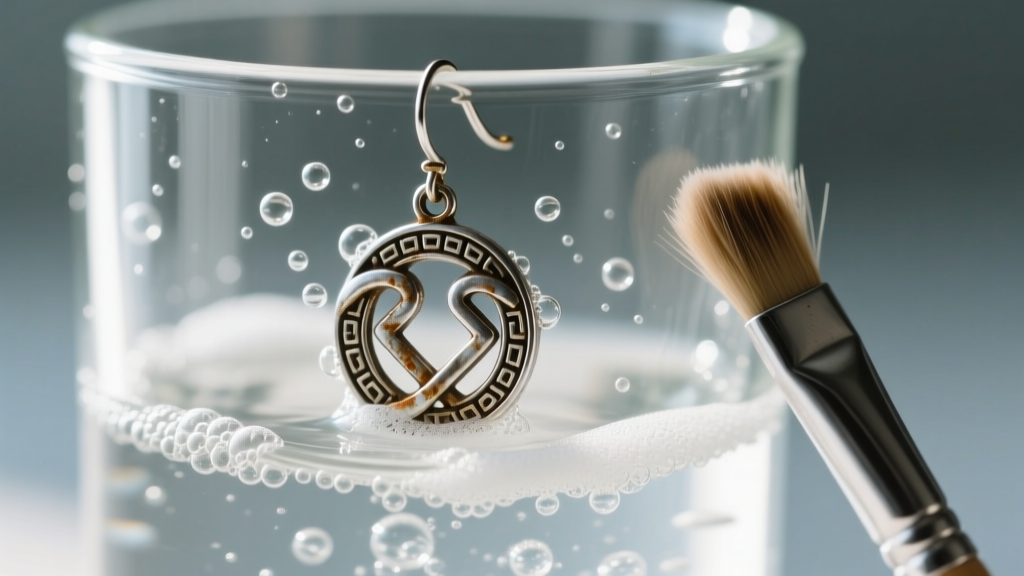
If you cannot use an ultrasonic machine, you must combine a chemical reaction with manual agitation. For sterling silver Greek key studs, a thiourea-based silver dip will instantly strip oxidation. According to the Victoria and Albert Museum’s jewelry conservation guidelines, chemical dips must be thoroughly rinsed, as residual acids can cause long-term pitting. Immediately after dipping, use a soft-bristled, extra-fine detailing brush (like a mascara wand or a specialized jeweler’s brass brush) dipped in mild dish soap to physically sweep the loosened tarnish out of the 1mm-wide Meander grooves.
Snag Hazards: Managing Angular Geometric Edges
The Greek key pattern is defined by sharp, outward-facing corners. In poorly manufactured earrings, these corners are left with microscopic burrs from the casting or stamping process, turning your earrings into hooks that catch on silk blouses, lace, and fine hair.
Troubleshooting the Snag Radius
The severity of the snagging depends on the earring style. Greek key dangles have a high swing radius, meaning they build momentum and catch on collars. Greek key studs or huggies sit flush, minimizing the catch radius but increasing the chance of hair wrapping around the post joint.
- The Bevel Check: Run a piece of fine silk or a cotton ball over the edges of the earring. If the cotton fibers catch, the corners are too sharp.
- The Jeweler’s Fix: A bench jeweler can use a rubberized silicone polishing wheel to “ease” or bevel the outer 0.5mm of the corners. This softens the edge just enough to prevent snagging without destroying the optical illusion of the sharp geometric pattern.
- DIY Mitigation: For minor burrs on inexpensive brass or silver pairs, gently dragging the edge across a high-grit (1000+) nail buffer can smooth out casting flash without stripping heavy gold plating.
Earlobe Strain: Weight Distribution in Drop Styles
The Meander motif is dense. Unlike filigree or open-work designs, a solid metal Greek key drop requires a continuous ribbon of metal. A standard 12mm x 45mm solid 14k gold Greek key drop earring can easily weigh between 7 and 11 grams per ear. This pendulum effect places immense stress on the earlobe and the earring post.
Post Bending and Gauge Upgrades
Standard earring posts are manufactured at 20-gauge (0.81mm) or 18-gauge (1.02mm). A 20-gauge wire will inevitably bend under the swinging weight of a heavy Meander drop, causing the earring to tilt forward and eventually snap at the solder joint. According to the Gemological Institute of America (GIA), the alloy composition of 14k gold makes it harder than 18k, but the physical thickness of the wire is the primary factor in structural integrity.
| Earring Weight (Per Ear) | Minimum Safe Post Gauge | Required Backing Type | Lobe Support Needed? |
|---|---|---|---|
| Under 3 grams (Studs/Huggies) | 20-Gauge (0.81mm) | Standard Butterfly Friction | No |
| 3 to 6 grams (Small Drops) | 18-Gauge (1.02mm) | La Poussiere or Silicone Disc | Optional |
| 6 to 10 grams (Large Drops) | 16-Gauge (1.29mm) | Omega Clip or Screw Back | Yes (Silicone Patches) |
| 10+ grams (Statement Chandeliers) | 14-Gauge (1.63mm) or Ear Wire | French Wire with Silicone Stopper | Yes (Lobe Support Patches) |
Pro-Tip: If your heavy Greek key earrings are tilting forward and stretching your piercing, apply a clear silicone earlobe support patch (like BlingDots) to the back of your earlobe. This distributes the 10-gram point-load across a 15mm surface area, preventing permanent lobe sagging.
Material Authenticity: Avoiding the "Tourist Trap" Alloys
Because the Greek key motif is deeply tied to Mediterranean tourism, the market is flooded with cheap, mass-produced souvenirs masquerading as fine jewelry. These are often cast from Zamak (a zinc alloy) or low-grade brass, featuring a micro-thin flash of gold plating that wears off in weeks, exposing the base metal to your skin’s acidity and turning your earlobes green.

How to Verify Meander Earring Authenticity
- The Stamp Location Test: Mass-produced tourist jewelry often stamps "925" or "18K" on a flat metal tag soldered to the back. Authentic fine jewelry will have the hallmark stamped inside the grooves or on the post itself. Use a 10x jeweler's loupe to inspect the crevices.
- The Magnet Test: While gold and silver are non-magnetic, the steel springs inside the butterfly backings are magnetic. However, if the main body of the Greek key earring is attracted to a rare-earth neodymium magnet, it contains iron or steel and is absolutely not solid gold or silver.
- The Sound Test: Drop the earring onto a glass table. Solid gold and silver produce a dull, soft “thud.” Zamak and brass produce a high-pitched, ringing “ping.”
Quick Troubleshooting Matrix
Use this rapid-reference guide to diagnose and fix your Greek key earring issues on the bench:
- Symptom: Black gunk packed in the bottom of the labyrinth grooves.
Fix: Soak in warm water with a drop of ammonia-free dish soap for 10 minutes, then agitate with a soft interdental brush. Avoid hard bristles that scratch high-polish gold. - Symptom: Earring post bends backward after a week of wear.
Fix: The post gauge is too thin for the Meander drop weight. Take it to a jeweler to have the post replaced with an 18-gauge or 16-gauge hardened white gold or platinum wire. - Symptom: Skin turns green or itchy behind the earlobe.
Fix: You are reacting to nickel or copper in a base-metal alloy. Coat the post and back of the earring with a layer of clear nail polish as a temporary barrier, or have a jeweler laser-weld a small 14k gold pad over the skin-contact area. - Symptom: Hair constantly wraps around the hinge of a Greek key huggie.
Fix: Apply a microscopic drop of jeweler’s wax or clear UV resin over the hinge seam to create a smooth bridge that hair can slide over, rather than catching inside the mechanical joint.
Preserving the Heritage Design
Greek key earrings are an investment in classical aesthetics, but their intricate geometry requires a departure from standard jewelry care routines. By understanding the physics of the drop weight, the metallurgical realities of crevice tarnishing, and the manufacturing shortcuts of mass-market alloys, you can troubleshoot existing pairs and shop for future Meander pieces with absolute confidence. Always prioritize eased edges, appropriate post gauges, and verified hallmarks to ensure your earrings remain a timeless asset rather than a high-maintenance liability.


