Troubleshooting Mens Square Stud Earrings: Fix Snags and Sagging
Solve common issues with mens square stud earrings. Learn how to prevent lobe sagging, stop corner snagging, and choose the right post and backing.

The Unique Geometry Problem: Why Square Studs Fail
Mens square stud earrings offer a sharp, masculine aesthetic that contrasts beautifully with the natural curves of the ear. However, the very geometry that makes them visually striking also introduces specific mechanical and anatomical failures. Unlike round or oval studs, which distribute weight evenly and lack catch-points, square studs present flat planes and 90-degree corners. As of 2026, jewelry manufacturers have made significant strides in micro-machining, yet many mass-market square studs still suffer from poor weight distribution, edge snagging, and post misalignment.
If your square studs are constantly spinning, pulling on your earlobe, or catching on your clothing, the issue is rarely your piercing itself. It is almost always a failure in the jewelry's structural engineering. Troubleshooting these issues requires a deep understanding of metal density, post placement, and friction mechanics.
Troubleshooting Snagging: Edge Profiles and Bevels
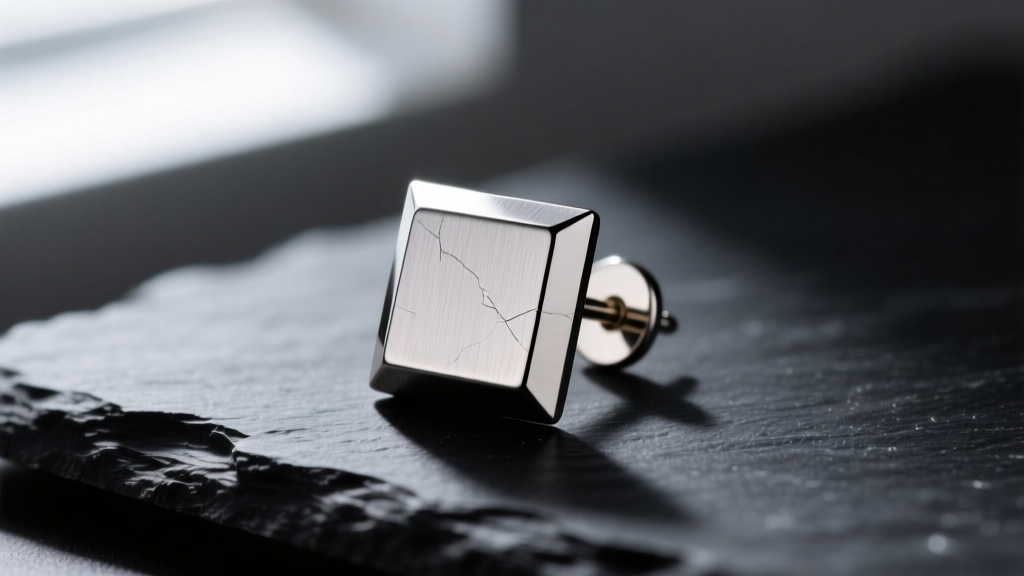
The most common complaint regarding mens square stud earrings is the 'snag factor.' A standard stamped square blank features razor-sharp 90-degree corners. When you pull a shirt over your head or wipe your face with a towel, these corners act like tiny hooks, catching on fabric loops and hair. Over time, this snagging doesn't just ruin your clothes; it causes micro-trauma to the fistula (the piercing channel), leading to irritation bumps and delayed healing.
The Micro-Bevel Solution
To solve this, you must look for square studs that feature a micro-chamfer or beveled edge. A proper bevel cuts the 90-degree corner at a 45-degree angle, typically removing just 0.5mm of material from the edge. This reduces the catch radius to near zero while maintaining the sharp, masculine silhouette of the square from a front-facing perspective. According to manufacturing standards outlined by jewelry suppliers like Rio Grande, hand-filed or CNC-machined bevels are vastly superior to tumbled finishes, which can unevenly round the corners and make the earring look worn or cheap.
Actionable Fix: If you already own a pair of snag-prone square studs, a jeweler can easily add a micro-bevel using a fine-grit polishing wheel. Alternatively, upgrade to studs that explicitly advertise 'chamfered edges' or 'comfort-fit corners.'
Fixing Lobe Sag: Weight Distribution and Post Placement
A 6mm x 6mm square stud has a surface area of 36mm². If crafted from solid 316L stainless steel (which has a density of roughly 8.0 g/cm³), a 2mm thick square stud can weigh nearly 6 grams. While 6 grams sounds light, when suspended from the bottom edge of an earlobe, it creates a pendulum effect that leads to lobe fatigue, sagging, and the dreaded 'cheese-wire' migration.
The Center-of-Gravity Rule
Weight is only half the problem; where the weight is anchored is the real culprit. For a square stud to sit perfectly flush and parallel to the ground, the post must be soldered or laser-welded at the exact geometric center (the 3mm x 3mm intersection on a 6mm square). If the post is off by even 0.5mm, the center of gravity shifts. The earring will constantly rotate to find equilibrium, resulting in a crooked, tilted appearance that drives wearers crazy.
Pro Tip: Perform the 'Spin Test.' Gently rotate the backing of your earring. If the square face wobbles or orbits in a tiny circle rather than spinning perfectly on its central axis, the post is misaligned. There is no way to fix a misaligned post at home; the jewelry must be replaced.
Furthermore, a 6mm square has a diagonal measurement of roughly 8.5mm. If the post is placed too close to the edge of the earlobe, the corners of the square will press into the cartilage of the anti-helix or the side of your neck. Always ensure your lobe has at least 5mm of vertical clearance from the piercing hole to the bottom edge of the earlobe before wearing squares larger than 5mm.
Backing Slippage: Upgrading Your Hardware
Standard butterfly clutches (friction backs) are notorious for failing on square studs. This happens for two reasons: first, square posts are often slightly thicker (18-gauge or 1.0mm) to support the heavier face, which stretches out the metal tension loops inside a standard butterfly clutch. Second, many manufacturers use short 6mm posts to save metal. A 6mm post leaves almost no room for the earlobe tissue and the backing mechanism, causing the clutch to pop off under slight pressure.
Comparing Backing Mechanisms for Square Studs
| Backing Type | Mechanism | Security Score | Best For Square Studs? |
|---|---|---|---|
| Butterfly Clutch | Metal tension friction | Low | No (Prone to slipping on heavy squares) |
| Screw Back | Threaded post and nut | High | Yes (Requires 8mm+ post length) |
| Silicone O-Ring | Elastomeric friction grip | Medium-High | Yes (Excellent for short posts and sensitive skin) |
| Flat Disc Lock | Spring-loaded internal pin | Very High | Yes (Distributes weight across a wider lobe area) |
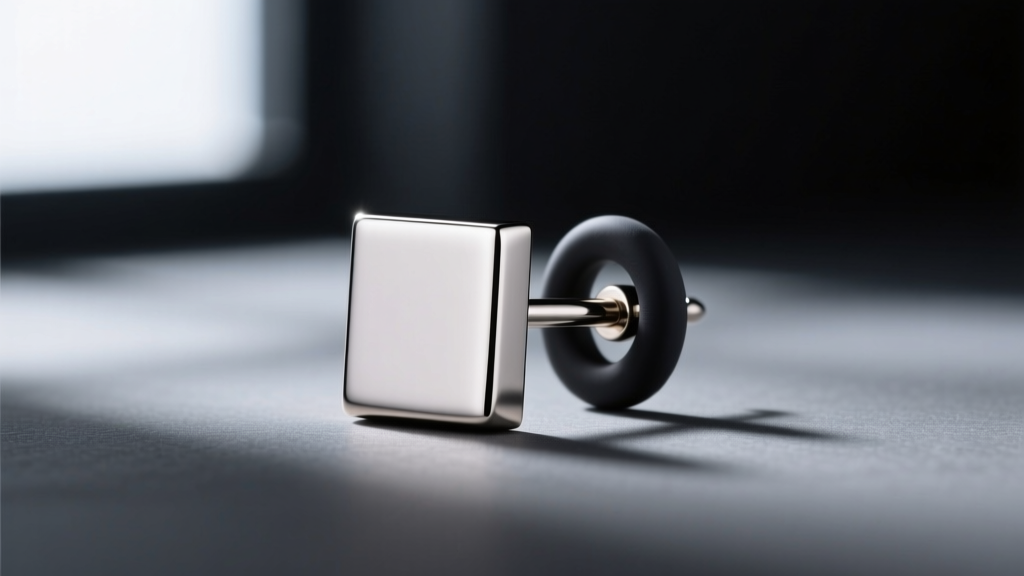
Actionable Fix: Ditch the butterfly backs immediately. If your posts are threaded, use stainless steel or titanium screw backs. If your posts are smooth, purchase 2mm or 3mm silicone O-rings. The elastomeric grip of high-quality silicone provides vastly superior friction compared to metal-on-metal tension, and it won't dig into the back of your ear while you sleep.
Material and Gauge Troubleshooting for Sensitive Lobes
Because square studs sit completely flush against the skin, they create a micro-environment that traps sweat, dead skin cells, and sebum. If the metal contains reactive alloys, this trapped moisture accelerates contact dermatitis. Many budget mens square stud earrings are marketed as 'surgical steel,' but this is an unregulated term. Standard 316L steel contains 8-12% nickel, a known allergen.
For troubleshooting chronic redness or itching behind a square stud, you must upgrade your material. The Association of Professional Piercers (APP) strongly recommends ASTM F136 implant-grade titanium for all body jewelry. It is entirely nickel-free, highly corrosion-resistant, and significantly lighter than steel, which helps alleviate the lobe sag mentioned earlier.
The Gauge Thickness Dilemma
Most standard earrings are 20-gauge (0.81mm). However, hanging a heavy, 6mm square face on a 0.81mm post creates a fulcrum effect. The thin post will slowly slice downward through the bottom of your piercing channel, a phenomenon known as the 'cheese-wire effect.' To troubleshoot and prevent this migration, you must wear thicker posts. Look for 18-gauge (1.02mm) or 16-gauge (1.29mm) posts. The increased surface area distributes the downward force of the square face, protecting the integrity of your fistula.
Quick Diagnostic Checklist
Before purchasing or wearing your next pair of mens square stud earrings, run them through this expert troubleshooting checklist:
- Edge Check: Run your fingernail along the corners. If it catches sharply, the edges are not beveled and will snag your clothes.
- Spin Test: Rotate the earring. The square face must spin perfectly on its center axis without orbiting or wobbling.
- Post Length: Measure the post. It should be at least 8mm long to accommodate the lobe thickness and a secure screw-back or O-ring.
- Magnet Test: If a magnet sticks strongly to your 'titanium' or 'surgical steel' square studs, they contain high levels of iron or nickel and should be discarded to prevent allergic reactions.
- Weight Check: Opt for hollow-backed or CNC-milled recessed backs to reduce overall gram weight without sacrificing the visual footprint of the square.
By addressing the unique mechanical challenges of square geometry, you can enjoy the sharp, modern aesthetic of square studs without the frustration of snags, sagging, or skin irritation.


