Turquoise Slab Earrings: Troubleshooting Cracks & Lobe Sag
Fix common issues with turquoise slab earrings. Learn how to prevent lobe sagging, repair cracked bezels, and protect porous stones from damage.

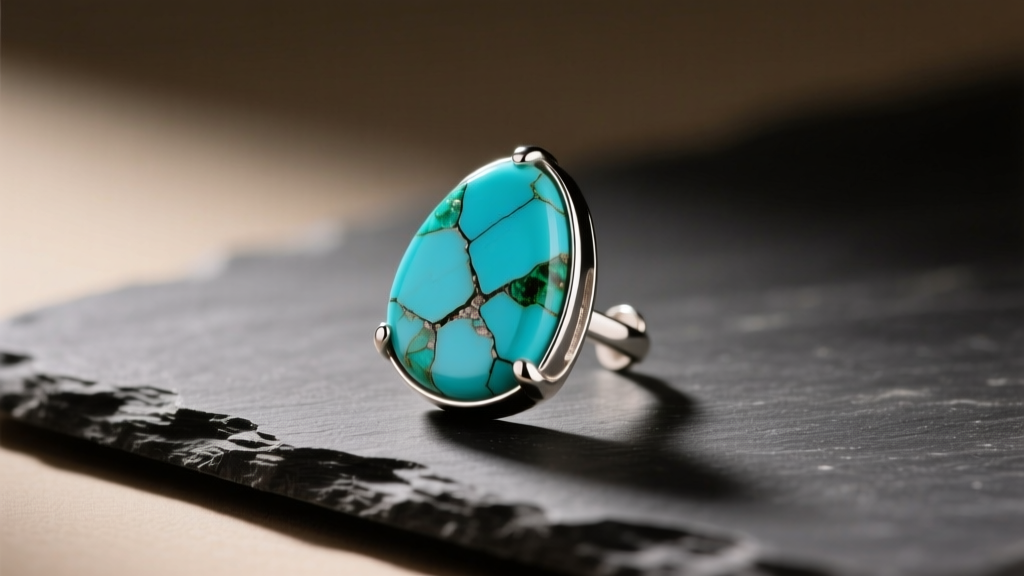
The Allure and Anatomy of Turquoise Slab Earrings
Turquoise slab earrings are celebrated for their bold, geometric profiles and the raw, unpolished beauty of the stone's natural matrix. Unlike traditional cabochons, which are domed and smoothed, slab cuts preserve the flat, planar geometry of the rough material. However, this distinct lapidary style introduces a unique set of structural and chemical vulnerabilities. With a Mohs hardness rating of just 5 to 6 and a specific gravity of 2.6 to 2.9, turquoise is both relatively soft and surprisingly heavy. When cut into large, flat slabs, the stone becomes highly susceptible to impact fractures, edge chipping, and severe earlobe stretching. In this comprehensive troubleshooting guide, we will diagnose the most common failure modes of turquoise slab earrings and provide expert-level solutions to restore and protect your jewelry.
The Weight Problem: Preventing and Fixing Lobe Sag
The most frequent complaint regarding slab earrings is the "cheese-cutter effect." A standard earlobe piercing can comfortably support 7 to 10 grams of weight. A pair of statement turquoise slab earrings, however, can easily weigh between 15 and 25 grams per earring. Over time, this pendulum-like weight pulls the fistula (the piercing hole) downward, thinning the tissue and causing irreversible sagging.
Immediate Structural Fixes
If your lobes are already stretched or the earrings hang at an unflattering angle, you must redistribute the physical load. Do not rely on standard friction earring backs; they will slide down the post under the slab's weight.
- Earlobe Support Patches: Adhesive patches (such as Blomed) feature a reinforced hole that rests against the back of the ear, spreading the earring's weight across a 15mm surface area rather than a single millimeter of tissue.
- Silicone O-Ring Stoppers: Replace standard metal butterfly backs with thick, medical-grade silicone O-rings. The high-friction rubber grips the post tightly and provides a wider cushion against the skin.
- Ear Chain Integration: For extremely heavy slabs, jewelers can attach a delicate 20-gauge sterling silver chain from the top of the earring hook to a secondary helix or lobe piercing, effectively suspending the weight from the ear's cartilage.

Stone Damage: Troubleshooting Cracks, Chipping, and Fading
Slab cuts are typically sliced parallel to the stone's natural bed, which often exposes the matrix—the host rock (usually limonite or sandstone) interspersed within the turquoise. The boundary between the turquoise and the matrix is a natural fault line. A minor drop on a tile floor can cause the slab to cleave perfectly along this matrix web.
Repairing Hairline Fractures
Never use cyanoacrylate (super glue) to repair a cracked turquoise slab. Superglue outgasses as it cures, leaving a permanent white, frosty residue that ruins the stone's color. Instead, lapidaries use Opticon F-99, a two-part epoxy resin specifically formulated for gemstone fracture filling. It has a refractive index closely matched to turquoise and penetrates microscopic fissures via capillary action, stabilizing the crack without altering the stone's hue.
Understanding Treatment Vulnerabilities
To troubleshoot color fading or surface degradation, you must first identify how your turquoise was treated. According to the Gemological Institute of America (GIA), the vast majority of turquoise on the market is altered in some way to improve durability.
| Treatment Type | Process Description | Primary Vulnerability | Troubleshooting & Care Fix |
|---|---|---|---|
| Natural | Untreated, raw stone | Highly porous; absorbs skin oils and turns green/brown over time. | Seal the stone annually with a microcrystalline wax (e.g., Renaissance Wax) to block oil absorption. |
| Stabilized | Infused with epoxy resin under high pressure | Heat sensitive; resin can soften or melt, causing cloudiness. | Never use ultrasonic or steam cleaners. Clean only with a damp, cool microfiber cloth. |
| Zachary Process | Safe chemical enhancement to improve color and durability | Highly stable, but harsh acids can still etch the surface. | Safe for mild soap washing; avoid direct contact with perfumes or hairsprays. |
| Dyed / Chalk | Powdered turquoise mixed with resin and dyed | Color bleeds when exposed to alcohol or acetone. | Wipe only with a dry polishing cloth; keep away from hand sanitizers. |
Hardware Failures: Bezel Gaps, Post Snapping, and Wire Fatigue
The physical connection between the heavy stone and the metal hardware is the most common point of catastrophic failure in slab earrings. Because slabs are rarely cut with perfect, machine-grade uniformity, setting them requires advanced metalsmithing techniques.
Fixing Bezel Gaps
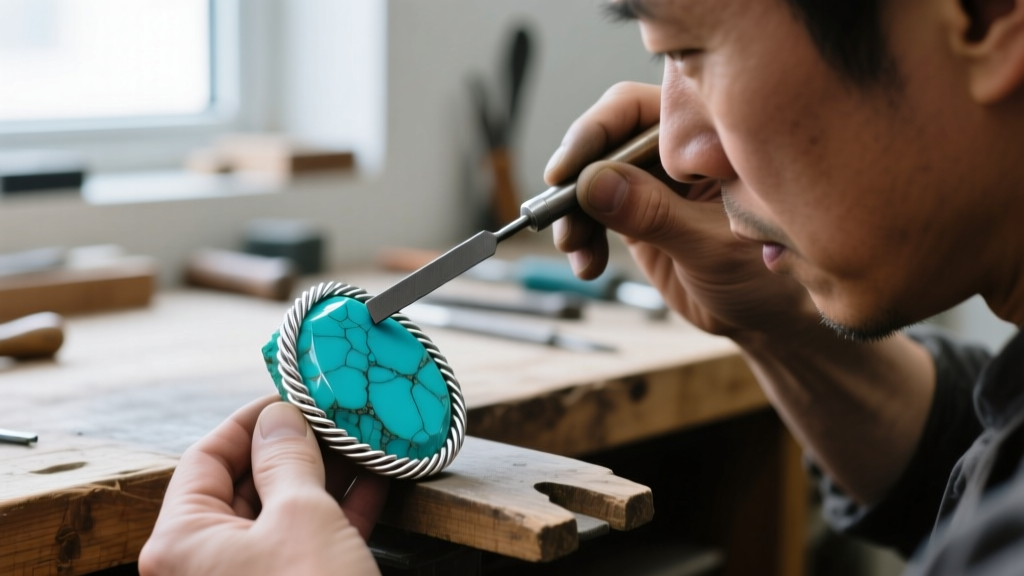
A bezel setting uses a thin strip of metal (usually 22-gauge or 24-gauge dead-soft sterling or fine silver) folded over the edge of the stone. If the slab has an uneven surface, the bezel wire will pull away, creating a gap where water and debris can enter, eventually pushing the stone out from the inside. To fix this, a jeweler uses a bezel burnisher—a hardened steel tool with a smooth, rounded tip—to apply localized, high-pressure friction. This work-hardens the silver and forces it to conform perfectly to the stone's microscopic undulations.
Upgrading Snapped Solder Joints
If the earring post snaps off flush with the backing plate, the issue is a fulcrum failure. A standard 20-gauge (0.81mm) post soldered directly to a large, heavy slab creates a tiny surface area for the solder. When the heavy slab swings, the leverage snaps the joint. The Fix: Have a jeweler laser-weld a 4mm sterling silver "patch" disc to the back of the slab, and solder an 18-gauge (1.02mm) or 16-gauge (1.29mm) post to the center of the patch. This triples the surface area of the solder joint and provides a thicker post that resists bending.
Wire-Wrapping Fatigue
Many artisan slab earrings are wire-wrapped rather than bezel-set. If the wire unspools or snaps, it is usually because the artisan used dead-soft wire for the structural frame. Dead-soft wire work-hardens and becomes brittle with movement. For structural integrity, the frame must be bent from half-hard wire, reserving dead-soft wire exclusively for the decorative, stationary weaves.
Chemical Reactions: Cleaning Tarnish Without Ruining the Stone
Sterling silver tarnishes when exposed to sulfur in the air. The instinctive reaction is to use a commercial silver dip (like Tarn-X). Never do this with turquoise slab earrings. Commercial dips contain thiourea and strong acids that will instantly strip the polish from stabilized stones, permanently etch natural turquoise, and leave a white, chalky residue trapped in the stone's matrix webbing.
"Turquoise is a porous gemstone that can absorb chemicals, which may alter its color or damage its surface. Always avoid harsh chemicals, ultrasonic cleaners, and steam cleaning." — GIA Turquoise Care Guidelines
The Safe Cleaning Protocol:
- Use a treated jeweler's cloth (such as a Sunshine Polishing Cloth) to manually buff the silver bezel and post. The cloth contains micro-abrasives that remove tarnish without liquid chemicals.
- If the silver is heavily oxidized, make a thick paste of baking soda and water. Using a cotton swab, apply the paste strictly to the metal hardware, avoiding all contact with the turquoise slab.
- Rinse the metal under a low stream of cool water, keeping the stone tilted upward so water runs away from it.
- Pat the metal dry immediately with a lint-free cloth to prevent water spots.
Quick Troubleshooting Checklist
Use this rapid diagnostic guide to identify and resolve your specific earring issue:
- Symptom: The stone looks dull and has turned slightly green.
Diagnosis: Natural turquoise absorbing skin oils and cosmetics.
Fix: Gently buff with a dry microfiber cloth and apply a thin coat of Renaissance Wax to reseal the surface. - Symptom: The earring post bends easily, causing the slab to hang crooked.
Diagnosis: Post gauge is too thin (likely 20g or 22g) for the stone's mass.
Fix: Visit a bench jeweler to swap the finding for an 18-gauge post or a locking leverback mechanism. - Symptom: The silver bezel is catching on clothing.
Diagnosis: The bezel wire has pulled away from the stone's edge.
Fix: Use a plastic or wooden burnisher to gently push the metal edge back down against the slab; avoid metal tools that might scratch the silver. - Symptom: White, chalky spots have appeared on the stone's surface.
Diagnosis: Chemical etching from silver polish, perfume, or hairspray.
Fix: Unfortunately, chemical etching is permanent. A lapidary may need to re-sand and re-polish the top layer of the slab to remove the damage.
By understanding the mineralogical properties of turquoise—such as its porosity and cleavage planes—and the mechanical limits of earlobe anatomy, you can successfully troubleshoot and preserve your slab earrings for decades. For further reading on the mineralogy and structural composition of this ancient gemstone, consult the extensive database at Mindat.org.


