Troubleshooting 75 Carat Diamond Earrings & Heavy Studs
Expert troubleshooting for heavy diamond earrings. Learn how to secure 75 carat diamond earrings, prevent earlobe tearing, and choose custom backings.

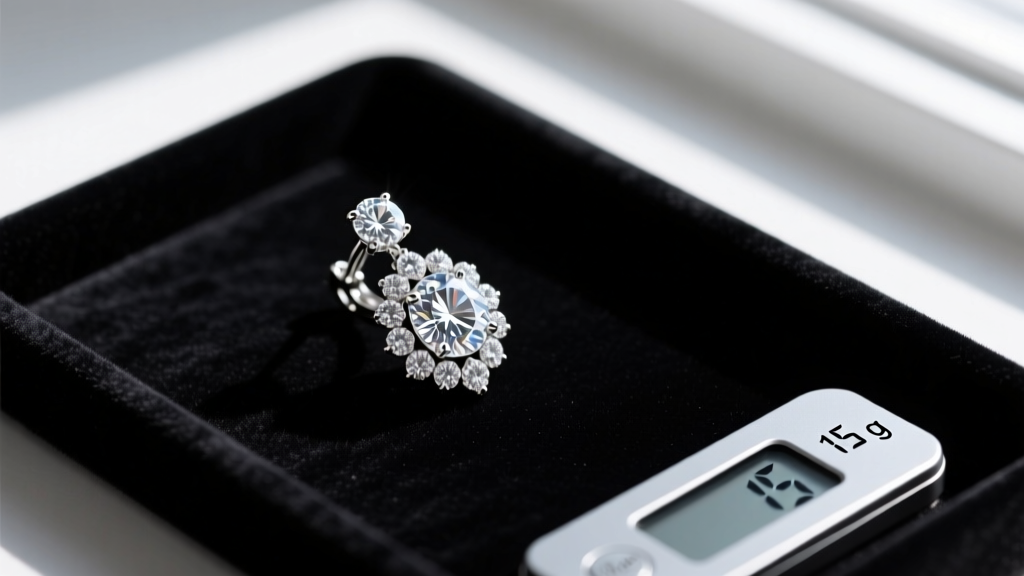
The Physics of High-Carat Diamonds: From 0.75ct to 75 Carats
When navigating the ultra-high jewelry market, the phrase '75 carat diamond earrings' usually refers to a combined total weight (37.5 carats per ear) seen exclusively in museum-grade collections, royal vaults, or elite red-carpet loans. Because one metric carat equals 0.2 grams, a single 37.5-carat diamond weighs exactly 7.5 grams. While the vast majority of consumers are actually troubleshooting the much more common 0.75-carat daily studs, the mechanical principles of weight distribution, post metallurgy, and earlobe stress apply across the entire spectrum of heavy diamond jewelry. In 2026, as lab-grown diamonds allow consumers to wear larger, heavier stones daily, understanding the structural engineering required to keep your diamonds secure and upright is critical for anyone wearing stones over 2.00 carats.
The most common failure mode for heavy diamond studs is not the loss of the stone, but the degradation of light performance due to the 'droop effect.' When a heavy diamond pulls the earlobe forward, the pavilion facets tilt away from the primary light source. According to optical analyses by the Gemological Institute of America (GIA), even a 15-degree forward tilt can reduce a diamond's scintillation and fire by over 40%. Therefore, troubleshooting heavy earrings is as much about preserving optical brilliance as it is about physical security.
Troubleshooting Earlobe Stress and Fistula Elongation
The human earlobe is composed of adipose tissue and skin, lacking the cartilage structure necessary to support heavy loads. A standard pierced fistula can comfortably support 2 to 3 grams before micro-tearing begins. Wearing ultra-heavy jewelry without support leads to fistula elongation, irreversible tissue thinning, and eventual blowout.
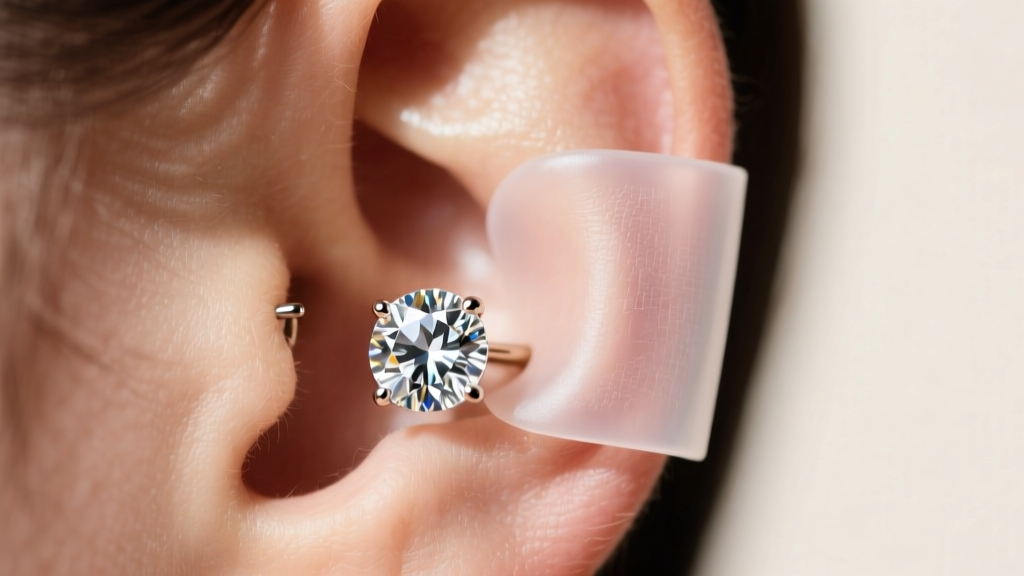
Non-Surgical Support Systems
For earrings weighing between 3 and 8 grams (approximately 15 to 40 carats total), non-surgical support patches are mandatory. These adhesive discs distribute the downward shear force across a wider surface area of the lobe's posterior.
- Thermoplastic Polyurethane (TPU) Patches: Brands like Ear Magic use medical-grade TPU that stretches slightly, allowing the earring to move naturally while preventing the post from slicing through the tissue. These must be replaced every 48 hours to prevent contact dermatitis.
- Silicone Support Discs: Thicker and more rigid than TPU, silicone discs (like Lobe Wonder) feature a central slit that grips the earring post. They are ideal for static events but can cause pressure necrosis if worn for more than 6 continuous hours.
- Custom Resin Splints: For antique or irregularly shaped heavy earrings, jewelers can 3D-print custom resin splints molded exactly to the wearer's earlobe topography, providing a perfect load-bearing shelf.
Engineering Custom Backings for Extreme Weight
Standard friction backs (butterfly backs) rely on the tension of thin sheet metal against a notched post. They are entirely useless for heavy stones; the kinetic energy of a simple head turn can generate enough centrifugal force to dislodge a friction back holding a 5-gram stone. For high-carat jewelry, mechanical locking and structural harnesses are required.
| Backing Type | Max Weight Capacity | Mechanism of Action | Best Use Case |
|---|---|---|---|
| La Pousette (Locking) | 3.5 grams | Spring-loaded internal clutch locks into a grooved post. | 1.00ct - 3.00ct daily studs |
| Omega Clip | 6.0 grams | Hinged paddle clamps the entire lobe, distributing weight to the back. | Heavy drops and chandelier earrings |
| Post & Nut (Screw) | 8.0 grams | Threaded post with a screw-on nut; requires exact 1.2mm+ gauge. | High-value investment studs |
| Cartilage Harness | 20.0+ grams | Wire wraps around the helix/conch, bypassing the lobe entirely. | Museum-grade / 75 carat red-carpet pieces |
When dealing with extreme weights, the earring post itself must be upgraded. A standard 0.8mm (20-gauge) post will permanently bend under the leverage of a heavy stone. Master jewelers upgrade heavy studs to 1.2mm or 1.6mm posts forged from Pt950 (95% Platinum). Platinum's high density and tensile strength prevent bending, whereas 18k yellow gold is too malleable and will warp under sustained shear stress.
Security, Insurance, and Appraisal Red Flags
The Jewelers' Security Alliance (JSA) consistently reports that high-value earrings are prime targets for opportunistic theft because they are easily snatched and difficult to trace once separated from their documentation. Securing 75 carat diamond earrings—or any high-value pair—requires a multi-layered approach to provenance and tracking.

Micro-Tagging and Girdle Inscriptions
For any diamond over 2.00 carats, a laser inscription on the girdle is non-negotiable. However, inscriptions can be polished away by a skilled thief. In 2026, high-jewelry houses are embedding passive RFID (Radio Frequency Identification) microchips directly into the custom platinum backings or the hollowed-out galleries of the earring settings. These chips cannot be detected by standard metal detectors and allow law enforcement to scan a recovery batch with a localized RF reader.
The Appraisal Gap
A common troubleshooting nightmare occurs when an owner attempts to claim a loss on heavy earrings, only to find their insurance rider is based on a 'replacement value' that does not account for the custom engineering of the setting. Standard jewelry appraisals often list the diamond's 4Cs but ignore the bespoke cartilage harness or the Pt950 heavy-duty post. Always ensure your appraisal explicitly details the structural mounting hardware, as replacing a custom-fitted harness can cost upwards of $2,500 in bench fees alone.
Summary Checklist for Heavy Diamond Maintenance
To ensure your heavy diamond earrings remain secure, brilliant, and comfortable, implement this bi-annual maintenance protocol:
- Post Integrity Check: Have a jeweler measure the post diameter with digital calipers. If a 1.2mm post has thinned to 1.05mm due to friction wear, it must be re-tipped or replaced immediately.
- Prong Tension Mapping: Heavy stones experience more kinetic shock. Prongs should be checked under 10x magnification for 'lifting' or micro-fractures at the base.
- Ultrasonic Warning: Never clean heavy, tension-set, or fracture-filled diamonds in an ultrasonic cleaner. The high-frequency vibrations can shatter stones with internal strain or loosen the specialized locking mechanisms of the backing.
- Fistula Resting: If wearing stones over 5 grams, limit wear to 4-hour intervals and sleep with the earlobes elevated to promote lymphatic drainage and reduce tissue swelling.
Whether you are engineering a mounting for a historic 75-carat masterpiece or simply trying to keep your 0.75-carat engagement studs sitting perfectly flush against your ear, respecting the physics of weight and metallurgy is the hallmark of true jewelry expertise.


