Troubleshoot Flaws: Best Jewelry Earring Making Supplies Guide
Fix structural flaws and allergic reactions in handmade designs with our expert guide to sourcing premium jewelry earring making supplies.
The Hidden Costs of Compromised Earring Architecture
Handcrafting earrings is a delicate balance of metallurgy, physics, and aesthetic design. Yet, even the most visually stunning bespoke pieces will fail if the underlying architecture is flawed. Whether you are a seasoned bench jeweler or an emerging indie designer, encountering structural failures—like warped ear wires, snapping jump rings, or customer complaints regarding contact dermatitis—can severely damage your brand's reputation. The root cause of these issues almost always traces back to the improper selection of jewelry earring making supplies.
Troubleshooting handmade earring flaws requires moving beyond the generic 'hypoallergenic' marketing buzzwords and understanding the precise mechanical properties of your materials. In this comprehensive guide, we will diagnose the four most common structural and biocompatibility failures in handmade earrings and detail the exact specifications, gauge sizes, and material grades you need to source to permanently resolve them.
Structural Failure #1: Jump Rings Snapping Open Under Tension
The most frequent point of failure in dangle and drop earrings is the jump ring connecting the ear wire to the focal charm. When a heavy gemstone or resin component swings, it exerts lateral torque on the jump ring. If the ring is made from dead-soft wire or has an improperly calculated Aspect Ratio (AR), the slit will pull apart, and the earring will be lost.
The Troubleshooting Fix: You must understand Aspect Ratio, which is the Inner Diameter (ID) divided by the Wire Gauge thickness. For unsoldered jump rings bearing weight, an AR higher than 5.0 is a structural liability. For example, a 20-gauge (0.81mm) wire with a 5mm ID yields an AR of 6.1—far too high for heavy dangles. To fix this, either decrease the ID or increase the wire thickness. According to Rio Grande Metals Information, utilizing half-hard or full-hard temper wire for jump rings drastically increases the yield strength, preventing the ring from pulling open. For high-end, heavy statement pieces, sourcing pre-soldered jump rings or learning to silver-solder your own closures is non-negotiable.
Structural Failure #2: Ear Wires Bending and Losing Tension
French hooks (fishhook ear wires) are notorious for bending out of shape when caught on hair or clothing. If your ear wires lack 'memory' (the ability to spring back to their original shape), the issue is your wire temper. Many beginners mistakenly purchase dead-soft wire because it is easier to wrap around a mandrel, only to find the finished ear wires warp instantly upon wear.
The Troubleshooting Fix: You must source half-hard or full-hard wire for ear hooks, and employ work-hardening techniques. After forming the hook, gently hammering the lower curve with a rawhide mallet or a polished steel chasing hammer compresses the metal's grain structure, increasing its rigidity without compromising its tensile strength. As outlined in the Halstead Bead Wire Temper Guide, matching the correct temper to the specific gauge is critical for longevity.
| Wire Gauge | Temper | Best Use Case | Failure Risk if Misused |
|---|---|---|---|
| 20g (0.81mm) | Half-Hard | Standard French Hooks & Leverbacks | Bends permanently if dead-soft; too stiff for tight loops if full-hard |
| 22g (0.64mm) | Full-Hard | Delicate Studs & Lightweight Dangles | Snaps under heavy tension; difficult to bend without annealing |
| 18g (1.02mm) | Dead-Soft | Forging & Hammering Ear Cuffs | Will warp instantly if used for unsupported, hanging ear wires |
| 21g (0.72mm) | Half-Hard | Argentium Silver Ear Threads | Breaks if pulled through the piercing too aggressively |
Biocompatibility Failure: Contact Dermatitis from Base Metals
There is no legally recognized definition of 'hypoallergenic' in jewelry manufacturing. When customers complain of itchy, swollen, or weeping earlobes, they are typically reacting to nickel or copper alloys leaching into the skin. Even standard 925 Sterling Silver contains 7.5% copper, which can oxidize and cause localized irritation in highly sensitive individuals, especially in fresh or unhealed cartilage piercings.
The Troubleshooting Fix: To guarantee biocompatibility, you must upgrade your jewelry earring making supplies to implant-grade materials. The gold standard for sensitive ears is ASTM F136 Titanium. Unlike commercial-grade titanium, ASTM F136 is the exact alloy used in surgical implants and contains zero nickel. Alternatively, Niobium (ASTM B392) is a highly reactive, nickel-free elemental metal that is exceptionally well-tolerated by the human body. A major advantage of sourcing niobium ear wires is that they can be anodized using a simple DC power supply to create vibrant, permanent colors without the use of toxic dyes or platings. Always verify that your metal supplier provides a mill certificate or explicit ASTM grading for their titanium and niobium stock, as unverified 'titanium-colored' steel is a common trap in the wholesale market.
Weight Distribution: Solving 'Lobe Drag' in Statement Pieces
Lobe drag occurs when the center of gravity on a heavy dangle earring pulls the earlobe downward, causing discomfort, stretching of the piercing fistula, and an unflattering aesthetic. This is particularly problematic when working with dense materials like solid brass, thick lampwork glass, or large cabochon stones.
The Troubleshooting Fix: The solution lies in redistributing the physical load across a wider surface area of the ear. First, abandon standard friction backs (butterfly clutches) for heavy pieces, as their narrow surface area digs into the neck. Instead, source wide-diameter silicone O-ring backs or saddle-back earring findings, which distribute the weight across the entire back of the earlobe. For extreme statement pieces, consider designing with ear threads (28-gauge flexible chains that weave through the piercing) or leveraging lightweight metals like anodized aluminum for the structural framework, reserving heavier precious metals only for small accent details.
The Ultimate Troubleshooter's Sourcing Checklist
To maintain rigorous quality control over your handmade earring line, audit your supply chain against these strict parameters:
- Wire Certification: Ensure all titanium is certified ASTM F136 and all niobium is ASTM B392. Avoid 'surgical steel' (316L) for new piercings, as it contains trace nickel that violates the EU Nickel Directive (EN 1811:2011) limits for prolonged skin contact.
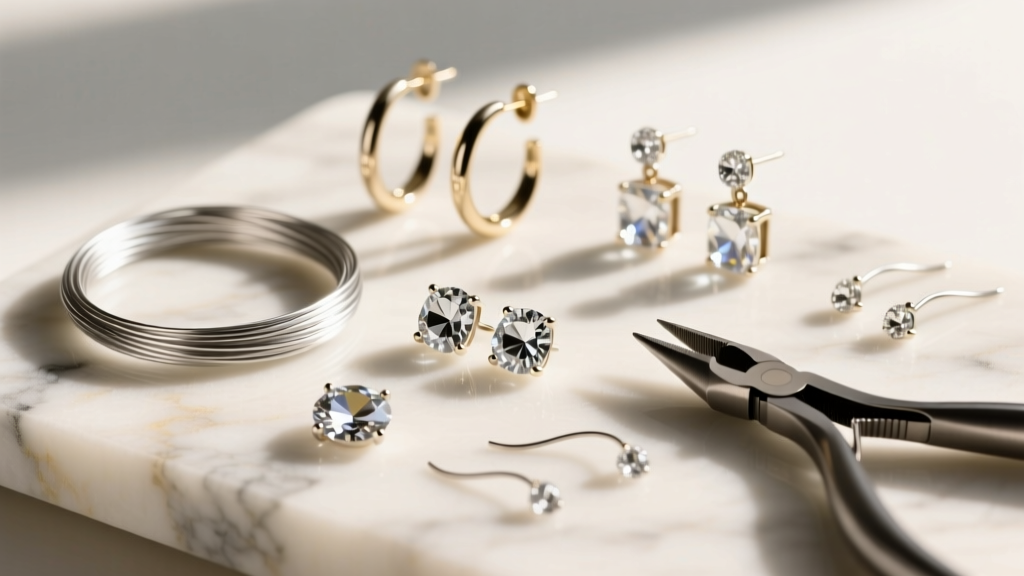
- Flush Cutters: Invest in high-carbon steel or tungsten carbide flush cutters (such as those by Tronex or Lindstrom). A poor cut leaves a 'pinch' on the wire end, creating a micro-fracture that will eventually snap under the repetitive stress of being put on and taken off.
- Findings Integrity: When sourcing pre-made leverbacks or kidney wires, test the tension of the closure mechanism. If the snap-shut mechanism feels mushy or fails to click audibly, the alloy is too soft and will fail the consumer.
Conclusion: Engineering for Longevity
Troubleshooting handmade earring flaws is rarely about fixing the design itself; it is almost always about fixing the materials used to execute the design. By respecting the mechanical limits of wire tempers, calculating precise aspect ratios for jump rings, and strictly adhering to implant-grade biocompatibility standards, you elevate your craft from fragile hobbyist work to professional-grade wearable art. Investing in premium, precisely graded jewelry earring making supplies is the most effective way to ensure your creations are as structurally resilient as they are beautiful.