Troubleshooting 7.5 mm Earrings: Fit and Hinge Fixes
Learn how to troubleshoot 7.5 mm earrings. Fix hinge issues, solve cartilage irritation, and master the inner diameter math for a perfect, painless fit.

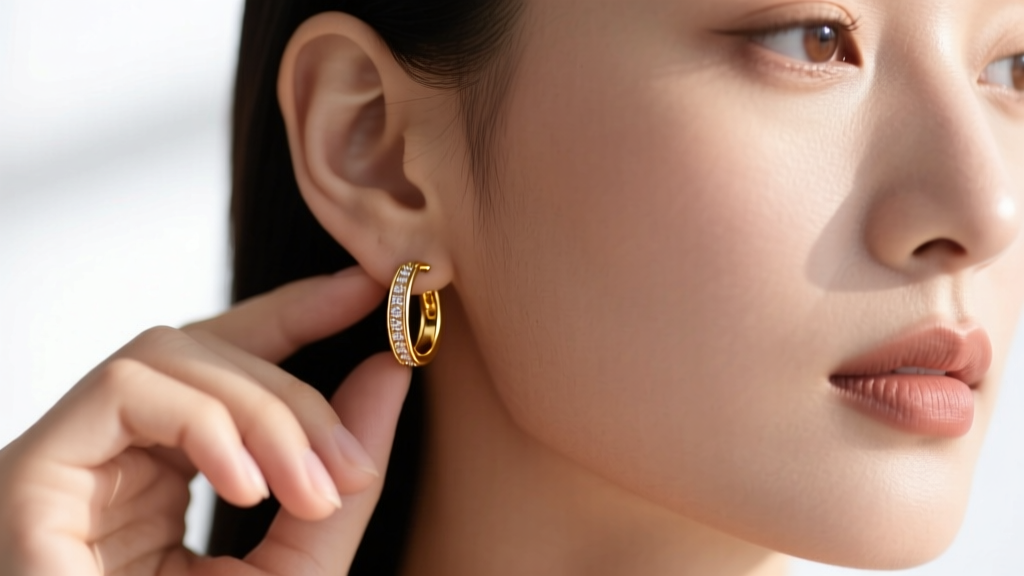
In the 2026 jewelry landscape, micro-huggies and ultra-fine cartilage clickers dominate the market. Among these, 7.5 mm earrings occupy a highly specific, often frustrating niche. They are the ultimate "tweener" size: slightly too large to sit flush like a standard 6mm stud, yet noticeably tighter than a standard 10mm hoop. While they offer a sleek, minimalist aesthetic, their compact dimensions frequently lead to a unique set of mechanical and anatomical problems.
If your 7.5 mm earrings are causing pain, failing to click shut, or irritating your piercings, you are not alone. This comprehensive troubleshooting guide will help you diagnose the exact failure points of small-diameter jewelry and provide actionable, professional-grade solutions.
The Anatomy of a 7.5 mm Fit Problem
To troubleshoot effectively, we must first clarify what "7.5 mm" actually means. In jewelry manufacturing, this measurement almost always refers to the Inner Diameter (ID), not the Outer Diameter (OD). However, the ID alone does not tell the whole story regarding fit and comfort.
The true functional clearance of your earring depends heavily on the wire gauge (thickness). Consider the following mathematical reality:
- 20-Gauge (0.81 mm wire): Leaves approximately 6.69 mm of functional open space inside the hoop.
- 18-Gauge (1.02 mm wire): Leaves approximately 6.48 mm of functional open space.
- 16-Gauge (1.29 mm wire): Leaves approximately 6.21 mm of functional open space.
The Problem: If you have a thicker earlobe (common in the lower lobe) or a cartilage piercing that retains slight swelling, a 16-gauge 7.5 mm hoop will compress the tissue. This compression restricts blood flow, traps moisture, and initiates the dreaded "cheese-cutter effect," where the jewelry slowly migrates through the skin due to concentrated downward pressure.
The Solution: Always measure your lobe or cartilage thickness with a digital caliper before purchasing. If your tissue thickness exceeds 6.5 mm, a 7.5 mm ID hoop in 16-gauge will inevitably cause irritation. Size up to an 8.5 mm or 9 mm ID, or drop down to a 20-gauge wire if your piercing channel can safely accommodate it.
Troubleshooting Huggie Hinge and Clasp Failures
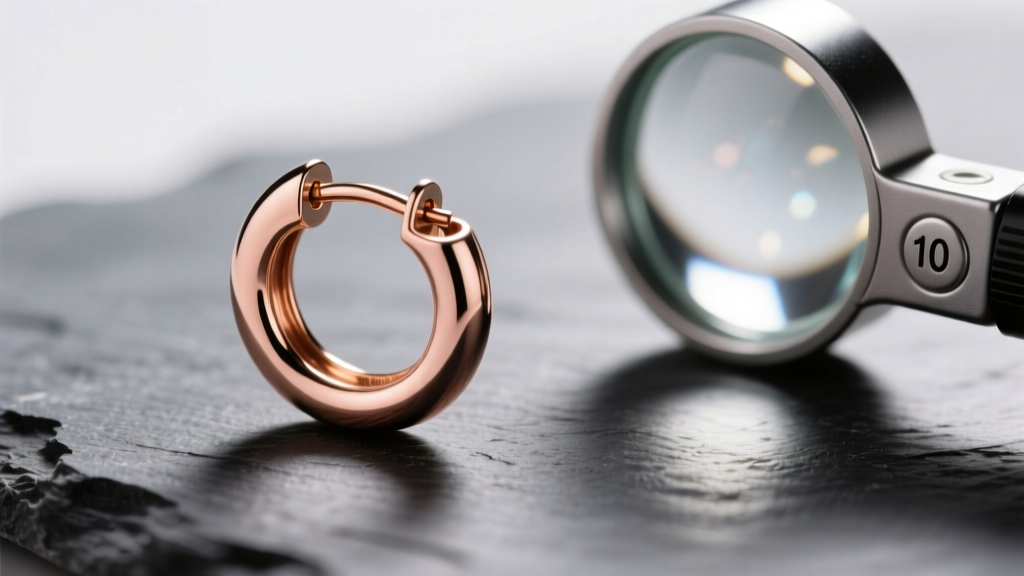
Because 7.5 mm huggies require miniaturized hardware, their hinge mechanisms and clasp posts are incredibly delicate. A common complaint is that the earring "won't click" or pops open unexpectedly during the day.
Diagnosing the Micro-Tension Failure
Most 7.5 mm clickers use a friction-fit post that snaps into a hollow receiving tube. When this fails, it is rarely a broken hinge; it is almost always a misalignment of the post or a buildup of microscopic debris.
- Debris Accumulation: Sebum, dead skin cells, and soap residue easily compact inside the tiny receiving tube of a 7.5 mm hoop, preventing the post from seating fully. Fix: Soak the earring in warm distilled water with a drop of mild, fragrance-free soap. Use a soft-bristled interdental brush to gently clear the receiving tube.
- Post Deflection: If you have ever forced the hoop closed, the male post may have bent slightly upward or downward. Fix: Using nylon-jaw jewelry pliers (never metal-on-metal, which will mar the gold or titanium), gently grip the post and apply micro-pressure to realign it with the hinge axis.
- Hinge Fatigue: If the hinge pin itself is loose, the two halves of the earring will wobble, preventing the clasp from engaging. Fix: This requires professional laser welding. Do not attempt to squeeze the hinge with pliers, as you will crush the micro-pin.
Solving Lobe and Cartilage Irritation: The Clearance Matrix
When a 7.5 mm earring causes localized redness, heat, or hypertrophic scarring, the issue is usually a mismatch between the jewelry's geometry and the piercing's anatomy. Below is a troubleshooting matrix to help you identify the exact failure mode based on your piercing placement.
| Piercing Type | Ideal 7.5 mm Application | Common Failure Mode | Actionable Solution |
|---|---|---|---|
| Standard Lobe | Snug huggie for thin lobes (under 6mm thick) | Tissue compression; lobe turns purple or feels cold. | Switch to an 8.5mm ID or a flat-back labret stud. |
| Helix (Upper Cartilage) | Tight clicker for flat, flush aesthetics. | Swelling has nowhere to go; jewelry embeds in the skin. | Downsize to a 16G titanium labret post until fully healed. |
| Tragus | Minimalist hoop that clears the ear canal. | Thick tragus tissue forces the hoop into an oval shape, stressing the solder joint. | Use a 6mm or 7mm ID specifically designed for thick tragus anatomy. |
| Conch | Not recommended. | The 7.5mm ID is too small to wrap around the conch ridge, causing severe pressure necrosis. | Size up to a 10mm-12mm conch hoop or use a straight barbell. |
Expert Insight: Never force a 7.5 mm hoop into a piercing that requires you to pull the tissue to make the clasp meet. According to the Association of Professional Piercers (APP), jewelry should glide into a healed channel without any tissue manipulation. If you have to stretch the skin to click it shut, the inner diameter is too small.
Material Sensitivities and Moisture Trapping
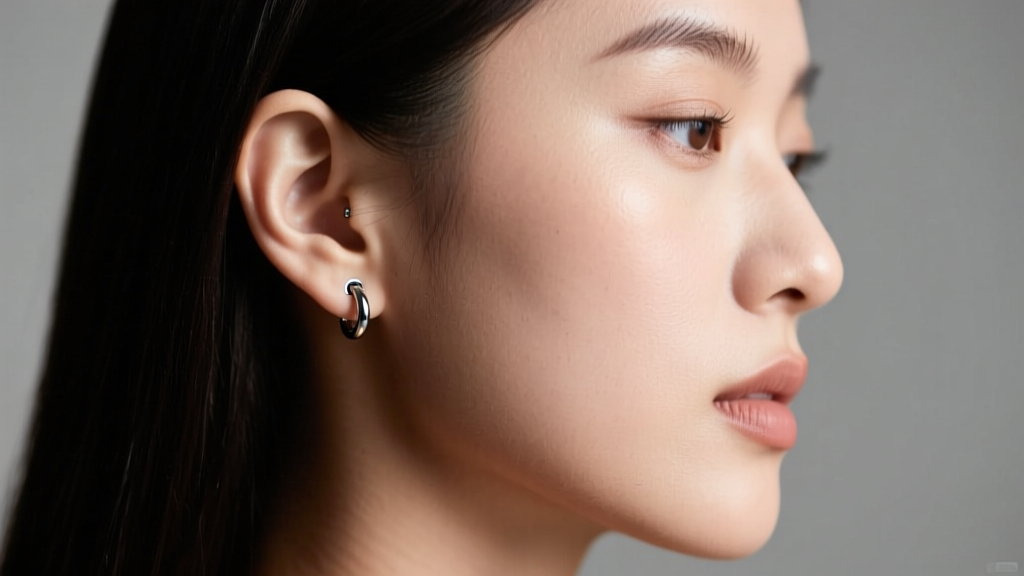
A tight-fitting 7.5 mm earring creates a micro-environment against your skin. Because there is very little airflow between the metal and your tissue, moisture, sweat, and bacteria become trapped. This frequently leads to contact dermatitis or localized fungal infections, which many people mistakenly attribute to a "metal allergy."
Evaluating Your Metal Grade
If you are experiencing chronic itching or weeping around a tight 7.5 mm hoop, evaluate your material immediately:
- Surgical Steel (316L): Contains up to 10% nickel. In a tight, moisture-trapping 7.5 mm fit, nickel leaching increases significantly. Verdict: Avoid for tight huggies.
- 14k or 18k Yellow Gold: Generally safe, but the copper and zinc alloys can oxidize when trapped against sweaty skin, causing a green or black discoloration. Verdict: Safe, but requires daily removal and cleaning.
- Implant-Grade Titanium (ASTM F136): Contains zero nickel and is highly biocompatible. It resists corrosion even in high-moisture, low-airflow environments. Verdict: The absolute best choice for 7.5 mm cartilage clickers. As noted by the World Gold Council, while high-karat gold is excellent, titanium remains the undisputed king of hypoallergenic performance in tight-fitting body jewelry.
Step-by-Step Adjustment Guide for 7.5 mm Hoops
If your 7.5 mm continuous hoop (a seamless ring without a hinge) feels slightly too tight, you can manually adjust its geometry to gain vertical clearance without altering the actual inner diameter. This technique is called "ovalizing."
How to Safely Ovalize a Continuous Hoop
- Protect the Metal: Wrap the jaws of your jewelry pliers in masking tape or use specialized nylon-jaw pliers to prevent scratching the finish.
- Identify the Stress Points: Hold the hoop vertically. You will apply pressure to the sides (the 9 o'clock and 3 o'clock positions).
- Apply Micro-Pressure: Gently squeeze the sides of the hoop inward by no more than 0.5 mm. This will cause the top and bottom (12 o'clock and 6 o'clock) to bow outward slightly.
- Test the Fit: You have now created a subtle oval shape. This provides an extra 1 to 1.5 mm of vertical clearance for your lobe or cartilage, while keeping the hoop snug against the sides of your ear.
Warning: Never bend the hoop near the solder joint (where the two ends of the wire meet). Repeated bending near the solder will cause metal fatigue and eventually snap the earring in half. Always apply pressure to the apex of the curve, opposite the seam.
When to Abandon the 7.5 mm Size
Troubleshooting can only take you so far. Sometimes, the 7.5 mm size is simply anatomically incompatible with your body. If you have tried adjusting the shape, switching to ASTM F136 titanium, and cleaning the hinges, but you still experience the cheese-cutter effect or persistent soreness, it is time to size up.
Moving to an 8 mm or 9 mm hoop will dramatically change the way the jewelry interacts with your tissue, distributing the weight over a wider arc and eliminating the downward pressure that causes migration. Remember, the goal of ear styling is not just visual minimalism, but long-term tissue health. By understanding the precise mechanics of small-diameter jewelry, you can curate a collection that is as comfortable as it is stylish.


