Typical Earring Gauge Guide: Material Properties & Sizing
Discover the typical earring gauge for lobes and cartilage. Compare material properties, strength, and sizing for titanium, gold, and steel body jewelry.

Decoding the Typical Earring Gauge
When navigating the world of body jewelry, understanding the 'typical earring gauge' is just as critical as selecting the right metal. The gauge system dictates the thickness of the wire or post that passes through your piercing. Counterintuitively, the higher the gauge number, the thinner the jewelry. While commercial mall kiosks and fast-fashion brands often default to ultra-thin 20-gauge or 22-gauge wires to save on material costs, professional piercers and high-end jewelers adhere to stricter, biologically sound standards.
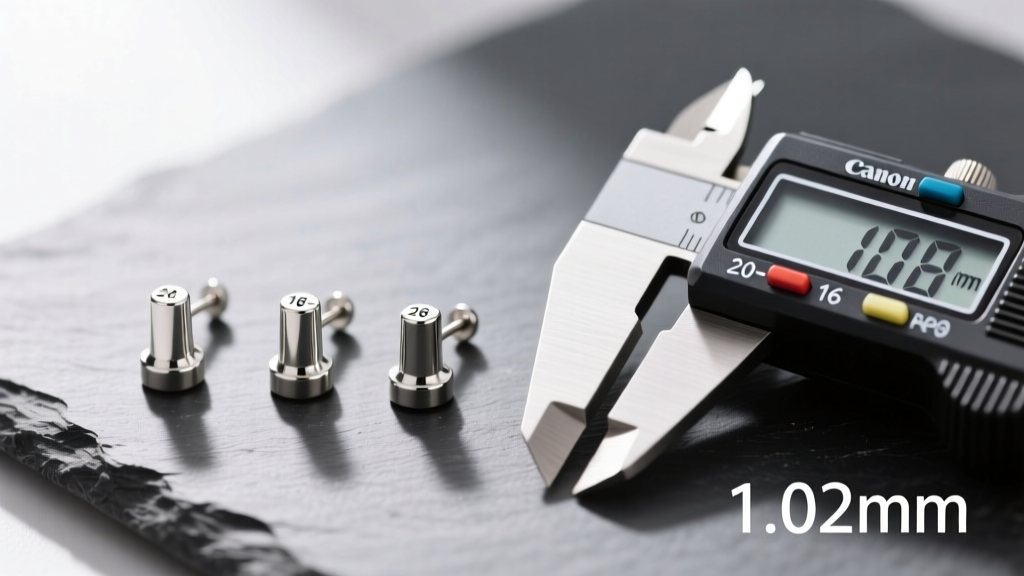
The typical earring gauge for a standard healed lobe piercing is 18-gauge (1.02mm). However, for cartilage piercings, initial healing, or heavy statement pieces, the standard shifts to 16-gauge (1.29mm) or 14-gauge (1.63mm). But gauge does not exist in a vacuum; it is intrinsically tied to the metallurgical properties of the material being used. A material's tensile strength, hardness, and density will dictate whether a specific gauge is structurally viable or destined to bend, snap, or cause tissue damage.
The Gauge-to-Millimeter Conversion Matrix
Before analyzing material properties, it is essential to ground the terminology in exact measurements. Below is the standard conversion chart utilized by professional piercers and master jewelers.
| Gauge Size | Millimeters (mm) | Inches | Primary Application & Material Notes |
|---|---|---|---|
| 20G | 0.81mm | 0.032' | Commercial fashion lobes; prone to bending in softer metals like gold. |
| 18G | 1.02mm | 0.040' | The typical earring gauge for healed standard lobe piercings across most metals. |
| 16G | 1.29mm | 0.051' | Standard for cartilage, helix, and high-quality heavy gold lobe jewelry. |
| 14G | 1.63mm | 0.064' | Required for industrials, conchs, and heavy statement drops to prevent migration. |
| 12G | 2.06mm | 0.081' | Stretched lobes and heavy structural body jewelry. |
How Material Properties Dictate Gauge Selection
Not all metals behave identically when machined to a 1.02mm (18G) thickness. The yield strength and Vickers hardness of a metal determine how well it will survive the mechanical stress of daily wear, sleeping, and accidental snags.
Titanium (ASTM F136): The High-Strength Standard
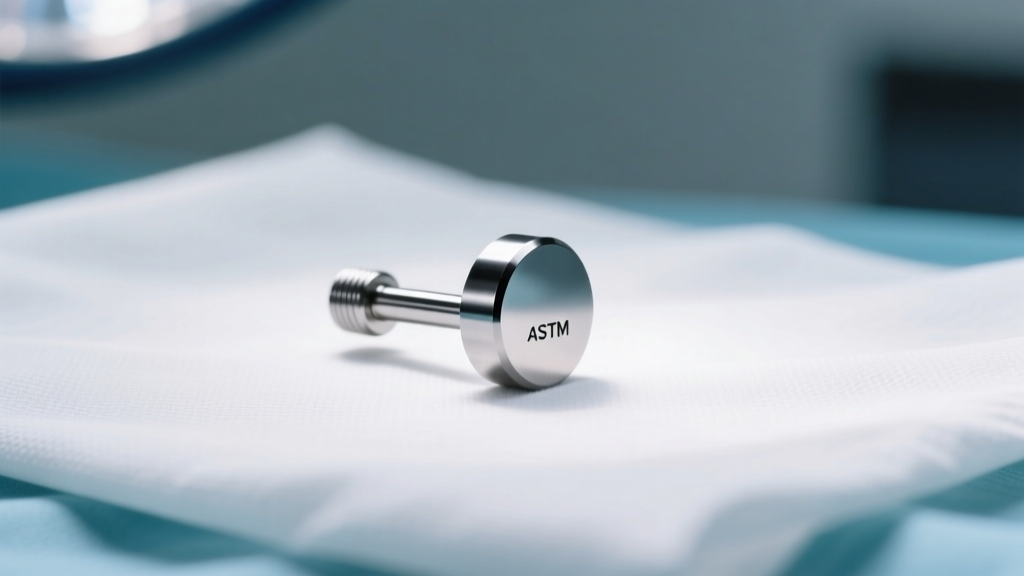
Implant-grade titanium, specifically ASTM F136, is the gold standard for initial piercings and sensitive ears. Titanium boasts an exceptional strength-to-weight ratio. Because of its high tensile strength, a 16-gauge titanium post is incredibly rigid and resistant to bending. Even at 18-gauge, titanium maintains enough structural integrity to serve as a reliable post for most lobe and cartilage applications. Furthermore, its lightweight nature reduces the downward force on the fistula (the piercing channel), making it highly forgiving if a slightly thinner gauge is used.
Implant-Grade Stainless Steel (316LVM)
Surgical steel (316L or 316LVM) is widely used and highly rigid. The 'VM' stands for Vacuum Melted, a process that traps nickel impurities within the crystal structure of the steel, reducing the risk of allergic reactions. Steel is denser and stiffer than titanium. A 16-gauge steel post is virtually unbendable by hand. However, because of its higher density, heavy steel jewelry at thinner gauges (like 18G or 20G) can exert more gravitational pull on the tissue, which is why professional piercers often mandate 14G or 16G for steel cartilage jewelry to distribute the weight safely.
Solid Gold (14k vs. 18k): The Alloy Vulnerability
Pure 24k gold is far too soft for body jewelry; it would deform under the slightest pressure. Therefore, gold is alloyed with metals like copper, silver, and zinc. This is where the typical earring gauge intersects with metallurgy. 14k gold has a higher Vickers hardness than 18k gold due to the higher percentage of alloy metals. Consequently, an 18-gauge post made of 14k gold will resist bending better than an 18-gauge post made of 18k gold. For high-end 18k gold body jewelry, master jewelers often upgrade the typical earring gauge from 18G to 16G to compensate for the metal's inherent softness, ensuring the post does not warp when the earring back is secured.
The Physics of the 'Cheese Cutter Effect'
One of the most critical concepts in body jewelry mechanics is the 'cheese cutter effect.' In physics, Pressure equals Force divided by Area. If you wear a heavy, solid 14k gold drop earring (high Force) on an ultra-thin 20-gauge wire (microscopic Area), the pressure exerted on the bottom of your piercing hole is immense. Over time, this localized pressure causes tissue ischemia (restricted blood flow), leading the jewelry to slowly slice through the earlobe, much like a wire cutting through a block of cheese.
To mitigate this, the gauge must be scaled up in proportion to the weight and density of the material. If you are purchasing heavy solid gold dangles or large gemstone clusters, you must abandon the commercial 20G standard and opt for a 16G or 14G wire. This increases the surface area distributing the weight, preserving the structural integrity of your earlobe over decades of wear.
Lobe vs. Cartilage: Adjusting the Typical Earring Gauge
The anatomical location of the piercing fundamentally alters the required gauge, largely due to tissue density and swelling dynamics.
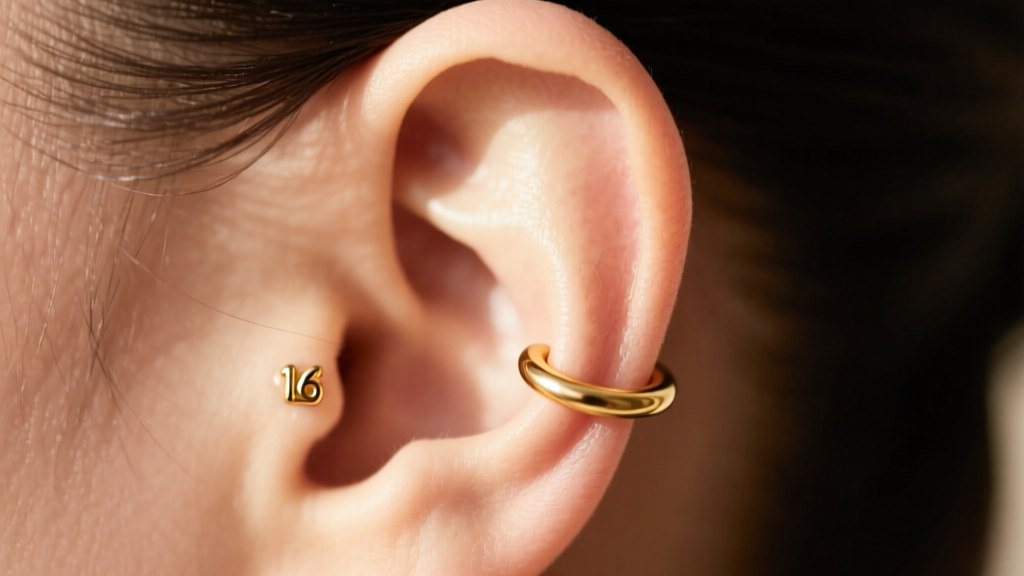
- Standard Earlobes: The tissue is soft, vascular, and forgiving. The typical earring gauge for healed lobes is 18G, though 16G is increasingly preferred by fine jewelry brands to accommodate heavier gold and gemstone designs without risking migration.
- Cartilage (Helix, Conch, Tragus): Cartilage is avascular and rigid. Piercings here are highly susceptible to irritation bumps and swelling. The Association of Professional Piercers (APP) strongly recommends 16G or 14G for cartilage. A thicker gauge provides a stable scaffold that prevents the jewelry from moving excessively, which is a primary catalyst for hypertrophic scarring.
Expert Sourcing and Verification
Marketing terms like 'hypoallergenic' or 'surgical' are largely unregulated in the fashion jewelry sector. The Federal Trade Commission (FTC) Jewelry Guides dictate strict rules for metal purity claims, but gauge and implant-grade certifications often fall into a gray area in commercial retail.
As an informed consumer, you should invest in a pair of digital Vernier calipers to verify the typical earring gauge of your purchases. Measure the post or wire at its thickest point, excluding any decorative soldering or anodized coatings. Furthermore, demand material traceability. Reputable body jewelers will provide mill certificates proving their titanium meets ASTM F136 or ASTM F67 standards, and that their gold is nickel-free and cadmium-free. By marrying an understanding of material science with precise gauge selection, you ensure your jewelry remains safe, comfortable, and structurally sound for a lifetime.


