Metallurgy Behind a Unique Gold Earrings Design: Alloy Guide
Discover how gold alloys, karats, and Vickers hardness dictate the structural limits of a unique gold earrings design. Expert metallurgy guide.

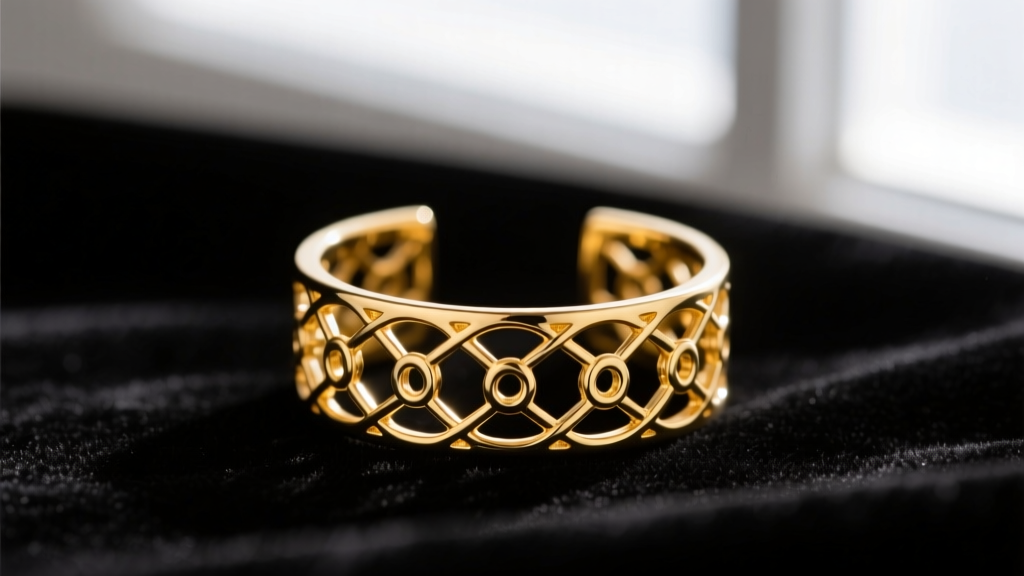
The Metallurgical Reality of Gold in Jewelry
When conceptualizing a truly unique gold earrings design, aesthetics are only half the battle. The physical limitations and metallurgical properties of the chosen alloy dictate whether a piece will become an heirloom or a structural failure. Pure gold (24-karat) is notoriously soft, registering a mere 25 to 30 on the Vickers Hardness (HV) scale. To create durable, wearable jewelry, gold must be alloyed with other metals. This fundamental metallurgical reality is the starting point for any serious jeweler or collector.
According to the Gemological Institute of America (GIA), the specific blend of copper, silver, zinc, and palladium not only alters the color of the gold but drastically shifts its tensile strength, malleability, and resistance to stress corrosion cracking. Understanding these variables is critical when evaluating or commissioning complex ear cuffs, tension-set drops, or micro-filigree studs.
Karat Breakdown: Which Gold Supports Complex Structures?
The karat system measures the purity of gold, with 24 parts representing 100% purity. As the karat drops, the percentage of alloying metals increases, fundamentally changing how the metal behaves during casting, forging, and daily wear.
14K Gold: The Structural Workhorse
Comprising 58.3% pure gold, 14K gold is the undisputed champion for intricate, high-stress jewelry. With a Vickers Hardness rating of approximately 150-180 HV, 14K gold possesses the tensile strength required for ultra-thin 20-gauge ear wires, delicate filigree frameworks, and secure micro-pavé prong settings. If a unique gold earrings design features tension settings or structural ear cuffs that rely on the metal's 'spring' to stay attached to the cartilage, 14K is often the mandatory choice.
18K Gold: The Balance of Richness and Resilience
At 75% pure gold, 18K offers a significantly richer, warmer hue and a higher intrinsic value, but it drops to roughly 120-150 HV. While it is highly favored in luxury European markets and is excellent for cast pieces and solid huggies, it requires thicker prongs and heavier structural supports. An 18K gold ear hook must typically be forged at a thicker 18-gauge to prevent bending when inserting or removing the earring.
22K & 24K Gold: The Softness Limitation
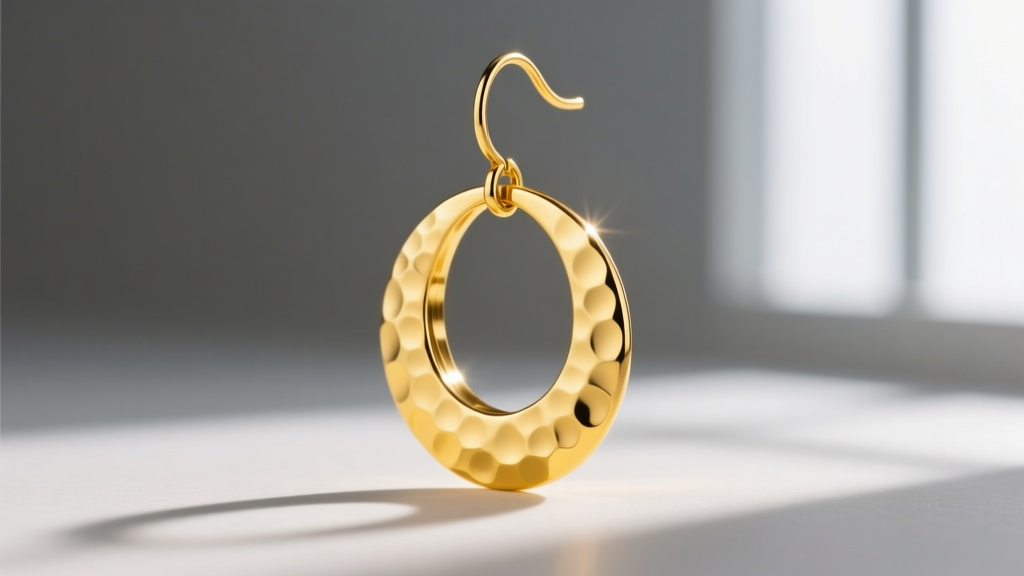
Ranging from 91.6% to 99.9% pure gold, these high-karat metals are exceptionally malleable (dropping below 70 HV). They are entirely unsuitable for prong settings, thin wires, or clasps. However, they excel in specific design niches. Hammered disc earrings, heavy solid bezels, and ancient-style repoussé work leverage the softness of 22K and 24K gold, allowing artisans to manipulate the metal by hand without the need for frequent annealing.
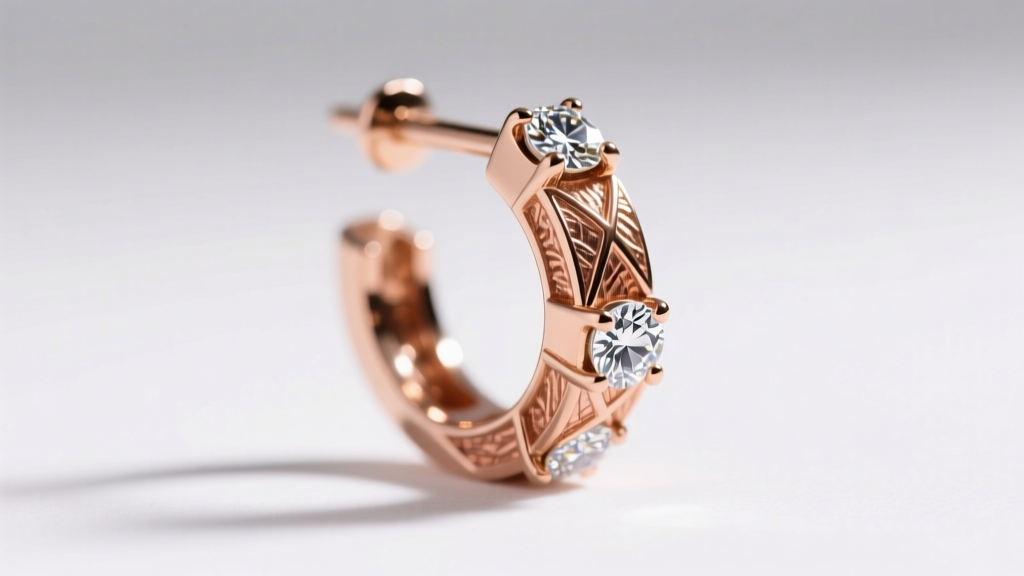
Color Alloys and Their Impact on Design
The color of gold is entirely dependent on its alloying metals, which concurrently alter the metal's physical properties. The Birmingham Assay Office strictly regulates these compositions in the UK, highlighting the global importance of standardized alloy mixtures.
| Gold Color | Primary Alloying Metals | Avg. Vickers Hardness (18K) | Best Design Application |
|---|---|---|---|
| Yellow Gold | Silver, Copper, Zinc | 125 - 135 HV | Classic cast drops, bezel settings, signet studs. |
| Rose Gold | High Copper, Low Silver | 135 - 150 HV | Durable chains, structural ear cuffs, tension settings. |
| White Gold | Palladium or Nickel, Zinc | 120 - 130 HV | Diamond halo studs, rhodium-plated geometric dangles. |
Expert Note on Rose Gold: The high copper content in rose gold not only provides its signature pink hue but also increases its overall hardness and durability compared to yellow or white gold of the same karat. This makes 14K and 18K rose gold exceptionally well-suited for modern, architectural unique gold earrings design concepts that require rigid structural lines.
Expert Note on White Gold: True white gold requires rhodium plating to achieve a bright, silvery finish. Over time, friction against the earlobe or hair will wear this plating away, revealing the slightly yellowish-gray underlying alloy. Designers must account for this wear pattern, especially on the posts and friction backs of stud earrings.
Design Limitations and Failure Modes by Karat
Ignoring the metallurgical properties of gold alloys leads to predictable, catastrophic failures. When evaluating a complex piece, be aware of the following specific failure modes:
- Prong Shearing (18K & 22K): Thin prongs holding heavy gemstones in high-karat gold will eventually bend outward or snap under lateral pressure. 14K or platinum is required for secure stone retention in active-wear earrings.
- Stress Corrosion Cracking (SCC): Certain 14K and 18K yellow and white gold alloys are highly susceptible to SCC when exposed to chlorine (e.g., swimming pools) or mercury. This causes microscopic cracks that can lead to the sudden snapping of an earring post or ear cuff band.
- Casting Porosity: Highly detailed, unique gold earrings design pieces created via lost-wax casting can suffer from gas porosity if the alloy's melting point and cooling rate are not perfectly managed. This results in internal voids that weaken the structural integrity of thin bands.
- Galvanic Reactions: When white gold alloyed with nickel is exposed to sweat, it can cause severe contact dermatitis. The EU Nickel Directive strictly limits nickel release to 0.5 micrograms per square centimeter per week, making palladium-alloyed white gold the superior, albeit more expensive, choice for sensitive lobes and cartilage piercings.
'A beautiful design is only as good as the alloy that supports it. We routinely reject 18K gold for our ear cuff collections because the metal lacks the necessary memory and spring-back to grip the cartilage securely over years of wear.' — Master Bench Jeweler, 2026 Industry Symposium.
Sourcing and Pricing: What to Expect in 2026
As we navigate the 2026 jewelry market, the pricing of gold earrings is heavily bifurcated between material costs and artisanal labor. With raw gold spot prices remaining historically high, the premium placed on a unique gold earrings design is increasingly driven by the complexity of the fabrication rather than the raw weight of the metal.
Expect to pay a 30% to 50% markup for palladium-alloyed white gold compared to standard nickel-alloyed white gold, due to the density and cost of palladium. Furthermore, hand-forged 22K gold pieces command massive artisanal premiums, as the metal requires specialized, time-consuming hammering and annealing techniques that cannot be replicated by CAD/CAM 3D printing and casting.
Final Verdict for Collectors and Designers
Creating or purchasing a unique gold earrings design requires a compromise between purity, color, and structural integrity. If your priority is intricate filigree, secure gemstone settings, and high-tension ear cuffs, 14K gold (particularly rose gold) is your most reliable metallurgical partner. If you prioritize the deep, luxurious hue and intrinsic value of the metal, 18K yellow gold is ideal for solid, cast designs with thicker structural supports. Reserve 22K and 24K gold for solid, hammered, or bezel-set pieces where the softness of the metal can be celebrated as an artistic feature rather than a structural liability. By aligning your design ambitions with the hard science of metallurgy, you ensure your jewelry remains both beautiful and enduring.


