How to Tell if Diamond Earrings Are Real: A Step-by-Step Guide
Learn how to tell if diamond earrings are real with our step-by-step at-home testing guide, plus expert tips on moissanite and lab-grown differences.

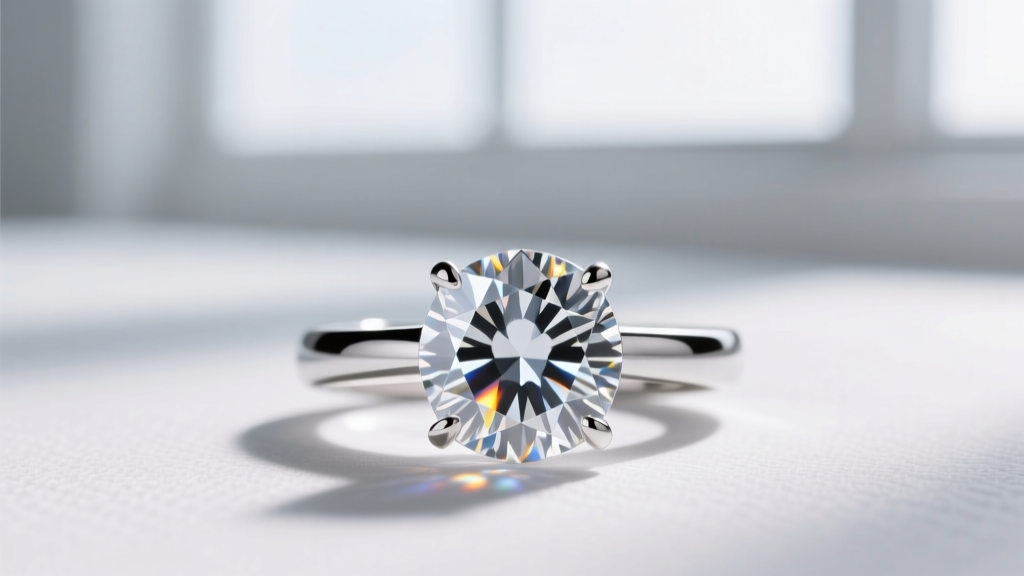
Whether you have inherited a pair of vintage studs, received a gifted pair of hoops, or are simply auditing your current jewelry box, verifying the authenticity of your gemstones is a crucial step in understanding your collection's true value. In today's market, the surge of high-quality simulants like cubic zirconia (CZ) and moissanite, alongside the massive growth of lab-grown diamonds, means that visual inspection alone is no longer sufficient.
If you are wondering how to tell if diamond earrings are real, you need a systematic approach. While no at-home test can replace a professional gemological appraisal, a combination of thermal, optical, and physical inspections can help you separate genuine diamonds from common imposters. Below is our comprehensive, step-by-step guide to testing your diamond earrings safely and accurately.
Step 1: The Fog Test (Thermal Conductivity)
Diamonds are exceptional heat conductors. This physical property is the basis for the fog test, which is the safest and easiest first step for testing earrings while they are still in their settings.
How to Perform the Fog Test
- Clean the earring thoroughly with a microfiber cloth to remove any oils or lotions that could trap moisture.
- Hold the earring by the post or the metal setting, avoiding touching the stone itself.
- Breathe on the stone exactly as you would to fog up a mirror.
- Observe how quickly the fog dissipates.
The Verdict: A real diamond will disperse the heat from your breath almost instantly, meaning the fog will clear in one to two seconds. If the stone remains foggy for three seconds or longer, or if condensation droplets form and cling to the surface, you are likely looking at cubic zirconia or glass, both of which are thermal insulators.
Step 2: The Read-Through Test (Refractive Index)
This test relies on a diamond's high refractive index (2.42), which bends light so severely that it prevents you from seeing clearly through the stone. Note: This test only works if you can safely remove the earring back and test the stone face-down, or if the earring features a loose stone.

Executing the Read-Through Test
Place a piece of newspaper or a book with dense, black text on a flat, well-lit table. Take your earring and place the stone face-down (table facet down) directly over the text. Look straight down through the pointed pavilion (the bottom) of the stone.
The Verdict: If you can read the letters, or even see distinct, smudged black shapes through the stone, it is not a real diamond. A genuine diamond will scatter the light so intensely that the text beneath it becomes completely illegible, appearing as a blurred, white or gray void. Cubic zirconia and white sapphire will often allow you to read the text or see distinct dark outlines.
Step 3: Inspect the Metal Setting and Hallmarks
Diamonds are premium gemstones, and jewelers rarely set them in cheap or soft metals. Examining the metal setting of your earrings can provide massive contextual clues about the stones they hold.
| Hallmark Stamp | Metal Type | Authenticity Clue |
|---|---|---|
| 10K, 14K, 18K | Gold | Highly likely to hold real diamonds (14K and 18K are industry standards). |
| PT, Plat, 950 | Platinum | Very high probability of real diamonds; platinum is the premium choice for secure prong settings. |
| 925, SS | Sterling Silver | Red flag. Silver is too soft for expensive diamonds; prongs will bend and lose the stone. Usually indicates CZ or moissanite. |
| CZ | N/A | Definitive proof the stone is Cubic Zirconia, regardless of the metal. |
Use a 10x jeweler's loupe to inspect the inside of the earring post, the friction back, or the basket setting for these microscopic stamps. According to the Gemological Institute of America (GIA), the quality of the metal setting is often a direct reflection of the quality of the center stone.
Step 4: The Loupe Inspection (Inclusions and Facet Edges)
To truly understand how to tell if diamond earrings are real, you must look at the stone's microscopic anatomy. Purchase a standard 10x magnification jeweler's loupe and examine the stone under bright, direct light.
What to Look For:
- Inclusions: Natural diamonds are formed deep within the earth under extreme pressure, resulting in internal flaws called inclusions (e.g., feathers, pinpoints, or clouds). If your stone is 100% flawless under 10x magnification, it is almost certainly a lab-created simulant like CZ. (Note: High-clarity natural or lab-grown diamonds may also appear flawless, so this is not a standalone test).
- Facet Junctions: Look closely at the edges where the flat facets meet. Diamonds are the hardest natural material (10 on the Mohs scale), meaning their facet edges will be razor-sharp and crisp. Cubic zirconia is much softer (8-8.5 on the Mohs scale) and will often show rounded, abraded, or chipped edges where the facets meet, especially on older earrings.
- Scratches: Inspect the surface of the stone. A real diamond cannot be scratched by anything other than another diamond. If you see surface scratches or scuffs, the stone is a simulant.
The Lab-Grown and Moissanite Blind Spots
It is vital to understand the limitations of at-home testing in the modern jewelry landscape. The tests above are excellent for identifying glass, white sapphire, and cubic zirconia. However, they will fail to identify two major categories:
1. Lab-Grown Diamonds
Lab-grown diamonds are chemically, physically, and optically identical to mined diamonds. They will pass the fog test, the read-through test, and the loupe inspection. As noted in GIA's research on laboratory-grown diamonds, distinguishing between earth-mined and lab-grown stones requires advanced spectroscopic equipment found only in professional gemological laboratories. If your earrings pass all at-home tests, they are real diamonds—but they could be lab-grown.
2. Moissanite
Moissanite is a silicon carbide simulant that is nearly as hard as a diamond (9.25 on the Mohs scale) and has an even higher refractive index (2.65). It will pass the read-through test and often passes the fog test. Furthermore, older thermal diamond testers will incorrectly identify moissanite as a diamond because moissanite is also highly thermally conductive.
Step 5: Using an Electronic Multi-Tester
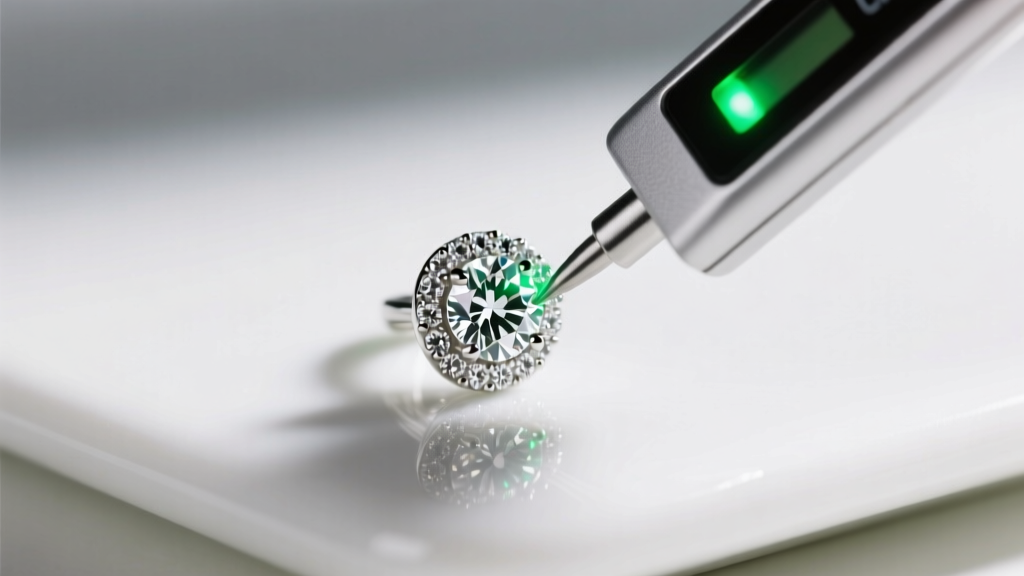
To confidently rule out moissanite, you must test for electrical conductivity. Diamonds are electrical insulators, while moissanite is a mild electrical conductor.
Never use a thermal or electrical diamond tester while the earring is still in your ear. The metal post can conduct heat or electricity, leading to false readings or minor burns. Always remove the earring and test the stone on a stable, non-conductive surface.
Modern electronic multi-testers feature dual modes. When the probe touches a real diamond, the device registers high thermal conductivity and low electrical conductivity, triggering a green light and a specific 'diamond' chime. If it touches moissanite, it registers high thermal and high electrical conductivity, triggering a warning light or a distinct 'moissanite' buzz. Investing in a dual-tester (typically ranging from $40 to $150 for reliable consumer models) is the most definitive at-home method for verifying your earrings.
When to Seek a Professional Gemologist
While this step-by-step guide provides a robust framework for evaluating your jewelry, at-home tests cannot determine a diamond's specific color, clarity, carat weight, or cut grade. If your earrings pass the tests above and you require an insurance appraisal, or if you intend to sell them, you must take them to a certified gemologist.
A professional will use advanced tools like a refractometer, a polariscope, and specialized UV fluorescence imaging to map the exact characteristics of your stones. They will also verify the structural integrity of the earring posts and prongs, ensuring your genuine diamonds are secure for daily wear. By combining these at-home steps with professional verification, you can wear your diamond earrings with absolute confidence.


