Who Painted Girl with a Pearl Earring? A Gemological Deep Dive
Discover who painted Girl with a Pearl Earring and explore the technical gemology, weight constraints, and modern recreations of Vermeer's iconic drop.

The Master Behind the Canvas
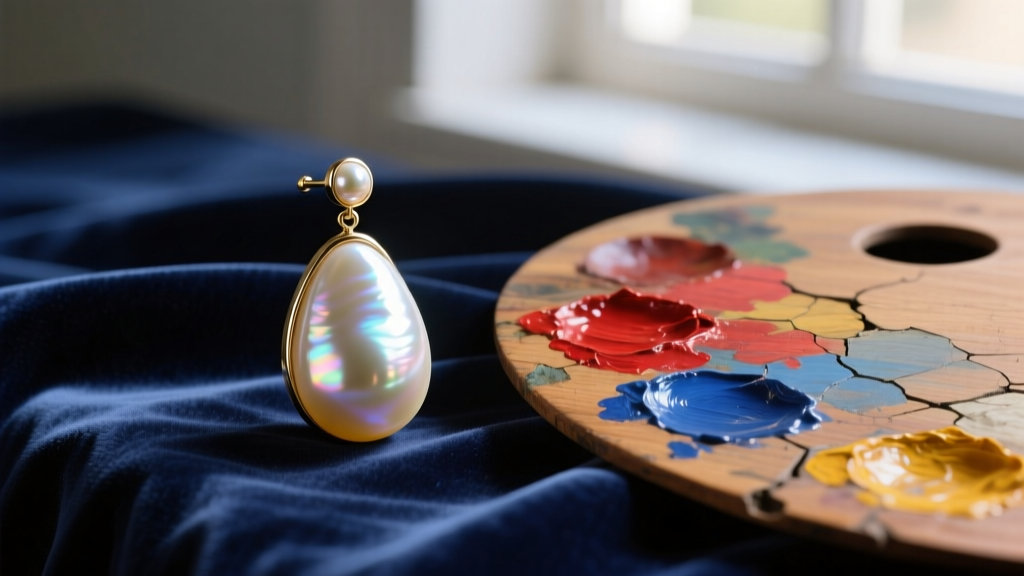
When art enthusiasts and jewelry historians ask who painted girl with a pearl earring, the answer points to the Dutch Golden Age master Johannes Vermeer, who completed the iconic oil painting around 1665. Housed today in the Mauritshuis Museum in The Hague, the artwork is celebrated for its luminous lighting and the enigmatic gaze of its subject. However, for those of us in the jewelry industry, the true focal point of the canvas is not the girl herself, but the massive, light-catching drop earring dangling from her left earlobe.
While the painting is a masterpiece of chiaroscuro, the earring itself presents a fascinating gemological and biomechanical puzzle. Was it a real pearl? Could a 17th-century earlobe support such a stone? And how would a master jeweler recreate this exact piece today without causing catastrophic tissue damage to the wearer? In this expert deep dive, we move past the art history and examine the technical anatomy of the world's most famous painted earring.
The Dutch East India Company and the 17th-Century Pearl Trade
To understand the earring, we must understand the market of 1665. During the Dutch Golden Age, the Dutch East India Company (VOC) dominated global trade routes, bringing exotic goods, including natural saltwater pearls from the Persian Gulf and the Indian Ocean, to Amsterdam. Natural pearls of significant size were extraordinarily rare and heavily regulated, typically reserved for European royalty or ultra-wealthy aristocrats.
A pearl of the scale depicted in Vermeer's painting—estimated by visual proportion to be between 14mm and 18mm in diameter—would have been an astronomical luxury. For context, a perfectly round, natural 15mm saltwater pearl in the 1600s would have commanded a price rivaling a prime Amsterdam canal house. Given that the subject of the painting is likely a tronie (a study of a character or expression, rather than a specific wealthy patron), it is highly improbable that Vermeer's studio possessed a genuine natural pearl of this magnitude as a mere prop.
Gemological Analysis: Real Nacre or Studio Illusion?
Modern gemologists and art conservators have long debated the material of the earring. Based on the specular highlights and the sheer volume of the drop, the consensus among experts aligns with the Gemological Institute of America (GIA)'s historical assessments of period jewelry: the 'pearl' is almost certainly an imitation.
The Tin-Amalgam Hypothesis
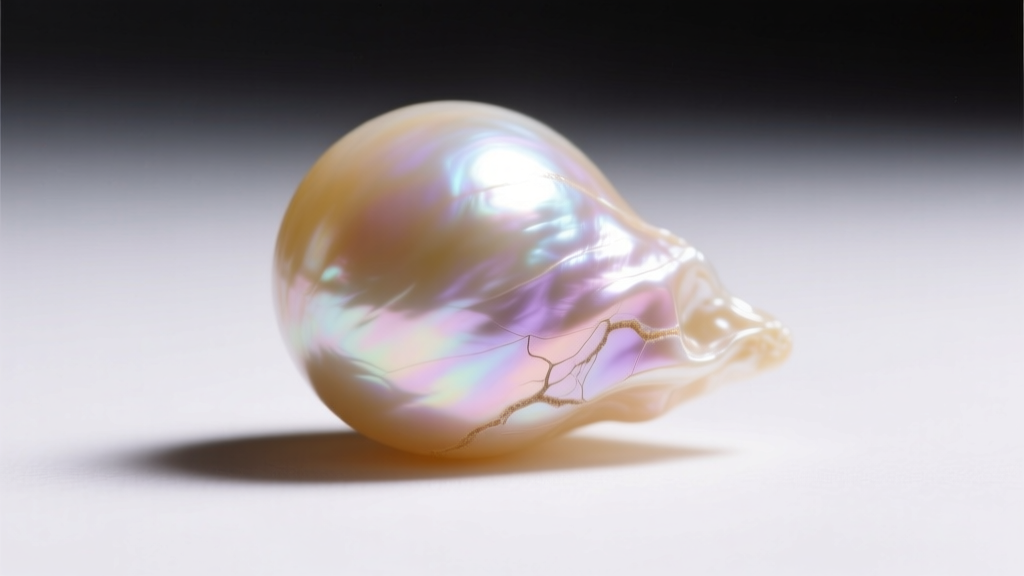
In the 17th century, Venetian and Dutch glassmakers perfected the art of creating imitation pearls. These were typically blown glass beads coated on the inside with a mixture of ground fish scales (essence d'orient) or a tin-amalgam lacquer to simulate the iridescent luster of nacre. Vermeer's masterful use of lead-tin yellow and pure lead white highlights perfectly captures the sharp, glassy reflection of a blown-glass drop rather than the soft, deep, overlapping luminescence of genuine aragonite nacre layers.
- Refractive Index (RI): Genuine nacre has an RI of 1.52–1.66. 17th-century lead glass possesses an RI of 1.60–1.70, yielding the sharper, more artificial specular highlights Vermeer painted.
- Surface Perfection: Natural pearls of 18mm almost universally exhibit baroque shaping, surface pitting, or growth rings. The painted drop is suspiciously spherical and flawless, a hallmark of molded or blown glass.
The Biomechanics of the Drop: Lobe Stress and Gauge Limits
Let us suspend disbelief and assume, for the sake of technical analysis, that the subject was wearing a genuine 18mm solid saltwater pearl. What would this mean for the structural integrity of her earlobe?
The density of solid nacre (aragonite and conchiolin) is approximately 2.7 g/cm³. An 18mm diameter sphere has a volume of roughly 3.05 cm³. Therefore, the bead alone would weigh approximately 8.2 grams. When you add an 18-karat gold drop wire and a decorative cap, the total static weight of the earring easily exceeds 10 grams.
| Bead Diameter | Material Composition | Estimated Weight | Lobe Impact & Risk Profile |
|---|---|---|---|
| 15mm | Hollow Glass (Imitation) | ~2.5g | Low risk; easily supported by standard 22G wire. |
| 15mm | Solid Freshwater Nacre | ~5.1g | Moderate risk; requires 20G wire and a jumbo back. |
| 18mm | Solid Saltwater Nacre | ~8.5g | High risk; dynamic load will cause lobe migration. |
| 18mm | 17th-Century Tin-Amalgam | ~4.0g | Moderate risk; heavy but manageable with proper findings. |
Dynamic Load and Tissue Migration
The human earlobe is composed of adipose tissue and collagen, lacking cartilage. A standard lobe piercing is performed at 20-gauge (0.81mm) or 18-gauge (1.02mm). When a 10-gram earring is subjected to dynamic load—the subtle swinging caused by walking, turning the head, or even speaking—the sheer force on the piercing fistula is magnified. Over time, this pendulum effect causes tissue necrosis and migration, eventually leading to a split lobe. If Vermeer's subject wore a solid stone of that size daily, her piercing would have required surgical repair within a matter of months.
Recreating the Vermeer Drop: A 2026 Jeweler’s Specification
Today, clients frequently request recreations of the 'Girl with a Pearl Earring' drop for historical reenactments, bridal events, or high-fashion editorials. As modern jewelers, we must balance the visual weight of the 17th-century aesthetic with the biomechanical realities of human anatomy.
Material Selection: South Sea vs. High-Density Glass
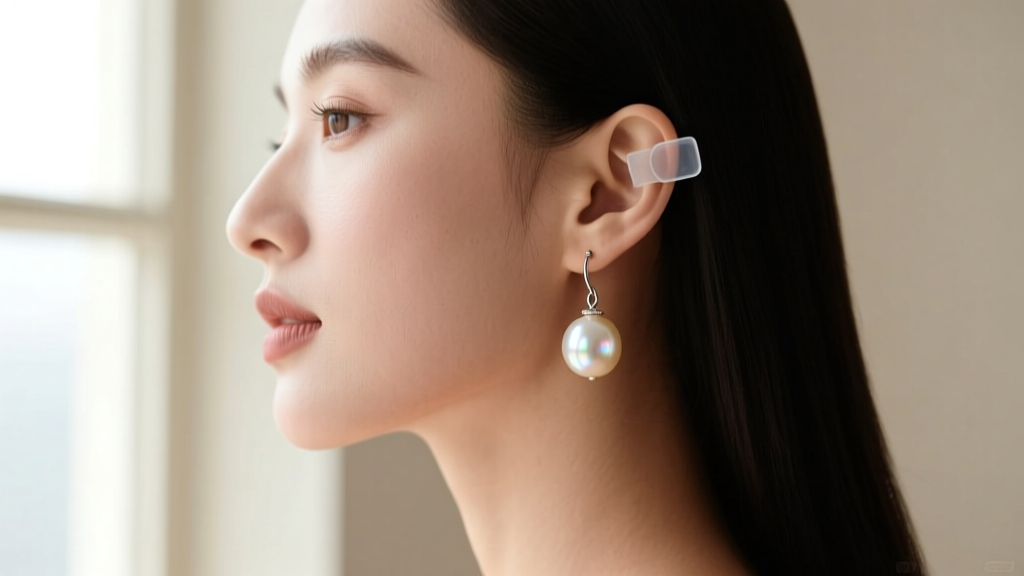
For clients demanding genuine nacre, the only viable option for an 18mm round stone is the White or Silver-Lip South Sea pearl (Pinctada maxima). However, a high-quality, clean 18mm South Sea pearl commands a retail price between $8,000 and $15,000 in 2026. For theatrical or everyday wear, we recommend high-density barium glass or solid resin cores coated in modern synthetic pearl essence. These materials mimic the exact visual weight and luster of Vermeer's subject while keeping the total earring weight under 4 grams.
Structural Findings and Support Systems
To safely suspend a heavy drop earring, standard friction posts and butterfly backs are entirely insufficient. A professional recreation requires the following technical specifications:
- Wire Gauge: Upgrade the drop wire to a minimum of 18-gauge (1.02mm) or 16-gauge (1.29mm) hardened 18k yellow gold to prevent the wire from bending and the pearl from tilting forward.
- Friction Distribution: Utilize a locking leverback finding or a La Pousette locking mechanism, which features a wider surface area to distribute the weight across the back of the earlobe rather than concentrating it at the fistula.
- Dermal Support: For stones exceeding 8 grams, we mandate the use of clear silicone earlobe support patches (such as BlingDots). These adhesive discs sit behind the ear, featuring a reinforced center that absorbs the shear stress of the earring, completely bypassing the fragile piercing channel.
Conclusion: The Enduring Legacy of a Painted Prop
So, who painted girl with a pearl earring? Johannes Vermeer did. But the true genius of the artwork lies not just in the brushstrokes, but in the enduring illusion of the jewelry itself. Vermeer captured the exact optical properties of a massive, light-reflecting drop, creating a piece of 'jewelry' so iconic that it continues to challenge and inspire gemologists and master jewelers centuries later. By understanding the material science, historical trade routes, and biomechanical limits of the human ear, we gain a profound new appreciation for both the art of painting and the engineering of fine jewelry.


