Expert Guide to Versace Earrings Women's: Metals and Authenticity
Explore the technical details of Versace earrings women's collections. We analyze metal grades, clasp mechanics, motif casting, and authentication markers.

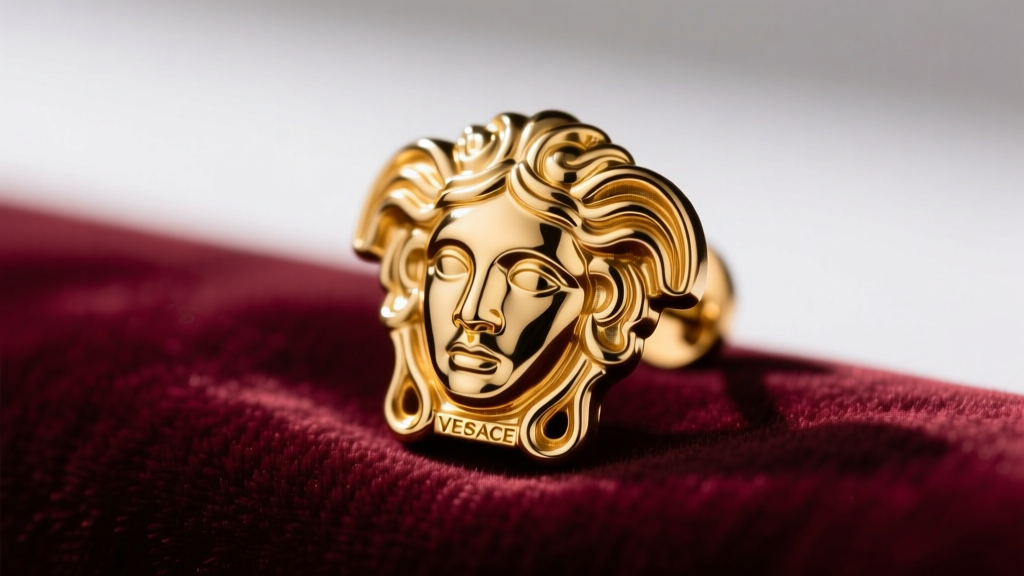
The secondary and primary markets for Versace earrings women's collectors and enthusiasts seek out span two distinct categories: high-fashion costume jewelry and solid fine jewelry. While the iconic Medusa and Greca motifs remain constant across both lines, the metallurgical composition, structural engineering, and long-term wearability differ drastically. As we move through 2026, the archive vintage market for 1990s Gianni-era hardware has surged, making a technical understanding of Versace's manufacturing processes essential for both authentication and ergonomic comfort.
This expert deep dive bypasses generic styling advice to examine the exact metal alloys, clasp load-bearing mechanics, and casting techniques that define authentic Versace earwear.
The Metallurgy: Fashion Hardware vs. Fine Jewelry
To accurately evaluate Versace earrings women's styles, one must first identify the production line. Versace's fashion jewelry relies on a brass or bronze base metal, finished with advanced electroplating or Physical Vapor Deposition (PVD). Modern 2026 PVD coatings utilize titanium nitride or zirconium to create a gold-tone finish that is significantly more resistant to tarnishing and sweat-induced corrosion than the traditional 0.5-micron gold electroplating used in the 1990s.
Conversely, the Versace Fine Jewelry line utilizes solid 18k gold (75% pure gold alloyed with copper, silver, or palladium for structural integrity). According to the Gemological Institute of America (GIA), 18k gold provides the optimal balance between the rich, warm hue required for the brand's signature yellow gold aesthetic and the tensile strength needed to support heavy medallions without bending.
| Collection Line | Base Material | Finish / Plating | Average Weight (Pair) | Price Bracket (USD) |
|---|---|---|---|---|
| Fashion / Runway | Brass / Bronze | PVD Gold-Tone or Ruthenium | 15g - 35g | $450 - $1,200 |
| Fine Jewelry (Medusa) | Solid 18k Gold | High Polish / Satin | 8g - 18g | $3,500 - $12,000+ |
| Archive Vintage (90s) | Brass / Pewter | Electroplated Gold (Worn) | 20g - 45g | $800 - $4,000 |
Clasp Mechanics and Load-Bearing Engineering
The most common failure point in heavy statement earrings is the clasp mechanism. Standard butterfly friction backs are entirely inadequate for the oversized Medusa medallions or Barocco drop styles, which can easily exceed 15 grams per ear. To counteract this, Versace engineers specific load-bearing hardware.
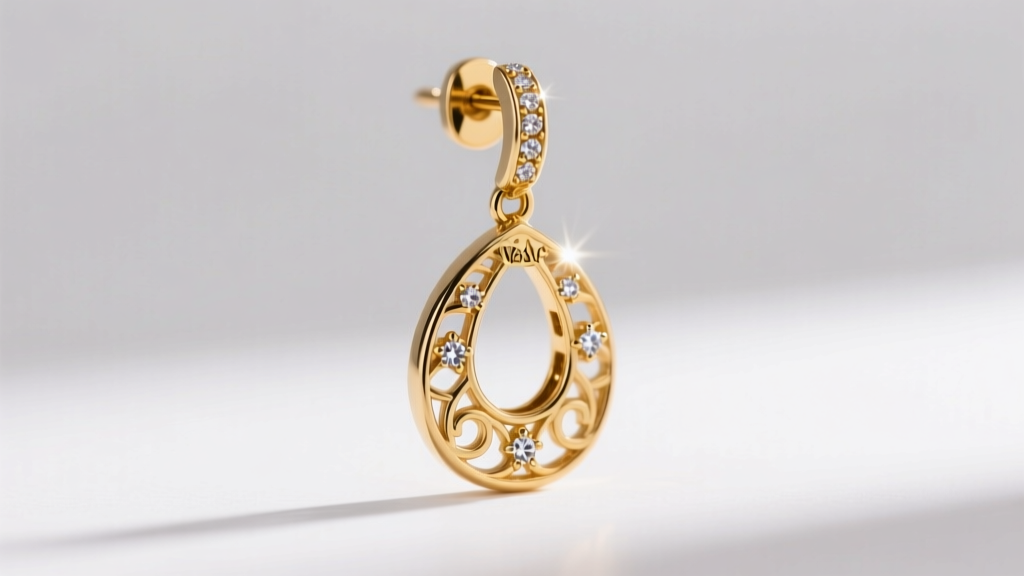
The Omega Clip and Hinged Saddleback
For heavy drop earrings, Versace utilizes the omega clip—a hinged, spring-loaded wire that snaps into a grooved saddle. This mechanism distributes the weight of the earring across the lower lobe and the cartilage ridge, rather than relying solely on the piercing hole. The post gauge for these heavy-duty mechanisms is typically 16-gauge (1.2mm) or even 14-gauge (1.6mm) in vintage archive pieces, providing the necessary shear strength to prevent the metal from warping under the pendulum effect of a swinging drop earring.
Reinforced Friction Clutches
For medium-weight studs (8g to 12g), Versace employs custom-machined butterfly clutches with extended barrels and dual-loop tension springs. These provide a wider surface area against the back of the earlobe, reducing localized pressure points that cause tissue necrosis or tearing over extended wear.
Decoding the Motifs: Casting and Enamel Techniques
The tactile quality of authentic Versace hardware is a direct result of specialized manufacturing techniques that are difficult and cost-prohibitive for counterfeiters to replicate accurately.
Lost-Wax Casting for 3D Medallions
The iconic, fully three-dimensional Medusa heads found on the Fine Jewelry line are created using traditional lost-wax casting. A master wax model is encased in a plaster investment, burned out in a kiln, and replaced with molten 18k gold. This results in crisp, undercut facial features and deep, shadowed recesses. Stamped or die-struck counterfeits will lack this deep relief, appearing flat with blurred, indistinct facial features.
Champlevé and Guilloché Enameling
On select high-end pieces, the Greca key pattern is rendered using champlevé enameling. Artisans carve troughs into the solid gold base, fill them with vitreous enamel powder, and fire the piece at over 800°C. The result is a glass-like, perfectly flush finish. Cheaper fakes will use painted epoxy resin, which sits proud of the metal surface, lacks optical depth, and will yellow or chip within months of exposure to UV light and cosmetics.
The 2026 Authentication Matrix
With the proliferation of high-quality 'super fakes' in the luxury secondary market, visual inspection of the motif is no longer sufficient. Authentication requires a multi-point technical analysis.
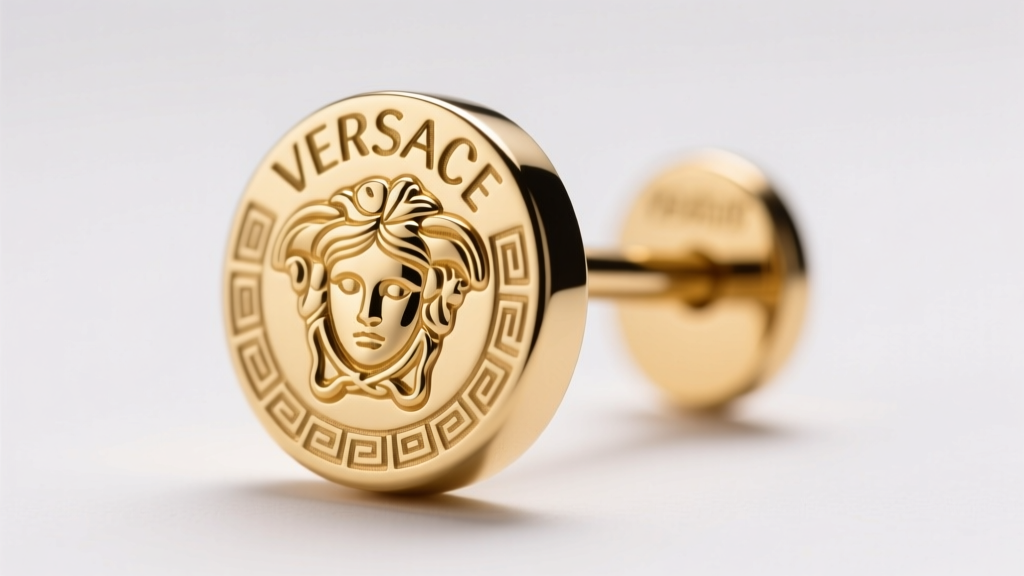
- Hallmark Kerning and Depth: Authentic fine jewelry pieces feature laser-engraved or deeply stamped hallmarks. The 'VERSACE' logotype will have precise kerning. According to the Federal Trade Commission (FTC) Jewelry Guides, metal quality marks (like 750 or 18k) must be accompanied by a registered trademark. Look for the tiny, distinct Medusa head stamp adjacent to the metal purity mark.
- The Magnet Test: While not definitive on its own, a strong neodymium magnet can expose cheap counterfeit bases. Authentic brass, bronze, and gold are non-magnetic. If the earring exhibits magnetic pull, it contains a ferrous steel core and is an immediate fake.
- Screw-Thread Precision: Many modern Versace statement studs utilize a screw-back mechanism for security. Authentic threads are machine-cut with smooth, burr-free ridges. Counterfeits often feature roughly cast threads that bind, cross-thread, or feel gritty when turned.
- Serial Number Verification: Post-2015 fine jewelry pieces include a unique serial number laser-etched on the post or the backplate. This number must match the certificate of authenticity and can be verified through a certified Versace boutique.
Ergonomics and Lobe Health: Managing Statement Weight
Wearing 25-gram Barocco drop earrings requires proactive lobe management. The human earlobe is composed of dense fibrofatty tissue with no cartilage support; sustained loads over 10 grams will cause the piercing fistula to stretch, eventually leading to a 'cheese-cutter' effect where the earring tears through the tissue.
To mitigate this, experts recommend utilizing medical-grade silicone support discs (such as BlingDots) placed behind the earlobe. These discs increase the surface area of the earring back, distributing the kinetic load across a 15mm radius rather than a 2mm piercing hole. Furthermore, applying a thin layer of cyanoacrylate-based 'ear putty' or specialized jewelry adhesive to the post can lock the earring in a forward-facing position, preventing the heavy Medusa medallion from drooping and stretching the lower edge of the fistula.
Conclusion
Navigating the technical landscape of Versace earwear requires looking past the immediate visual impact of the Greca and Medusa motifs. By understanding the specific metallurgical compositions, recognizing the engineering behind load-bearing clasps, and applying rigorous authentication matrices, collectors and wearers can confidently invest in pieces that offer both structural longevity and uncompromising luxury.


