Versace Hoop Earrings: Authenticity & Material Deep Dive
Master the technical details of Versace hoop earrings. Explore Medusa hardware metallurgy, weight tolerances, gauge specs, and authentication markers.

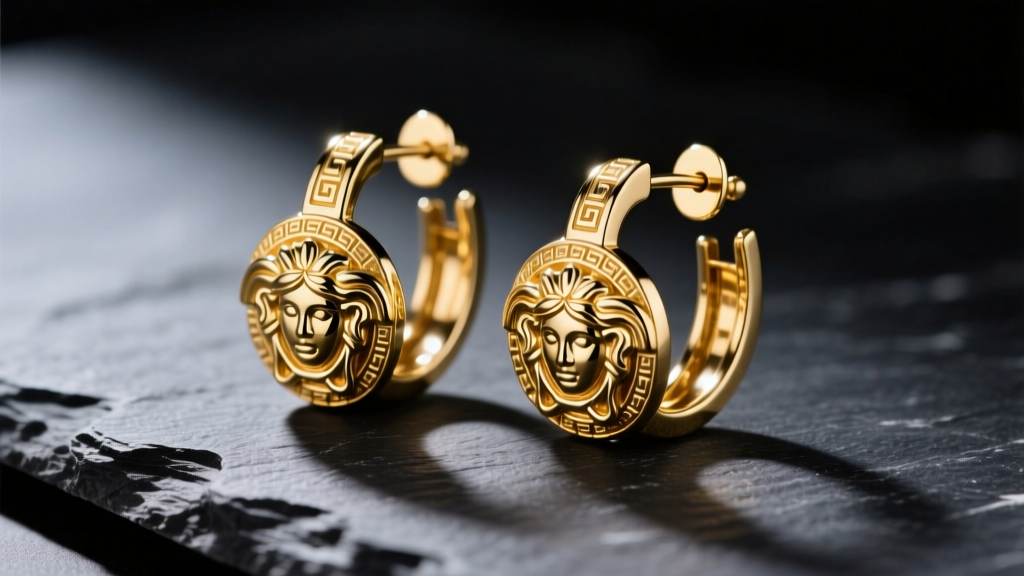
The Metallurgy of the Medusa: Base Alloys and Galvanic Plating
When evaluating luxury fashion jewelry, the distinction between fine jewelry and high-end fashion jewelry lies entirely in the metallurgy and surface engineering. Versace hoop earrings, particularly the iconic Medusa hardware collections, are not cast in solid gold or silver. Instead, they rely on highly specific base alloys and advanced galvanic plating techniques to achieve their signature weight, luster, and durability. As of 2026, understanding these material sciences is the only reliable way to authenticate pieces in a secondary market flooded with high-precision 3D-printed counterfeits.
Base Alloy Composition and Lost-Wax Casting
Authentic Versace hoops are predominantly manufactured using CW617N brass, a lead-free copper-zinc alloy that offers excellent machinability and a high specific gravity (approximately 8.4 to 8.7 g/cm³). This density is crucial; it gives the earrings the substantial, premium 'heft' that consumers associate with luxury. The Medusa medallions and intricate Greek key patterns are typically produced via lost-wax casting (cire perdue). This involves injecting wax into precision-milled aluminum molds, assembling them into 'trees', and investing them in a plaster-like flask. After burning out the wax at roughly 750°C, molten brass is poured into the cavity, capturing microscopic details of the Medusa's hair and facial relief that die-striking simply cannot achieve.
Galvanic Plating and EU REACH Compliance
Once cast, tumbled, and hand-polished, the brass blanks undergo galvanic electroplating. For gold-tone pieces, Versace typically applies a palladium or white bronze underplate. This serves two critical functions: it acts as a diffusion barrier to prevent the copper in the brass from migrating to the surface and causing verdigris (green tarnish), and it ensures compliance with the strict EU REACH Regulation (EC) No 1907/2006 regarding nickel migration. The final layer is an 18k or 24k gold-tone flash, usually ranging between 0.5 and 2.0 microns in thickness, sealed with a clear organic passivation layer to retard oxidation. For silver-tone pieces, a thick layer of palladium or rhodium is applied over the barrier coat, offering a brilliant, tarnish-resistant white-metal finish.
Gauge, Weight, and Lobe Tension Mechanics
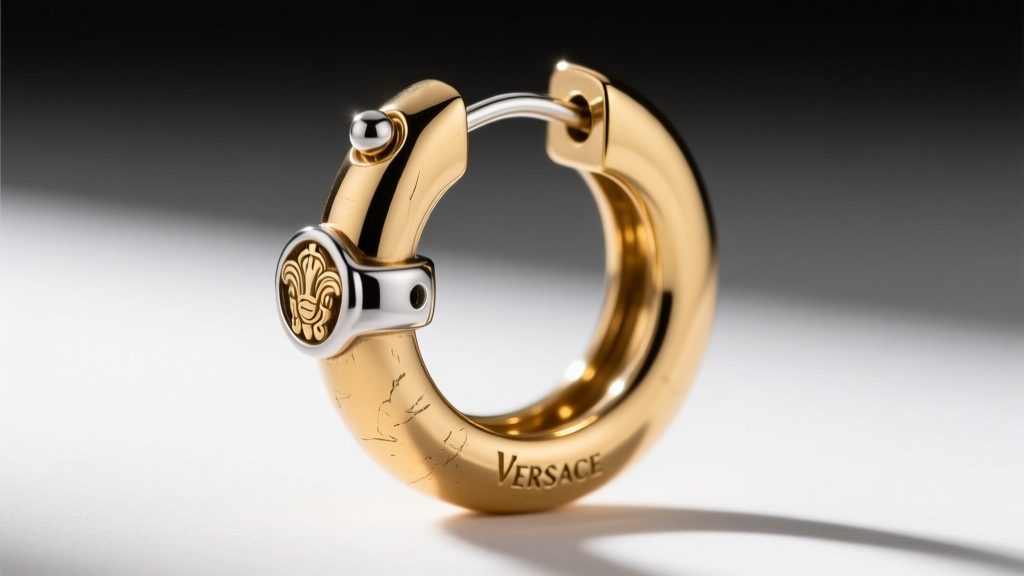
The structural engineering of Versace hoop earrings must account for significant mass. A standard 4.5cm Iconic Medusa hoop weighs approximately 14.2 grams per earring. While this substantial weight contributes to the luxury drape and feel, it introduces distinct biomechanical challenges for the wearer's earlobe.
Post Thickness and Piercing Tolerances
To support this mass without bending, the earring post or the structural wire of the hoop is typically engineered at 1.2mm in diameter, which correlates to a standard 16-gauge piercing. However, the hinge pin connecting the post to the hoop body is often slightly thinner, around 1.0mm (18-gauge), to allow for the mechanical articulation of the joint. Wearers with stretched or highly elastic piercings may experience 'droop' due to the 14+ gram payload. Expert stylists recommend utilizing transparent silicone earlobe support patches when wearing these specific hoops for extended periods to distribute the kinetic load and prevent permanent tissue elongation.
Authentication Matrix: Spotting 2026 Counterfeit Medusa Hardware
The proliferation of AI-assisted CAD modeling has allowed counterfeit syndicates to replicate the visual geometry of the Medusa motif with terrifying accuracy. Visual inspection of the facial relief is no longer sufficient. Authenticators must now rely on material forensics, hallmark typography, and specific gravity testing.
| Diagnostic Feature | Authentic Versace Specification | Common Counterfeit Indicator |
|---|---|---|
| Specific Gravity (Hydrostatic Test) | 8.4 - 8.7 g/cm³ (CW617N Brass) | 6.6 - 6.8 g/cm³ (Zamak/Zinc Alloy) |
| Medusa Relief Casting Seams | Seamless; hand-finished and tumbled | Visible parting lines or 3D-print layer artifacts |
| Hallmark Font Kerning | Deeply stamped, crisp sans-serif, precise kerning | Superficial laser etching, blurred edges, tight kerning |
| Hinge Pin Tolerance | Zero lateral play, smooth 180-degree articulation | Wobbling post, stiff hinge, visible gap at the joint |
According to data from luxury authentication databases like Entrupy, the most common failure point for modern fakes is the hallmark stamp. Authentic Versace pieces feature deeply struck mechanical stamps or high-wattage laser engravings where the 'MADE IN ITALY' and 'CE' marks exhibit perfect baseline alignment. Fakes often use low-resolution rotary engraving tools that leave micro-striations inside the letter cavities, easily visible under a 30x jeweler's loupe.
Clasp Engineering: Hinge and Snap-Barrel Mechanisms
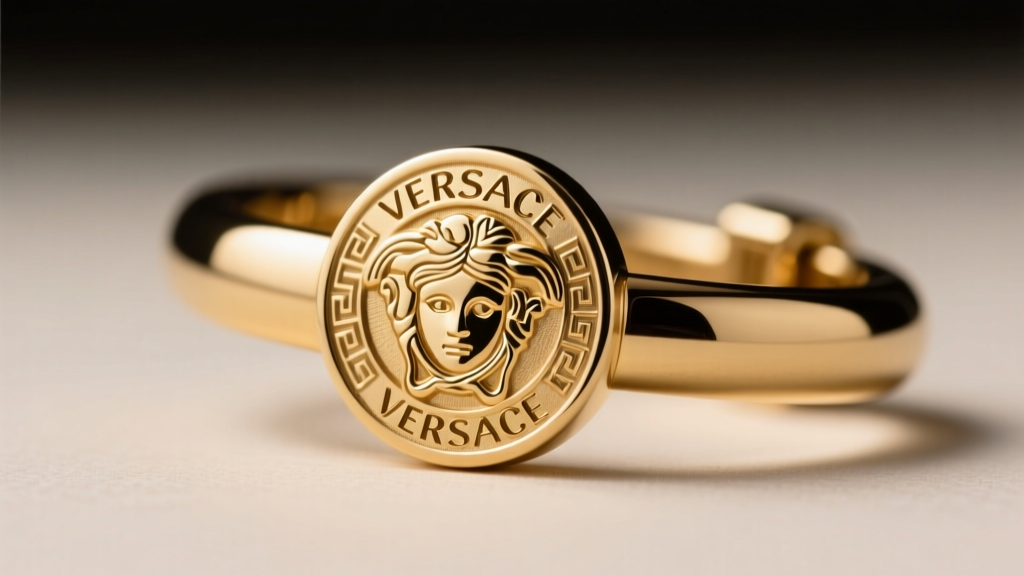
The closure mechanism on a Versace hoop is a marvel of micro-mechanical engineering, designed to secure a heavy, valuable object to a delicate piece of tissue. Most medium-to-large hoops utilize a hinged snap-barrel or omega clutch system.
Internal Spring Mechanics
Inside the receiving barrel of the clasp lies a microscopic beryllium-copper leaf spring. When the post clicks into place, this spring exerts roughly 1.5 Newtons of lateral force against the grooved notch on the post, locking it securely. Over time, the introduction of cosmetic oils, dead skin cells, and environmental dust can gum up this internal spring, leading to a 'soft close' where the earring fails to click. According to the Gemological Institute of America (GIA), attempting to clean these internal mechanisms with metal picks can permanently deform the spring. Instead, a drop of high-purity isopropyl alcohol applied with a micro-brush, followed by compressed air, is the safest method to restore the tension mechanism without stripping the galvanic plating.
Care Protocols for High-Micron Fashion Plating
Maintaining the galvanic finish on Versace hoops requires a strict departure from traditional fine jewelry cleaning methods. Because the gold or rhodium layers are measured in microns rather than millimeters, abrasive cleaning will rapidly expose the brass underplate.
- Avoid Ultrasonic Cleaners: The high-frequency cavitation bubbles generated by ultrasonic baths can literally blast the passivation layer and thin gold flash off the brass substrate, particularly around the intricate crevices of the Medusa's hair.
- Bypass Ammonia and Chlorine: Chemical dips containing ammonia (common in commercial silver cleaners) will react with the copper in the brass if the plating has any micro-fissures, causing rapid, irreversible blackening.
- Microfiber and Mild Surfactants: The only approved cleaning method involves a solution of distilled water and a pH-neutral surfactant (like baby shampoo), applied with a lint-free microfiber cloth. Use a soft-bristled makeup brush to gently agitate dirt from the Medusa relief.
- Storage Environment: Store in a low-humidity environment with anti-tarnish silica packets. The sulfur in the air is the primary enemy of the underlying alloys, and preventing oxidation from the inside-out is key to longevity.
Expert Note: Never use a silver polishing cloth on gold-tone or ruthenium-tone Versace hoops. These cloths are impregnated with micro-abrasives (like jeweler's rouge) designed to remove tarnish by stripping the top layer of metal. On plated fashion jewelry, this will instantly strip the finish down to the base brass.
By understanding the precise metallurgy, structural tolerances, and mechanical engineering behind Versace hoop earrings, collectors and enthusiasts can confidently navigate the luxury market. The Medusa motif is more than just a fashion statement; it is a masterclass in lost-wax casting and galvanic surface engineering, demanding a level of care and authentication rigor that matches its iconic status.


