Authenticating Jade Earrings: Vintage Sourcing & Grading
Discover how to authenticate, grade, and value vintage jade earrings. Expert insights on jadeite vs. nephrite, treatments, and historical eras.

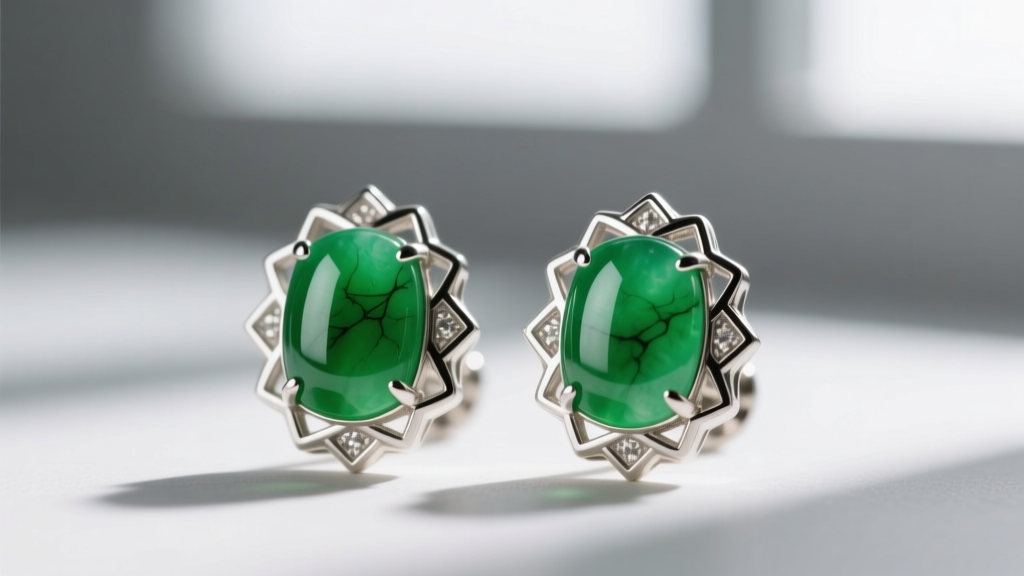
The secondary market for antique and estate jewelry is fraught with misrepresentation, but few categories present as complex a gemological challenge as jade. When sourcing jade earrings vintage collectors and appraisers must navigate a labyrinth of mineralogical distinctions, synthetic treatments, and historical hardware modifications. Unlike diamonds, which are graded on a universally standardized 4Cs scale, jade requires a nuanced understanding of mineralogy, cultural history, and polymer chemistry. This expert guide deconstructs the technical parameters required to authenticate, grade, and accurately value vintage jade earrings in today's market.
The Gemological Divide: Jadeite vs. Nephrite
The term "jade" is a commercial umbrella that covers two distinct metamorphic minerals: jadeite and nephrite. Understanding the mineralogical difference is the first step in evaluating any vintage piece. According to the Mindat Mineralogy Database, jadeite is a sodium- and aluminum-rich pyroxene, whereas nephrite is a calcium- and magnesium-rich amphibole. This chemical divergence results in vastly different physical properties that dictate both the carving techniques used in vintage manufacturing and the stone's inherent value.
| Property | Jadeite (NaAlSi2O6) | Nephrite (Ca2(Mg,Fe)5Si8O22(OH)2) |
|---|---|---|
| Mohs Hardness | 6.5 - 7.0 | 6.0 - 6.5 |
| Specific Gravity | 3.30 - 3.38 | 2.90 - 3.03 |
| Refractive Index | 1.66 (point reading) | 1.60 - 1.63 (point reading) |
| Fracture/Toughness | Granular, brittle | Fibrous, extremely tough |
| Vintage Era Prevalence | Art Deco, Mid-Century High Jewelry | Victorian, Art Nouveau, Carved Hoops |
Because vintage earrings are already mounted, standard refractometer readings are often impossible to obtain without damaging the setting. Gemologists instead rely on hydrostatic weighing to determine specific gravity (SG). If a pair of purported vintage jadeite earrings yields an SG of 2.95, they are definitively nephrite, regardless of the seller's claims. Furthermore, nephrite's fibrous interlocking structure makes it vastly tougher than jadeite, which is why intricate, lace-like Victorian cameo earrings are almost exclusively carved from nephrite, while smooth, highly polished Art Deco cabochons are typically jadeite.
Decoding the ABCs of Jade Treatments
The most critical financial risk when buying vintage jade earrings is purchasing treated stones misrepresented as natural. The Gemological Institute of America (GIA) categorizes jade into three distinct treatment types. While true antique pieces (pre-1950s) predate modern chemical treatments, the vintage market (1950s-1990s) is heavily saturated with later-treated stones sold as "estate" jewelry.
Type A: Untreated (The Collector's Standard)
Type A jadeite is entirely natural, subjected only to traditional plum wax polishing. Under 10x magnification, the surface of Type A vintage jade will show minor, natural pitting and a smooth, waxy luster. It will exhibit inert to weak fluorescence under long-wave UV light.
Type B: Acid-Bleached and Polymer-Impregnated
Introduced in the 1970s, Type B jade is boiled in hydrochloric acid to remove brown or yellow impurities, leaving the stone highly porous. It is then injected with polymer resin to restore structural integrity. 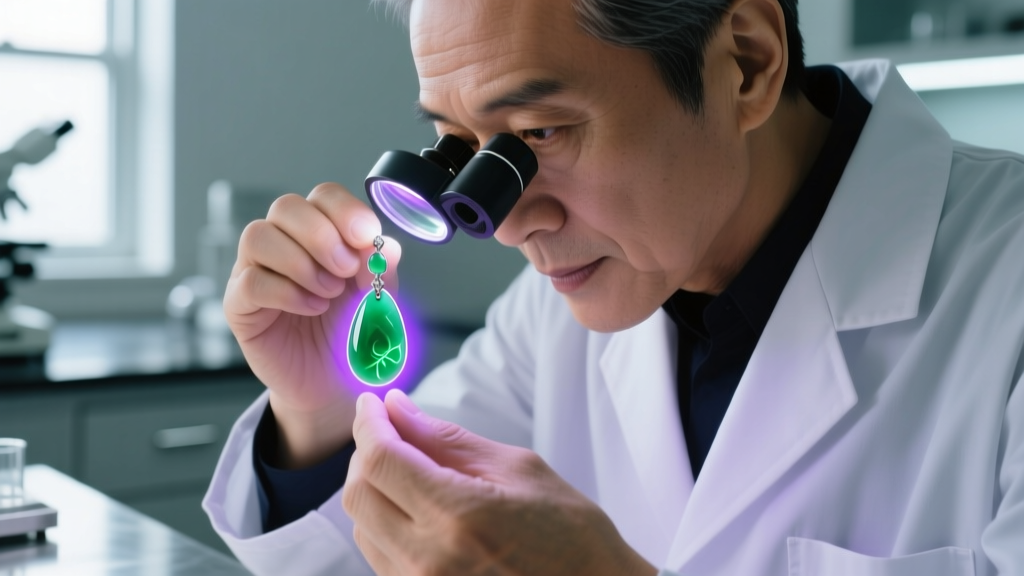 Under a Chelsea filter or strong UV light, the polymer resin in Type B jade will often fluoresce a chalky blue-white. More definitively, under 40x magnification, a gemologist will look for the "spiderweb" effect—a network of micro-fissures on the surface where the acid has eaten away the mineral matrix, leaving the polymer resin sitting slightly below the surface level.
Type C: Dyed
Type C jade is chemically dyed to mimic highly prized "Imperial Green" or vibrant lavender hues. In vintage drop earrings, dye concentration is usually visible under magnification as microscopic green veins pooling along the stone's natural grain boundaries and fractures, rather than a smooth, uniform color distribution.
Evaluating Era-Specific Hardware and Mountings
Authenticating the stone is only half the battle; evaluating the earring hardware provides crucial provenance data and helps identify "franken-jewelry" (modern stones placed in vintage settings, or vintage stones fitted with modern hardware).
- Victorian & Edwardian (1880s-1910s): Jade was often used in mourning jewelry or carved into neo-classical motifs. Look for 15k gold (common in British pieces pre-1932), C-clasp pin stems on convertible brooch-earrings, and early threaded screw-backs.
- Art Deco (1920s-1930s): Characterized by geometric jadeite cabochons set in platinum or white gold, frequently accented with single-cut diamonds and black onyx. Original platinum settings should show a distinct patina and lack modern rhodium plating.
- Mid-Century (1950s-1960s):
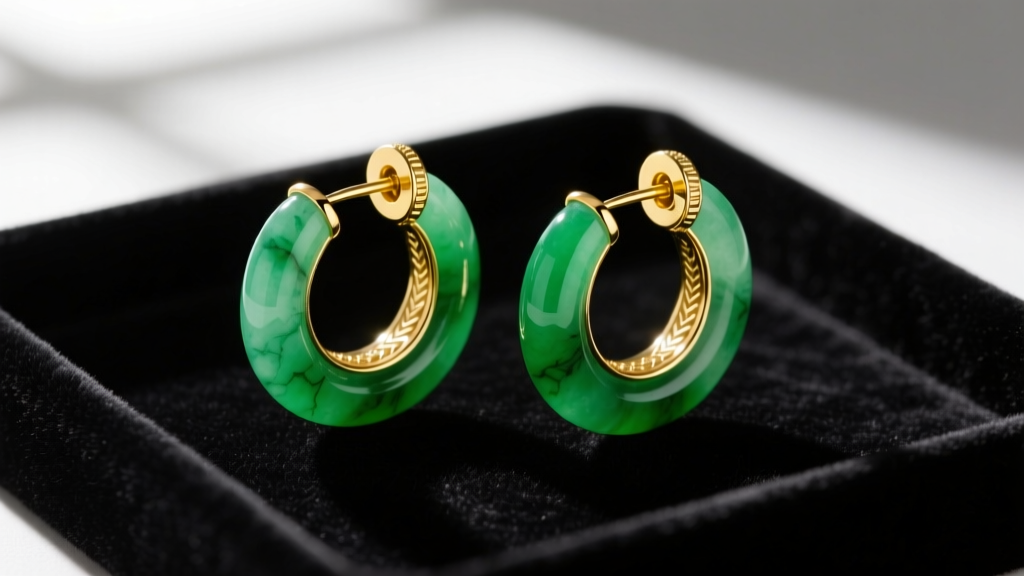 This era popularized the carved jade hoop and the "jade and gold" button earring. Hardware typically features 14k yellow gold with mechanical screw-backs or early friction posts. If a purported 1950s earring features a modern butterfly clutch and a laser-welded post joint, its collector value is significantly diminished due to the loss of original integrity.
Color, Texture, and Transparency: The Valuation Metrics
According to the Sotheby's Jadeite Buying Guide, the valuation of high-end vintage jadeite earrings hinges on the interplay of color, texture, and transparency. Unlike diamonds, where clarity is paramount, jade is valued for its internal glow and color saturation.
- Imperial Green: The most valuable color grade. It requires a vivid, highly saturated emerald-green hue with no gray or brown modifiers, paired with high translucency (often described as "glassy" or "icy"). Vintage Imperial Green cabochon studs can command upwards of $50,000 per pair at auction.
- Apple Green & Spinach Green: Lighter, more yellowish-green (Apple) or deeper, slightly muted green (Spinach). These are highly collectible in Mid-Century estate pieces and typically range from $2,000 to $15,000 depending on translucency.
- Lavender: Caused by trace amounts of manganese. Vintage lavender jade earrings are exceptionally rare in high saturation. Most vintage lavender pieces exhibit a chalky, opaque texture; translucent lavender commands a massive premium.
Texture refers to the grain size of the interlocking crystals. Fine-grained jade feels smooth and takes a mirror-like polish, which is essential for vintage cabochons. Coarse-grained jade appears pitted or "sugary" under magnification and is significantly less valuable.
Final Checklist for the Serious Collector
Before acquiring vintage jade earrings, run through this technical verification protocol to protect your investment:
- Request a Gemological Report: For any piece valued over $3,000, insist on a recent report from GIA, SSEF, or Gübelin confirming the material as natural jadeite or nephrite and explicitly stating "no indications of treatment."
- Inspect the Drill Holes: If the earrings feature carved beads or drops, examine the drill holes under a loupe. Type B and C treated jade will often show dye concentration or resin pooling at the edges of the drill hole, and the hole edges may appear chipped or "melted" due to acid erosion.
- Verify the Hardware Hallmarks: Cross-reference the gold or platinum hallmarks with the stylistic era of the piece. An 18k stamp on a piece with 1920s Art Deco styling should raise a red flag, as 18k gold was rarely used in American or British Art Deco manufacturing (14k and platinum were the standards).
- Perform the Acoustic Test: Gently tap two jadeite bangles or thick cabochons together (if applicable to the earring design). Type A jade produces a clear, resonant, high-pitched chime. Type B polymer-impregnated jade produces a dull, muted thud due to the internal resin disrupting the acoustic wave.
Mastering the authentication of vintage jade earrings requires moving beyond superficial aesthetics and engaging deeply with the material science and historical context of the pieces. By applying rigorous gemological testing and paying meticulous attention to period-correct hardware, collectors can confidently navigate the estate market and acquire pieces that hold both profound historical significance and enduring financial value.


