Wave Earrings: Structural Engineering, Gauges, and Metal Fatigue
Explore the structural engineering of wave earrings. Learn about metal fatigue, optimal gauge sizes, and material grades for lasting durability.

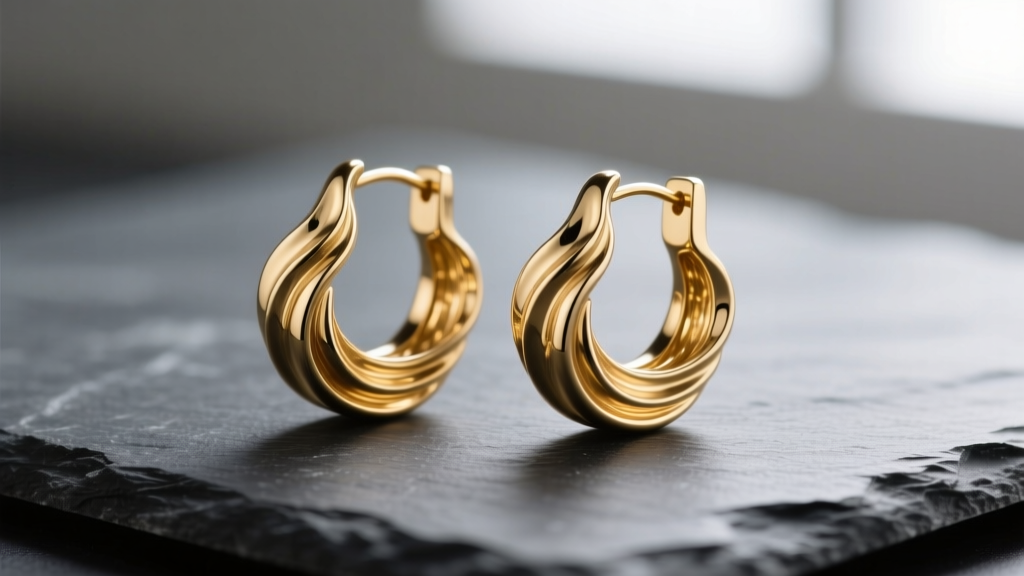
Wave earrings are deceptively complex pieces of jewelry. While their fluid, undulating geometry offers a striking aesthetic that mimics the natural motion of water, the continuous S-curves and sine-wave patterns introduce significant structural challenges. From a metallurgical and engineering standpoint, designing a wave earring requires a deep understanding of stress distribution, work hardening, and ergonomic weight distribution. As of 2026, while CAD/CAM milling and 3D-printed casting waxes have revolutionized how jewelers prototype these complex shapes, the fundamental physics of metal fatigue remain unchanged. This expert deep dive explores the technical specifications, gauge dynamics, and material sciences required to produce and select high-quality wave earrings that withstand daily wear without structural failure.
The Physics of the Undulating Curve: Stress and Metal Fatigue
The defining characteristic of wave earrings is their alternating convex and concave curves. In materials science, every bend in a wire or cast metal form creates an inflection point. When a straight piece of metal is manipulated into a wave pattern, the outer radius of each curve undergoes tensile stress, while the inner radius undergoes compressive stress. If the metal is not properly annealed (heated and cooled to relieve internal stresses) between bending stages, it undergoes work hardening. This increases the metal's brittleness and drastically lowers its fatigue limit.
According to fabrication standards outlined by Rio Grande, repeated micro-movements during daily wear—such as brushing hair or removing clothing—can cause cyclical loading at these inflection points. Over time, this leads to metal fatigue, manifesting as micro-fractures along the crests and troughs of the wave. High-end manufacturers mitigate this by utilizing cast designs with reinforced cross-sections at the curves, or by employing specialized multi-stage annealing processes for hand-forged wire wave earrings.
Optimal Gauge Thickness and Dimensional Tolerances
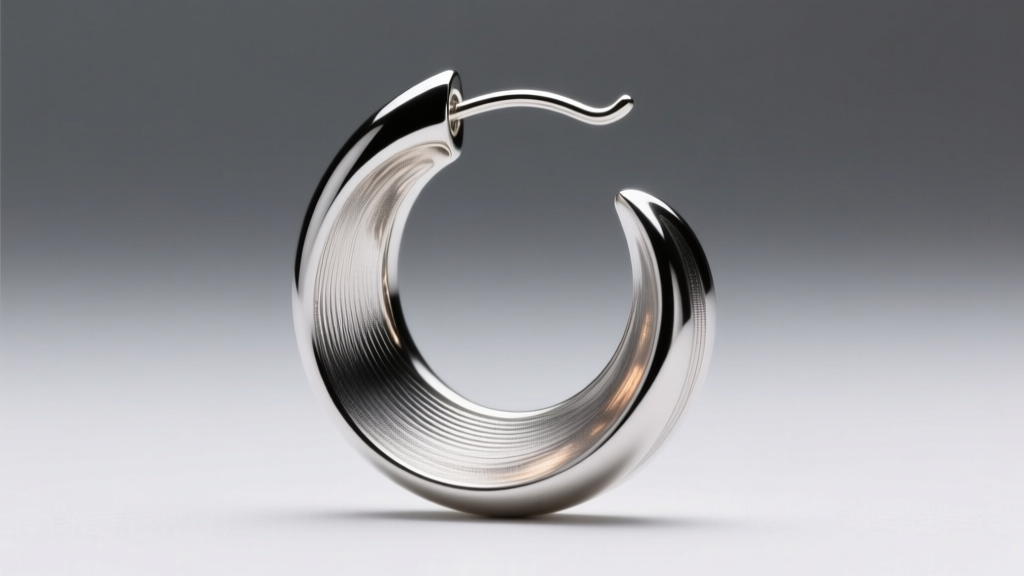
The gauge (thickness) of the metal is the single most critical factor in preventing the permanent deformation of wave earrings. Because the undulating shape acts as a lever, any lateral force applied to the earring is magnified at the post or hook attachment point. Selecting the correct wire gauge or cast thickness is essential for maintaining the structural integrity of the design.
| Gauge Size | Millimeter (mm) | Best Application for Wave Earrings | Structural Risk Profile |
|---|---|---|---|
| 20G | 0.81mm | Small, tight ear cuffs or micro-wave studs under 15mm. | High risk of bending and losing wave geometry under minor pressure. |
| 18G | 1.02mm | Standard lightweight drop waves (15mm - 25mm). | Moderate risk. Requires careful handling; prone to warping if snagged. |
| 16G | 1.29mm | Statement wave drops (25mm - 40mm) and cartilage hoops. | Low risk. Optimal balance of structural rigidity and wearable weight. |
| 14G | 1.63mm | Heavy, oversized architectural wave pieces and thick huggies. | Very low risk of deformation, but requires robust lobe support. |
For drop-style wave earrings exceeding 30mm in length, a minimum of 16G is strongly recommended. Thinner gauges will inevitably suffer from "springback" or permanent warping, ruining the precise symmetry of the wave pattern.
Material Grades: Which Alloys Survive the Bends?
Not all precious metals respond equally to the stresses of a wave geometry. The Vickers hardness (HV) and tensile strength of the chosen alloy dictate how well the earring will hold its shape over years of wear.
- 14k Gold (approx. 130-150 HV): The industry standard for wave earrings. The higher copper and zinc alloy content in 14k gold provides excellent tensile strength, allowing it to resist deformation at the curves better than higher-karat golds.
- 18k Gold (approx. 110-125 HV): Softer and more malleable. While it offers a richer color, 18k gold wave earrings are highly susceptible to bending if dropped or crushed. They require a heavier gauge (14G or 16G) to compensate for the softer alloy.
- Platinum (approx. 110-130 HV): Despite a similar hardness rating to 18k gold, platinum has a much higher density and tensile strength. It is highly resistant to metal fatigue and will not lose mass when polished, making it the premier choice for intricate, thin-gauge wave designs.
- Titanium Grade 5 (Ti-6Al-4V): With a Vickers hardness of over 330 HV, Grade 5 titanium is virtually impervious to bending. However, its extreme hardness makes it difficult to machine into complex wave shapes, often requiring advanced 5-axis CNC milling.
For authoritative data on precious metal properties and durability standards, the Gemological Institute of America (GIA) provides extensive metallurgical guidelines that inform modern jewelry fabrication.
Ergonomic Fit: Lobe vs. Cartilage Placement
The center of mass in a wave earring is fundamentally different from that of a straight bar drop or a simple hoop. Because the metal zig-zags laterally, the weight is distributed unevenly along the Y-axis. This creates a pendulum effect that can cause the earring to swing and rotate, leading to torque on the ear piercing fistula.
Lobe Placement Dynamics
For elongated wave drop earrings, the lateral sway can cause standard friction backs to loosen over time. To counteract this torque, experts recommend utilizing La Pousette clutch backs (which lock via a mechanical spring mechanism) or threaded screw-back posts. This ensures the post remains perfectly perpendicular to the earlobe, preventing the wave design from constantly flipping backward.
Cartilage and Helix Considerations
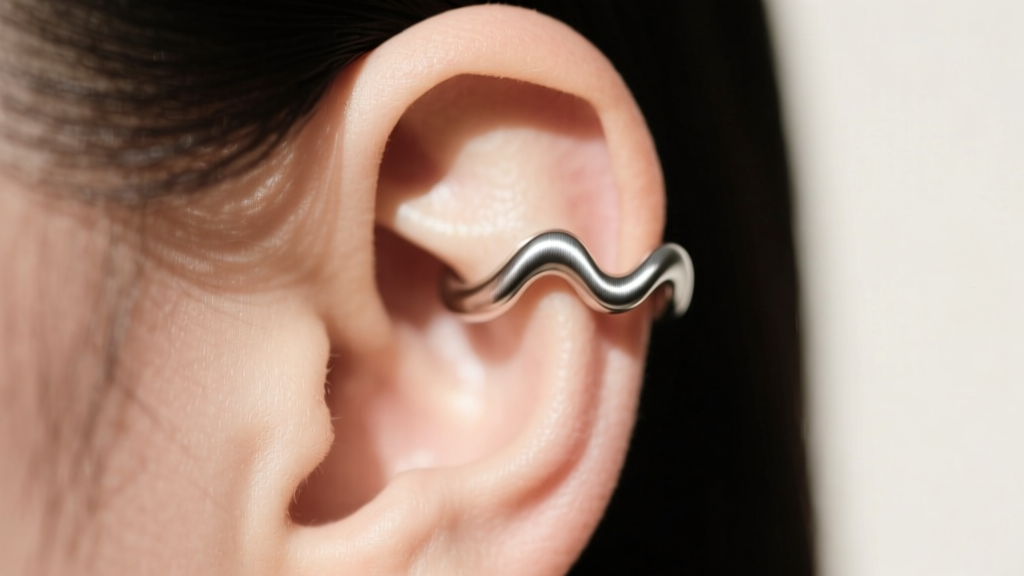
When adapting the wave motif for cartilage piercings (such as a wave-shaped barbell or ear cuff), the angle of the piercing tract is critical. Cartilage is rigid, meaning a wave barbell must be custom-bent or precisely cast to match the exact curvature of the wearer's helix. Forcing a standardized wave barbell into a curved piercing tract will cause immense pressure necrosis and localized swelling. Always opt for 16G or 14G internally threaded titanium for cartilage wave jewelry to ensure biocompatibility and structural rigidity.
Troubleshooting Common Structural Failures
Even well-engineered wave earrings can suffer from specific failure modes if improperly maintained. Understanding these issues allows collectors and jewelers to preemptively address them.
Expert Insight: Never use ultrasonic cleaners on vintage or heavily work-hardened wave earrings. The high-frequency cavitation can propagate existing micro-fissures at the inflection points, leading to sudden, catastrophic snapping of the metal.
Another common issue is the degradation of the polish inside the concave curves. Standard polishing wheels cannot reach the tight inner radii of a wave pattern. Over time, these areas accumulate oxidized skin oils and environmental tarnish. To maintain the optical brilliance of the curves, use specialized tapered felt bobs or string polishing techniques with a mild jeweler's rouge. For matte or brushed wave finishes, a simple fiberglass scratch brush will restore the directional grain without rounding off the sharp crests of the waves.
Final Technical Verdict
Wave earrings represent a perfect intersection of fluid art and rigid physics. When evaluating a piece, look beyond the surface finish and assess the gauge thickness relative to the drop length, the specific alloy used, and the security of the backing mechanism. By prioritizing structural engineering over sheer delicacy, you ensure that the undulating beauty of the metal remains intact for decades of continuous wear.


