Which Side Is Gay Earring? The 2026 Truth About Piercing Codes
Wondering which side is gay earring? Discover the history of the right-ear piercing code and how 2026 gender-fluid jewelry trends erased the rules.

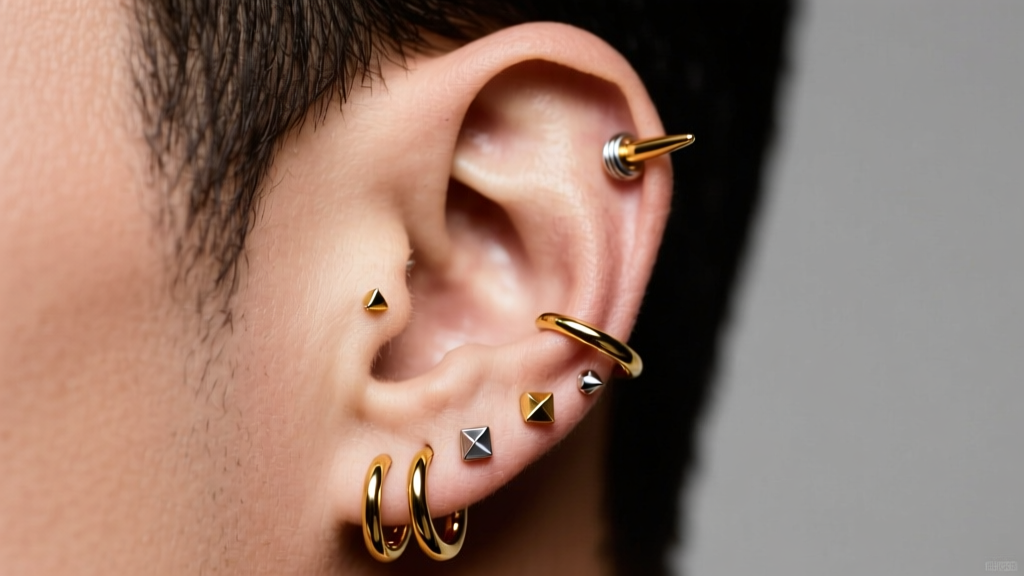
If you have recently found yourself typing which side is gay earring into a search engine, you are participating in a digital time capsule. The idea that a single ear piercing on a specific side acts as a secret semaphore for sexual orientation is one of the most enduring sartorial myths of the late 20th century. However, as we navigate the fashion and cultural landscape of 2026, the concept of a "gay earring" is not just outdated—it is entirely obsolete.
Today, men, masculine-presenting individuals, and gender-nonconforming folks are embracing bilateral symmetry, curated ear parties, and high-end body jewelry without a second thought about historical coding. In this deep-dive style and trend analysis, we will unpack the historical origins of the "right ear" myth, examine the cultural shifts that killed it, and provide a comprehensive 2026 styling and technical guide for modern masculine and gender-neutral ear curation.
The Historical Origin of the "Right Ear" Code
To understand the myth, we have to look back to the 1970s and 1980s. During an era when queer visibility was dangerously low and marginalized communities faced severe legal and social persecution, subtle sartorial codes were a matter of safety and community recognition. Just as the "hanky code" utilized colored bandanas in back pockets to signal specific preferences, ear piercings adopted a similar, albeit less formalized, binary.
In North American pop culture, a schoolyard rhyme emerged: "Left is right, and right is wrong." (The word "wrong" being a derogatory playground stand-in for homosexual). Consequently, a single piercing on the right earlobe became a covert signal among gay men. Conversely, heterosexual men who began adopting the single-earring trend in the 1980s—popularized by rock stars and athletes—strictly adhered to the left ear to avoid misinterpretation. According to cultural archives documented by institutions like the Victoria and Albert Museum, these micro-signals were vital for queer individuals to identify one another in hostile environments before the advent of digital networking.
The Death of the Code: Visibility and the 2010s Shift
The strict binary of the "gay earring" began to fracture in the late 1990s and 2000s. The rise of emo, scene, and pop-punk subcultures introduced bilateral facial and ear piercings to mainstream heterosexual youth. By the 2010s, global pop icons and actors began openly dismantling gendered fashion norms.
According to media monitoring by GLAAD, the surge in positive queer representation in mainstream media throughout the 2010s and early 2020s eliminated the need for covert signaling. When artists like Harry Styles, Lil Nas X, and Bad Bunny began sporting diamond studs, pearl drops, and heavy silver hoops in both ears, the cultural association between a specific earlobe and sexual orientation evaporated. In 2026, assuming someone's sexual orientation based on their ear jewelry is widely considered a faux pas, akin to judging someone's profession by their wristwatch.
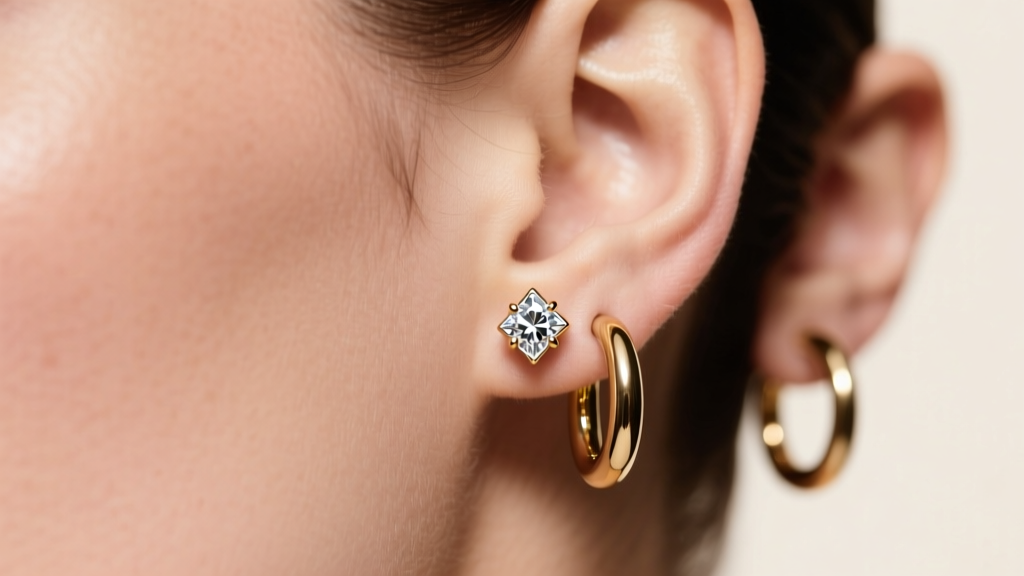
2026 Trend Analysis: The Modern Masculine & Gender-Neutral Ear
So, if the "which side" rule is dead, what are the actual trends dominating masculine and gender-neutral ear styling in 2026? The focus has shifted from placement as a code to curation as an art form.
1. The Intentional Asymmetry (The Ear Party)
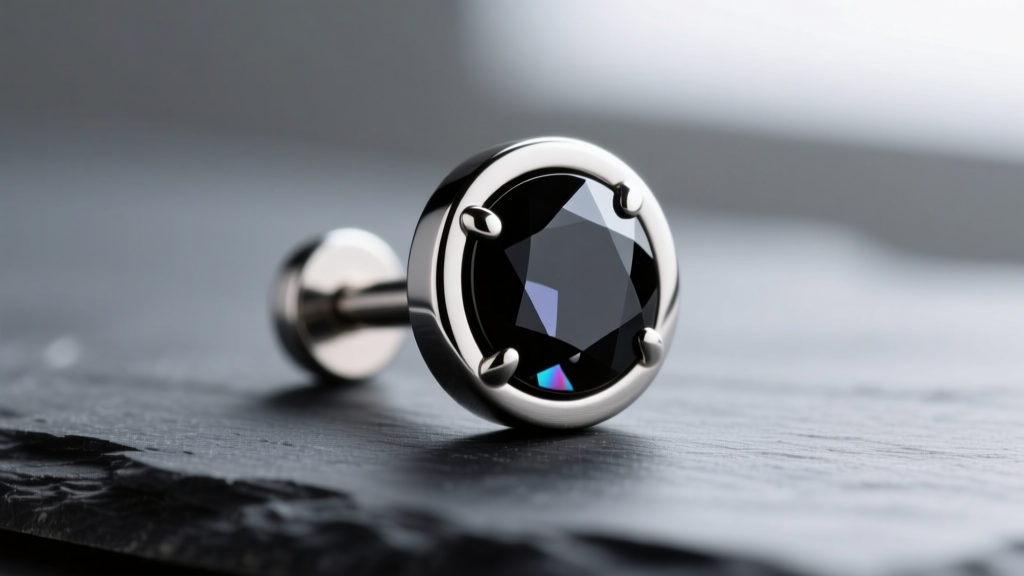
The "ear party" remains the dominant trend, but the execution has become highly technical. Rather than random assortments, 2026 styling relies on intentional asymmetry. A common setup involves a heavier, statement piece in the lower lobe (such as a 14k gold weighted huggie or a 5mm bezel-set onyx stud), graduating upward into delicate 18-gauge titanium threadless ends in the helix and forward helix. The asymmetry is now about balancing visual weight and anatomy, not signaling identity.
2. Bilateral Symmetry & Heavy Metals
For those who prefer a grounded, uniform aesthetic, bilateral symmetry is massive. Matching 10mm to 12mm seamless clicker rings in both lobes, or matching industrial barbells across both ears, project a bold, architectural aesthetic. Yellow gold has seen a massive resurgence, with 14k and 18k solid gold replacing the sterile silver tones of the early 2020s.
3. The Pearl Renaissance
Pearls are no longer relegated to feminine styling. Single, high-quality Akoya or freshwater pearl studs (typically 6mm to 8mm) worn in both lobes or as a singular accent in a cartilage piercing have become a staple in modern menswear and gender-fluid fashion, offering a soft contrast to structured tailoring.
Technical Specs: Gauges, Materials, and Healing
A major hallmark of the 2026 jewelry landscape is the demand for technical excellence. Consumers are vastly more educated about metal sensitivities and structural integrity. If you are building a curated ear, you must understand gauge sizing and material grades. Avoid "surgical steel" at all costs, as it contains nickel and causes contact dermatitis in a significant portion of the population.
| Piercing Type | Standard Gauge (2026) | Recommended Material | Avg. Price Range (High-End) |
|---|---|---|---|
| Standard Lobe | 18g or 16g (14g for stretching) | 14k/18k Solid Gold, ASTM F-136 Titanium | $80 - $350 per piece |
| Helix / Flat | 16g (Standard) | Implant-Grade Titanium (Threadless) | $45 - $150 per piece |
| Conch / Daith | 16g or 14g | 14k Gold Clickers with CZ or Opal | $120 - $400 per piece |
| Industrial | 14g (Standard) | ASTM F-136 Titanium (Internal Threading) | $60 - $200 per bar |
Brands like BVLA, Maria Tash, and Anatometal dominate the high-end space, utilizing internal threading and threadless (push-pin) technology to ensure that gemstone ends do not fall out and that the jewelry does not damage the fistula (the piercing hole) during insertion.
Aesthetic Framework: Styling Without the Baggage
Without the archaic "left vs. right" rule to guide you, how do you choose your styling? In 2026, we use a framework based on facial geometry, personal aesthetic, and lifestyle.
- Angular & Square Face Shapes: Soften sharp jawlines with curved silhouettes. Opt for medium-sized huggie hoops (8mm-10mm) or circular barbells in the lobes. Avoid long, sharp geometric drops that exaggerate angles.
- Round Face Shapes: Create the illusion of length and structure. Linear ear threads, vertical barbell stacks in the conch, or elongated geometric drops in the lower lobe draw the eye downward, balancing facial proportions.
- Heart-Shaped Faces: Balance a narrower chin with visual weight at the bottom of the ear. Teardrop shapes or bottom-heavy cluster studs work exceptionally well.
- Lifestyle & Occupational Hazards: If you work in environments where snagging is a risk (healthcare, construction, or frequent gym-goers), stick to threadless flat-back labret studs and seamless continuous rings. Avoid prong-set stones, which can catch on fabrics and gloves.
Conclusion: Wear What You Want, Where You Want
The search for which side is gay earring is a ghost of a bygone era—a reminder of a time when self-expression required a cipher. In 2026, the only rule in ear styling is anatomical safety and personal resonance. Whether you are opting for a single, flawless 14k gold diamond stud in your right ear, a heavy silver hoop in your left, or a fully curated bilateral ear party that would make a Renaissance king jealous, your jewelry is a reflection of your aesthetic, not your orientation. Invest in implant-grade materials, respect your anatomy, and let the outdated codes remain firmly in the history books where they belong.


