The Engineering of Wide Hoop Earrings: Weight, Gauge, and Fit
Discover the structural engineering behind wide hoop earrings. Learn about gauge thickness, weight distribution, clasp mechanics, and metallurgy.

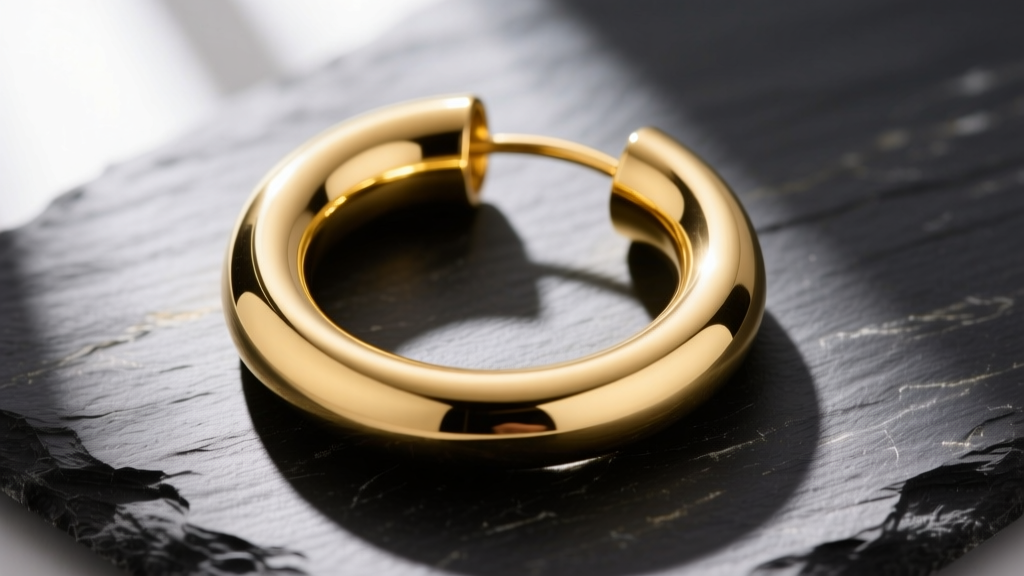
When evaluating statement jewelry, few pieces command attention quite like wide hoop earrings. However, beneath their sleek, continuous curves lies a complex intersection of metallurgy, physics, and anatomical ergonomics. As of 2026, advancements in CAD/CAM milling and 3D metal printing have revolutionized how jewelers approach the structural integrity of large-diameter and chunky-tube hoops. Yet, many consumers and even retail buyers overlook the critical engineering metrics—such as Vickers hardness, gauge-to-weight ratios, and clasp tolerances—that dictate whether a pair of wide hoops will sit flawlessly on the ear or warp, dent, and stretch the piercing over time.
This expert deep dive deconstructs the technical specifications of wide hoop earrings, providing a definitive framework for evaluating material grades, construction methods, and long-term wearability.
The Physics of Wide Hoops: Diameter vs. Tube Width
To accurately assess wide hoop earrings, one must first distinguish between diameter (the total width of the circle) and tube width (the thickness of the metal wire or tubing). A hoop can have a massive 80mm diameter but a delicate 1.5mm wire, or a modest 30mm diameter with a chunky 8mm tube width. The structural challenges differ vastly between the two.
Large-diameter hoops act as levers. When the bottom of a 60mm hoop catches on a sweater, the fulcrum is the earlobe piercing. The longer the lever (diameter), the higher the torque applied to the fistula (the piercing channel). Conversely, wide-tube hoops (often called "chunky hoops") introduce a massive weight burden directly on the lobe, requiring advanced weight-mitigation engineering.
Gauge, Millimeter Conversions, and Structural Use Cases
The jewelry industry relies on the American Wire Gauge (AWG) system, but for wide hoops, millimeter (mm) measurements are far more precise. Below is a technical breakdown of how tube width impacts structural integrity and wearability.
| Tube Width / Gauge | Construction Type | Est. Weight (50mm Dia) | Structural Integrity & Best Use |
|---|---|---|---|
| 1.2mm (16 Gauge) | Solid Drawn Wire | 4.5g | High flexibility; prone to warping if pulled. Best for cartilage/helios. |
| 3.0mm (8 Gauge equiv.) | Solid or Hollow Tube | 9.0g - 14.0g | Moderate rigidity; requires reinforced hinge clasps. Standard lobe wear. |
| 5.0mm+ (Chunky) | Hollow Electroformed | 11.0g - 16.0g | High rigidity but susceptible to impact denting. Statement lobe wear. |
| 8.0mm+ (Ultra-Wide) | CNC Milled Hollow | 18.0g+ | Extreme weight; requires specialized omega-backs or saddle clasps. |
Metallurgy and Material Grades for Chunky Hoops
The choice of metal in wide hoop earrings is not merely aesthetic; it is a structural necessity. The Vickers Hardness (HV) scale measures a metal's resistance to deformation. Pure 24-karat gold sits at a mere 25 HV, making it entirely unsuitable for wide hoops, as the weight of the metal alone would cause the hoop to oval out and the clasp to fail.
By alloying gold with copper, silver, and zinc, jewelers increase the hardness. Standard 18k gold achieves roughly 90 to 110 HV, which is acceptable for medium hoops but risks bending in diameters exceeding 50mm. 14k gold, however, boasts a Vickers hardness of 120 to 150 HV, making it the superior metallurgical choice for large, structural wide hoop earrings that must maintain a perfect circle under stress.
Implant-Grade Titanium: The ASTM F136 Standard
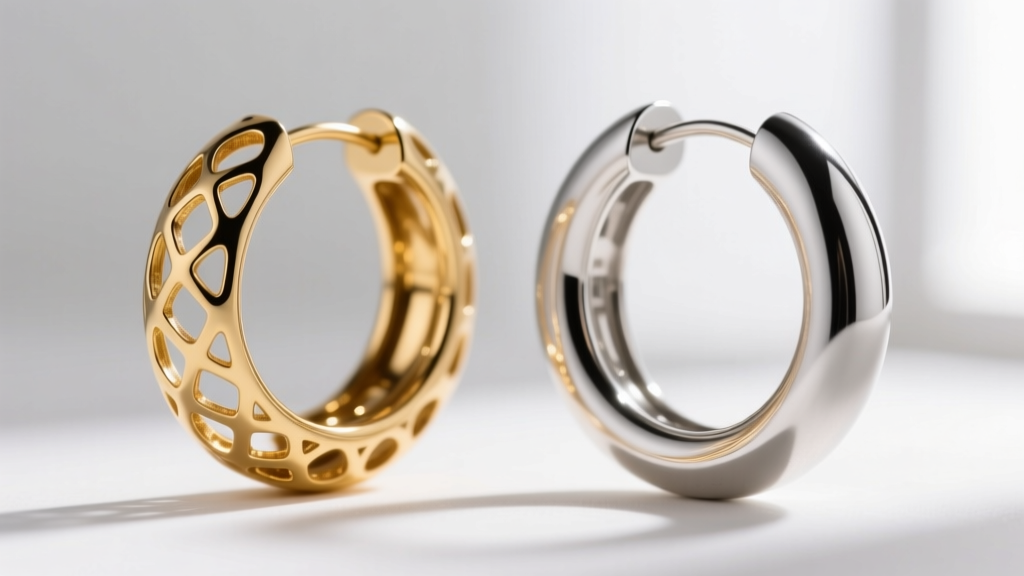
For those requiring hypoallergenic options, surgical steel (316L) is common but contains trace nickel, which can cause contact dermatitis in sensitive individuals over prolonged wear. The gold standard for 2026 is ASTM F136 Titanium (Ti-6Al-4V ELI). According to the ASTM International F136 specification, this extra-low interstitial titanium alloy offers a phenomenal strength-to-weight ratio. A 50mm wide hoop crafted from solid ASTM F136 titanium weighs approximately 30% less than its 316L steel counterpart while offering superior tensile strength, virtually eliminating the risk of the hoop warping out of shape.
Hollow vs. Solid Construction: Manufacturing Realities
When a hoop's tube width exceeds 3mm, solid construction becomes prohibitively heavy and expensive. Jewelers must transition to hollow construction, which introduces its own set of engineering challenges.
- Electroforming: A wax or resin mold is coated in a conductive layer and submerged in an electrolyte bath. Gold is deposited atom by atom. This creates a seamless, lightweight hollow tube, but the walls are often only 0.2mm thick, making them highly vulnerable to crushing if dropped on a hard surface.
- Stamped and Soldered Halves: Two sheets of metal are stamped into half-tubes and soldered together. While more dent-resistant than electroforming, the solder seam can oxidize or split if the hoop is subjected to lateral torque.
- CNC Milled Tubing: The most advanced method involves precision-milling a solid block of metal or drawing seamless tubing. This yields a uniform wall thickness (usually 0.5mm to 0.8mm), providing the optimal balance of low weight and high crush-resistance.
For a comprehensive understanding of metal allergies related to jewelry alloys and soldering materials, the National Center for Biotechnology Information (NCBI) provides extensive clinical data on nickel sensitization and contact dermatitis, emphasizing the importance of seamless, high-purity manufacturing in body jewelry.
Clasp Mechanics: Preventing Warping and Loss
The clasp is the most critical failure point on any wide hoop earring. The tension required to keep a heavy, large-diameter hoop closed while allowing it to swing freely demands microscopic precision. In high-end CAD-milled hinges, the tolerance between the post and the catch is often less than 0.05mm.
Evaluating Clasp Architectures
Not all clasps can handle the kinetic energy of a swinging wide hoop. Here is how the primary mechanisms perform under load:
- Hinge and Snap (V-Latch): The post features a V-shaped notch that snaps into a spring-loaded lever. This is ideal for hoops up to 40mm. On wider hoops, the lateral swing can cause the V-latch to disengage if the internal spring tension weakens over time.
- Saddle Clasp: A curved piece of metal that snaps over a central wire. This provides excellent security for chunky, wide-tube hoops because the surface area of the connection is larger, distributing the kinetic force more evenly.
- Continuous (Endless) Hoop: A thin wire that threads entirely through the piercing and into a hollow tube on the opposite side. While seamless and beautiful, continuous hoops are structurally unsuited for wide diameters, as the thin wire will inevitably bend and weaken the fistula upon insertion.
Ergonomics and Weight Distribution Framework
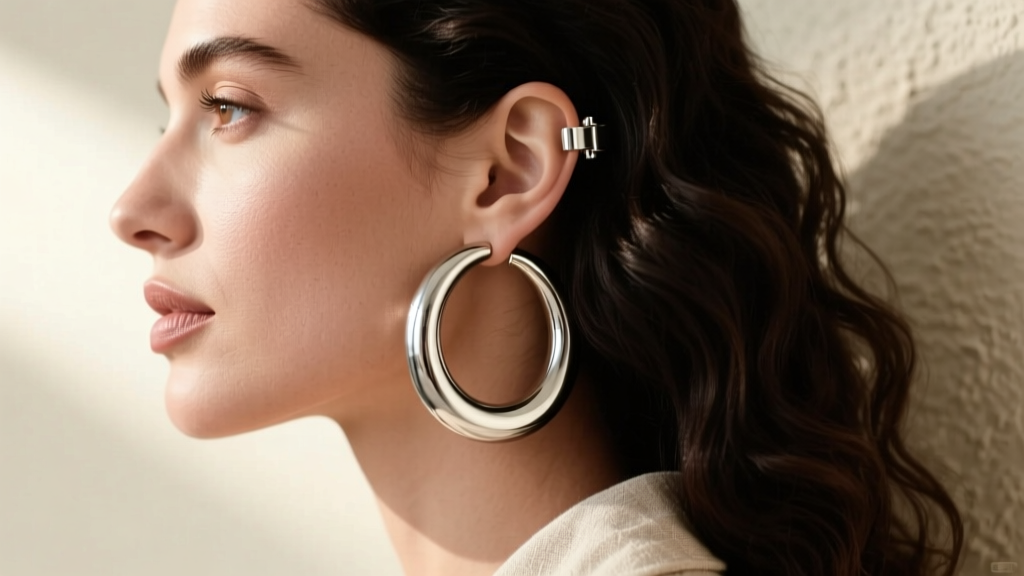
The human earlobe is composed of adipose tissue and skin, lacking the cartilaginous support found in the upper ear. When evaluating wide hoop earrings, we must apply the 8-Gram Threshold Rule.
"Dermatological and piercing consensus indicates that a standard earlobe piercing can comfortably support up to 7 to 10 grams of static weight before long-term tissue elongation (migration) begins to occur. Any earring exceeding this threshold requires either a reinforced piercing gauge or a specialized support mechanism."
Because a solid 14k gold hoop with a 50mm diameter and 4mm tube width easily exceeds 18 grams, wearing solid wide hoops daily will result in the "cheese-cutter effect," where the jewelry slowly slices downward through the tissue. To mitigate this, expert jewelers design wide hoops with ergonomic weight distribution. This involves tapering the tube width—making it thicker at the bottom (for visual impact and structural rigidity) and thinning it out to a 1.2mm (16g) or 1.0mm (18g) wire at the top where it passes through the ear. This reduces the friction and weight-bearing load directly on the fistula while maintaining the illusion of a uniformly chunky hoop.
Troubleshooting Common Structural Failures
If your wide hoop earrings are causing discomfort or failing mechanically, diagnose the issue using this technical checklist:
- Issue: The hoop is no longer a perfect circle.
Diagnosis: The alloy's Vickers hardness is too low (likely 18k or 22k gold), or the tube wall thickness is under 0.3mm. Solution: Upgrade to 14k gold or ASTM F136 titanium with CNC-milled tubing. - Issue: The piercing hole is stretching or aching.
Diagnosis: The earring exceeds the 10-gram ergonomic threshold without a tapered post. Solution: Switch to hollow electroformed construction or use silicone earring support patches to distribute the load across the back of the lobe. - Issue: The clasp clicks open randomly.
Diagnosis: Debris (sebum, lotion) has compromised the 0.05mm hinge tolerance, or the internal tension spring has fatigued. Solution: Clean the hinge with isopropyl alcohol and a micro-brush; if the spring is dead, the clasp must be laser-welded and replaced by a bench jeweler.
Understanding the engineering behind wide hoop earrings transforms them from a simple fashion accessory into a marvel of wearable architecture. By prioritizing material hardness, precise clasp tolerances, and anatomical weight distribution, you can invest in statement pieces that remain structurally flawless and comfortable for decades.


