Wire Wrapped Bead Earrings: Best Wire Metals & Gauges
Discover the best metals, wire gauges, and hardness levels for crafting durable wire wrapped bead earrings. Expert material comparisons inside.


The Structural Demands of Wire Wrapped Bead Earrings
Creating wire wrapped bead earrings requires more than just an eye for design; it demands a deep understanding of metallurgy and structural engineering on a micro-scale. Unlike cast jewelry, which relies on the uniform density of a mold, wire wrapping relies entirely on the tensile strength, malleability, and work-hardening properties of the metal. Earrings face unique environmental and physical stresses. They are frequently snagged by hair, pulled during removal, and exposed to the acidic pH of human skin and cosmetic chemicals. If the wire material or gauge is chosen incorrectly, the structural loops will gap, the wire will snap during the wrapping process, or the bead will eventually slip free.
In this comprehensive guide, we break down the exact material properties, gauge specifications, and hardness levels required to craft professional-grade wire wrapped bead earrings that endure daily wear while maintaining their aesthetic integrity.
Material Comparison: Choosing the Right Wire Alloy
The foundation of any wire wrapped bead earring is the metal itself. Different alloys offer vastly different working properties, tarnish resistance, and price points. According to jewelry manufacturing standards outlined by Rio Grande, selecting the right alloy is critical for both the artisan's workflow and the end consumer's satisfaction.
| Material | Composition | Tarnish Resistance | Workability | Best Application |
|---|---|---|---|---|
| Copper (C110) | 99.9% Pure Copper | Low (Oxidizes quickly) | High (Work hardens fast) | Practice, patina designs |
| Sterling Silver | 92.5% Ag, 7.5% Cu | Moderate | Excellent | Standard production earrings |
| Argentium Silver | 93.5% Ag, Germanium | Very High | Excellent (Fuses easily) | Premium, low-maintenance earrings |
| 14k Gold-Filled | 5% 14k Gold / Brass Core | High | Moderate (Cannot anneal) | High-end, durable gold tones |
| Gold-Plated | Microscopic Gold over Copper | Low (Flakes/Wears off) | High | Avoid for structural wraps |
Deep Dive: Argentium vs. Traditional Sterling
While traditional .925 sterling silver is the industry standard, it contains 7.5% copper, which reacts with sulfur and moisture in the air to create silver sulfide (tarnish). Argentium silver replaces some of the copper with germanium. When exposed to oxygen, the germanium forms a transparent, protective oxide layer that drastically slows tarnishing. For wire wrapped bead earrings featuring porous stones like turquoise or pearls—which can be damaged by harsh chemical silver polishes—Argentium is the superior choice because it requires only a simple wipe with a microfiber cloth to maintain its brilliance.
Decoding Wire Hardness and Tensile Strength
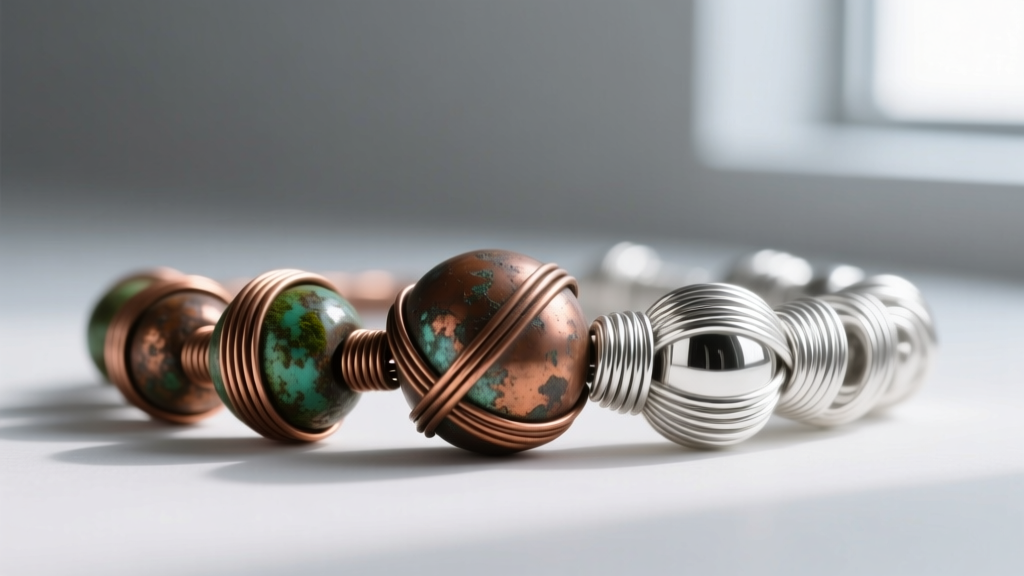
Wire hardness dictates how the metal behaves when manipulated with pliers. It is a measure of the metal's resistance to deformation. Understanding the crystalline structure of the metal is vital to preventing catastrophic failure (snapping) while wrapping.
- Dead Soft (Annealed): The wire has been heated and cooled to relax its crystalline lattice. It bends with zero resistance and is ideal for weaving or wrapping tightly around irregular, freeform beads. However, dead soft wire lacks the tensile strength to hold heavy stone beads in a structural loop; it will easily pull open under the weight of a large dangle.
- Half-Hard: The goldilocks zone for wire wrapped bead earrings. It has been slightly cold-worked, giving it enough stiffness to hold a wrapped loop securely, but enough malleability to bend around a bead cap without snapping. Most professional jewelers use half-hard wire for the main structural wraps and ear wires.
- Full-Hard (Spring Hard): Highly brittle and stiff. It is nearly impossible to use for wrapping beads because it will aggressively resist bending and snap if forced into a tight radius. It is strictly reserved for making clasps, pin stems, or structural components that require rigid spring-back.
Expert Tip: Never bend half-hard wire back and forth to test its flexibility. This creates "work hardening" by tangling the dislocations in the metal's crystal lattice, causing it to snap instantly. Make deliberate, single-pass bends using nylon-jaw pliers to prevent marring and structural weakening.
Gauge Sizing: Matching Wire Thickness to Bead Holes
The most frustrating failure mode in wire wrapping is selecting a wire gauge that is too thick for the bead's drilled hole, or too thin to support the bead's weight. According to gemstone drilling standards referenced by the Gemological Institute of America (GIA), bead hole sizes vary wildly based on the material's hardness and value.
The Core Gauge Breakdown
- 20-Gauge (0.81 mm): The undisputed workhorse of wire wrapping. It fits perfectly through standard 1mm drilled holes found in most glass, quartz, and agate beads. It is thick enough to be used for French ear wires and structural wrapped loops, providing excellent support for medium-to-heavy dangle earrings.
- 22-Gauge (0.64 mm): Essential for working with pearls, which typically feature smaller 0.7mm to 0.8mm drill holes to preserve the nacre and carat weight. 22-gauge wire is strong enough for small wrapped loops but should be doubled or reinforced if used to suspend heavy gemstones.
- 24-Gauge (0.51 mm): Primarily used as a secondary "weaving" or "binding" wire. It is too thin to support a bead on its own but is perfect for wrapping tightly around a 20-gauge core wire to secure a bead in a cage wrap or harness.
Troubleshooting Common Wire Wrapping Failures
Even with the right materials, technique dictates the longevity of the earring. Here are the most common structural failures and how to engineer them out of your design process:
1. The Gapping Loop
The Problem: The wrapped loop at the top of the bead does not sit flush against the bead cap, leaving a visible gap that catches on hair and clothing.
The Fix: This occurs when the wire is bent at an angle rather than a clean 90-degree break. Use chain-nose pliers to grip the wire exactly at the point where it exits the bead cap, and push the wire down to create a sharp, flush shoulder before initiating the loop.
2. Wire Snapping During the Wrap
The Problem: The tail of the wire breaks off while you are coiling it around the base wire.
The Fix: You are experiencing work hardening. If you are using dead soft wire for weaving, ensure you are not repeatedly adjusting the same section of the wrap. If using half-hard wire for the tail, anneal just the tail end with a micro-torch before wrapping, or switch to a softer temper for the binding wire.
3. Delamination in Gold-Filled Wire
The Problem: The gold layer flakes off, revealing the brass core underneath.
The Fix: This happens when using aggressive, serrated pliers that bite through the 14k gold layer (which is only 5% of the total thickness). Always use pliers with smooth, polished jaws, or dip your plier tips in a tool guard like Plasti-Dip to protect the gold-filled surface.
Sourcing and Storage Best Practices
The longevity of your raw materials is just as important as the finished piece. Copper and standard sterling silver wire will begin to tarnish while still on the spool if exposed to ambient humidity and airborne sulfur. When sourcing materials, Fire Mountain Gems and similar reputable suppliers recommend storing all unused silver and copper wire in sealed, anti-tarnish polyethylene bags with 3M anti-tarnish tabs. Never store wire in PVC plastics or rubber bands, as the sulfur compounds in these materials will accelerate oxidation and blacken the wire, making it brittle and unsightly before you even begin your wire wrapped bead earrings project.
By mastering the interplay between metal alloy, wire hardness, and precise gauge sizing, you elevate your jewelry from fragile crafts to enduring, professional-grade accessories that stand the test of time.


