YSL Stud Earrings: Expert Guide to Materials, Fit & Value
An expert technical deep dive into YSL stud earrings, covering brass metallurgy, post gauge specs, authentication hallmarks, and failure modes.

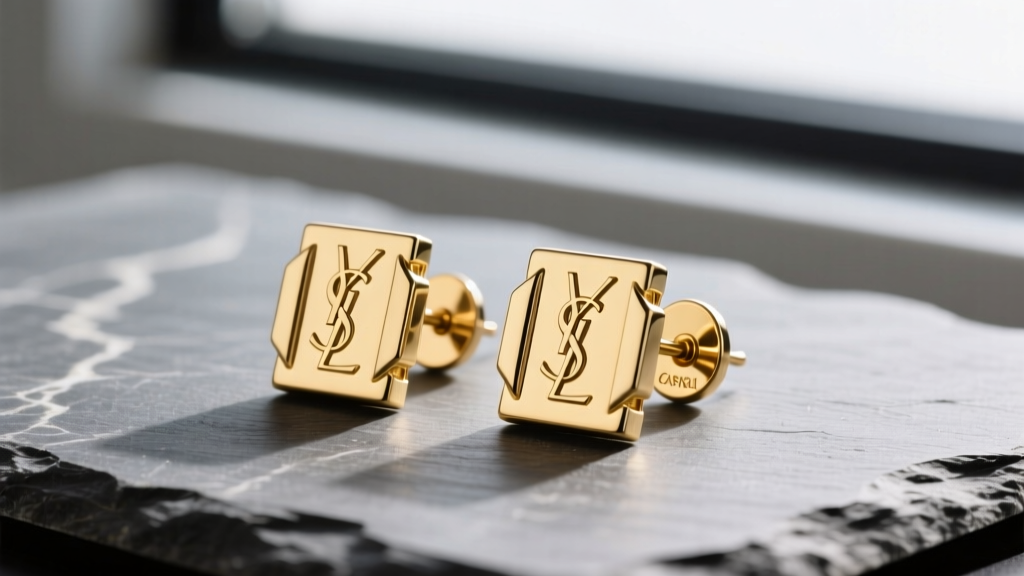
When evaluating luxury fashion jewelry, the distinction between aesthetic appeal and structural integrity is often blurred by brand prestige. For collectors and daily wearers alike, YSL stud earrings represent a fascinating intersection of high-fashion design and mass-produced metallurgy. As of 2026, the secondary market for vintage and contemporary Saint Laurent accessories has surged, making a technical understanding of these pieces essential for authentication, maintenance, and ergonomic wear.
This expert deep dive bypasses the standard style guides to examine the exact material compositions, post gauge specifications, clasp mechanics, and common failure modes of iconic YSL stud earrings. Whether you are investing in the Cassandra, Kate, or interlocking Logo collections, understanding the engineering beneath the gold-tone finish is critical.
The Metallurgy of Saint Laurent: Brass Alloys and Plating
Unlike fine jewelry lines that utilize solid 18k gold or platinum, the vast majority of YSL fashion earrings are constructed from a brass base alloy. Specifically, Saint Laurent typically employs a CuZn39Pb3 (copper-zinc-lead) alloy. This specific composition is chosen for its excellent machinability, allowing for the sharp, crisp edges seen in the brand's geometric hardware designs.
Plating Thickness and EU REACH Compliance
The base brass is subsequently plated. For silver-tone pieces, a palladium barrier layer is applied before a final rhodium flash. For gold-tone pieces, a 0.5 to 1.5-micron layer of gold alloy is deposited. While this provides a brilliant initial luster, it classifies as 'flash plating' rather than heavy vermeil. According to metallurgical standards outlined by the Gemological Institute of America (GIA), flash plating under 2.0 microns is highly susceptible to friction wear.
Furthermore, all authentic YSL earrings sold globally must comply with the EU REACH regulation regarding nickel release. The palladium barrier layer is engineered to keep nickel migration below the strict threshold of 0.5 µg/cm²/week, preventing contact dermatitis in sensitive wearers. Counterfeit pieces frequently skip this barrier layer, leading to severe allergic reactions and rapid oxidation.
Iconic YSL Stud Earrings: Dimensions & Gauge Specifications
The physical footprint and weight distribution of a stud earring dictate how it sits on the earlobe. Below is a technical breakdown of the three most prominent YSL stud silhouettes.
| Model | Dimensions (L x W) | Average Weight (per earring) | Base Metal |
|---|---|---|---|
| Cassandra Stud | 1.5 cm x 1.0 cm | 12.4 grams | Brass / Palladium |
| Kate Stud (Large) | 2.0 cm x 1.2 cm | 15.8 grams | Brass / Gold-Tone |
| Logo Stud (Interlocking) | 1.8 cm x 1.2 cm | 8.2 grams | Brass / Silver-Tone |
As the data illustrates, the Kate and Cassandra models are unusually heavy for standard friction-back studs. This weight disparity directly impacts the required post gauge and clasp tension, which we will address in the following section.
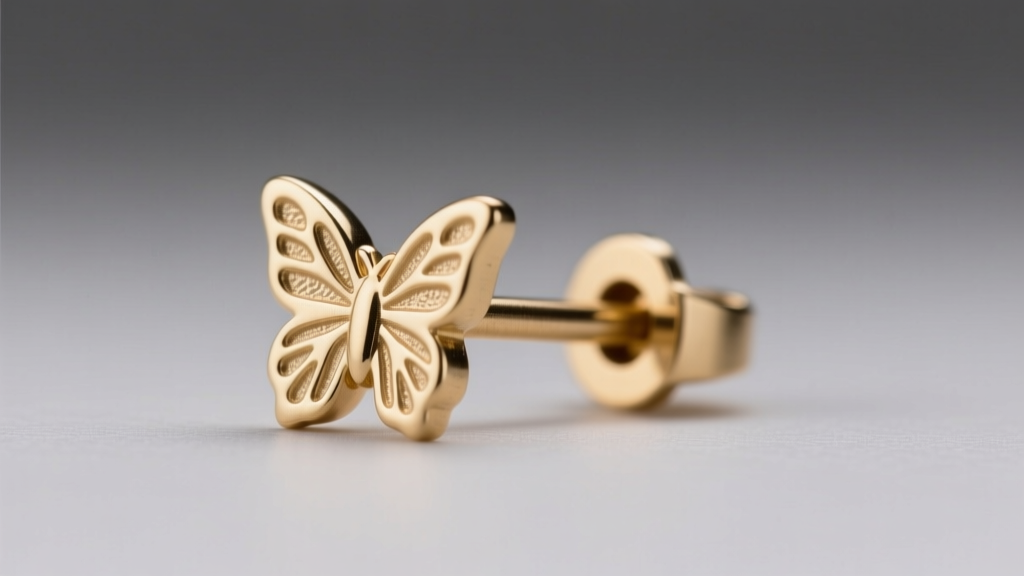
Post Gauge and Clasp Mechanics: A Technical Breakdown
The standard post diameter for YSL stud earrings is 0.8mm (equivalent to 20 gauge). While 0.8mm is the industry standard for lightweight diamond or pearl studs, it presents a structural vulnerability when supporting a 15-gram brass Kate stud. The concentrated mass creates a fulcrum effect against the earlobe piercing, frequently resulting in 'earlobe droop' where the earring faces downward rather than sitting flush against the skin.
Friction Backs vs. Screw Backs
YSL almost exclusively utilizes butterfly friction backs (push backs) rather than screw backs. The internal mechanism of an authentic YSL butterfly back features a dual-loop spring with a precise tension groove machined into the 0.8mm post.
- Tension Metric: Authentic backs require approximately 1.2 to 1.5 Newtons of force to slide past the post groove.
- Failure Point: Over time, the dual-loop springs in brass friction backs experience metal fatigue, reducing the clamping force and increasing the risk of loss.
Expert Modification: For heavy models like the Cassandra, jewelers recommend replacing the standard brass butterfly back with a heavy-duty silicone stabilizer disc paired with a sterling silver friction back to distribute the 12+ gram load across a wider surface area of the earlobe.
Authentication Protocol: Hallmarks and Engraving Depth
The proliferation of high-quality 'super fakes' in 2026 means that visual inspection of the overall design is no longer sufficient. Authentication must rely on macro-level inspection of the hallmarks. Services like Real Authentication emphasize that the methodology of the stamp is the primary tell.
'Authentic Saint Laurent hardware utilizes deep mechanical stamping or highly precise, deep-focus laser engraving. The kerning between the letters in 'Saint Laurent Paris' is mathematically consistent, and the floor of the engraving should be clean, not frosted or burnt.'

Key Authentication Markers
- The 'Paris' Stamp: Authentic YSL studs will feature 'Saint Laurent Paris' or 'YSL' stamped on the flat backplate or the post base. Counterfeits often use shallow laser etching that appears white or frosted under a 10x jeweler's loupe.
- Post Welding: Authentic 0.8mm posts are laser-welded to the brass backplate. The weld pool should be micro-scoped and clean. Fakes often use high-temperature soldering, leaving a visible, messy ring of oxidized flux or silver solder around the base of the post.
- Weight Verification: Because counterfeiters often use cheaper, lighter zinc alloys instead of dense CuZn39Pb3 brass, a digital jewelry scale is a vital tool. A fake Kate stud will often weigh 20-30% less than the authentic 15.8-gram specification.
Maintenance and Common Failure Modes
Owning YSL fashion jewelry requires an understanding of its specific degradation pathways. Because the core material is brass, exposure to environmental factors triggers predictable chemical reactions.
Verdigris and Lactic Acid Exposure
When the gold or rhodium flash plating wears thin—particularly on the post and the back of the earring where it rests against the skin—the underlying brass is exposed to human sweat. The lactic acid and chlorides in sweat react with the copper in the brass alloy to form copper carbonate, commonly known as verdigris. This manifests as a crusty, pale-green buildup that can irritate the piercing tract.
Preventative Protocol: Never store YSL studs in high-humidity environments like bathroom vanities. After wear, wipe the posts and backplates with a microfiber cloth lightly dampened with isopropyl alcohol to neutralize skin acids before placing them in an anti-tarnish ziplock bag.
Prong and Hardware Loosening
For YSL studs featuring crystal or enamel inlays (such as the Cassandra variations), the prongs holding the decorative elements are often cast as part of the brass base rather than hand-set by a bench jeweler. Repeated drops or impacts can cause these cast prongs to fatigue and snap. If a crystal becomes loose, do not attempt to bend the brass prong back into place; cast brass is brittle and will fracture. Instead, use a microscopic drop of two-part jeweler's epoxy to secure the stone.
The 2026 Market Value and Investment Perspective
While fashion jewelry is rarely purchased as a traditional financial investment, the archival market for specific YSL eras has matured significantly. Stud earrings from the Hedi Slimane era (2012-2016) and the early Anthony Vaccarello collections command a premium on the secondary market, often retaining 60-75% of their retail value if accompanied by original authenticity cards and pristine plating. By understanding the metallurgy, gauge limitations, and authentication markers detailed above, collectors can confidently navigate the market, ensuring their acquisitions are both structurally sound and genuinely iconic.


