How an 18 in Necklace on Woman Falls: Technical Fit & Style
Discover the biomechanics of an 18 in necklace on woman. Expert guide on gauge weights, clasp migration, bail sizing, and neckline pairing.


The 18-inch necklace, universally classified in the jewelry industry as the "princess" length, is the most manufactured and purchased chain size globally. However, understanding how an 18 in necklace on woman actually behaves requires moving beyond basic style advice and into the biomechanics of drape, metallurgical tensile strength, and spatial geometry. This technical deep dive deconstructs the anatomy of the 18-inch drop, analyzing gauge weight distribution, clasp migration physics, and precise neckline intersections.
The Biomechanics of the 18-Inch Drop
To predict exactly where an 18-inch chain will rest, we must look at standard anthropometric data. The average adult female neck circumference ranges between 13 and 14 inches. When you fasten an 18-inch chain around a 13.5-inch neck, you are left with 4.5 inches of total slack. Because the chain forms a teardrop or parabolic arc rather than a perfect circle, this translates to an anterior drop (the distance from the base of the front of the neck to the lowest point of the chain) of approximately 2.25 to 2.5 inches.
This specific drop places the nadir of the chain precisely at or slightly below the clavicle (collarbone). This anatomical landmark is crucial because it sits in the "visual safe zone"—high enough to avoid being swallowed by the bust line, but low enough to clear the tightest crewneck collars. However, variations in neck circumference drastically alter this fit. A wearer with a 15-inch neck will experience an 18-inch chain as a choker-style collar with only a 1.5-inch drop, fundamentally changing the visual proportion and pendant presentation.
Gauge, Weight, and the Center of Gravity Problem
One of the most common technical complaints regarding the 18-inch length is "clasp migration"—the phenomenon where the clasp continually slides from the nape of the neck to the front of the chest. This is not a defect in the chain; it is a predictable outcome of physics and center of gravity.
At 18 inches, a chain is long enough to move freely but short enough that the weight of the clasp (which is disproportionately heavy compared to fine chain links) acts as a pendulum weight. If the chain's overall mass is too low, the clasp will always seek the lowest gravitational point. Below is a technical breakdown of how gauge thickness in 14k gold affects weight and migration risk at the 18-inch mark.
| Chain Gauge (mm) | Style | Approx. Weight (14k Gold) | Migration Risk | Max Pendant Weight |
|---|---|---|---|---|
| 0.8mm | Cable | 2.1 grams | High (Clasp will slide) | 2.5 grams |
| 1.2mm | Box | 4.8 grams | Moderate | 6.0 grams |
| 1.8mm | Rope | 8.5 grams | Low | 12.0 grams |
| 2.5mm | Curb | 15.2 grams | None (Chain anchors clasp) | 20.0+ grams |
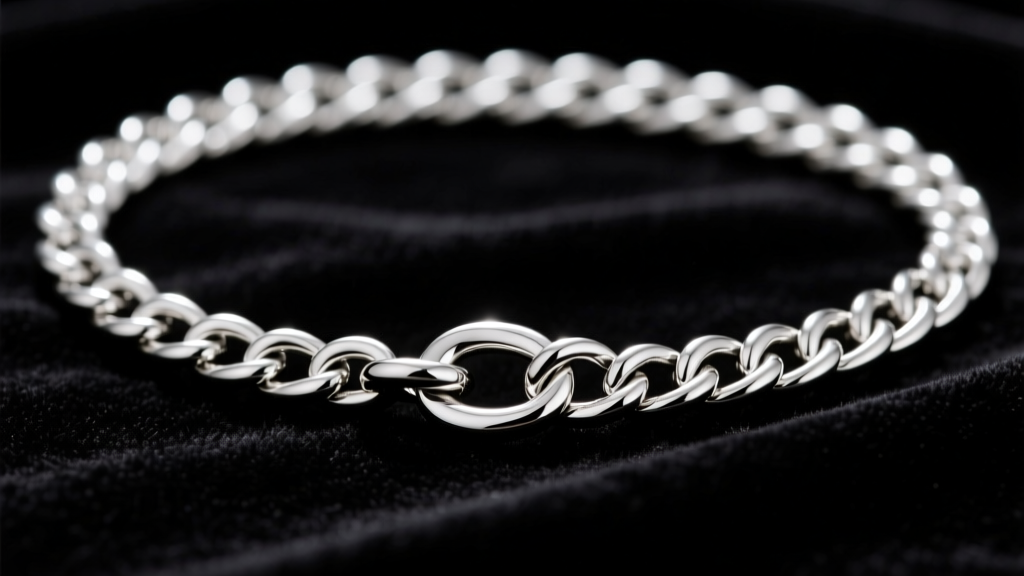
To counteract clasp migration on lightweight 18-inch chains (0.8mm to 1.0mm), expert jewelers often recommend adding a small counterweight jump ring near the clasp or opting for a spring-ring clasp, which is marginally lighter than a standard lobster claw. According to manufacturing standards outlined by Jewelers of America, balancing the clasp-to-chain weight ratio is critical for maintaining the integrity of the drape.
Pendant Bail Compatibility Matrix
When styling an 18 in necklace on woman, the addition of a pendant introduces a new variable: the bail. The inner diameter (ID) of the bail must accommodate not just the width of the chain, but its thickness and flexibility. An 18-inch chain that is too thick for a bail will cause the pendant to sit rigidly, preventing it from laying flat against the sternum.
- 0.9mm - 1.2mm Chains: Require a bail with a minimum 2.0mm ID. Ideal for delicate solitaire pendants and lightweight gemstone drops.
- 1.5mm - 2.0mm Chains: Require a bail with a minimum 3.5mm ID. Necessary for medium-weight lockets and die-struck medals.
- 2.5mm+ Chains: Require an open bail or a specialized tube bail with a 4.0mm+ ID. Standard soldered bails will not fit, and forcing them can compromise the structural integrity of the chain links.
Neckline Integration: A Spatial Analysis
The visual success of an 18-inch necklace is heavily dependent on the garment's neckline architecture. We can map the 18-inch drop against standard apparel industry neckline measurements to determine optimal pairings.
The Scoop Neck Intersection
A standard scoop neck typically drops to a circumference of 19 to 21 inches. Because the 18-inch chain sits above this threshold, it will rest directly on the fabric hem or slightly inside it. This creates visual clutter and increases the risk of the chain catching on the garment's stitching. For scoop necks, a 20 or 22-inch chain is technically superior to clear the hemline.
The V-Neck Vector
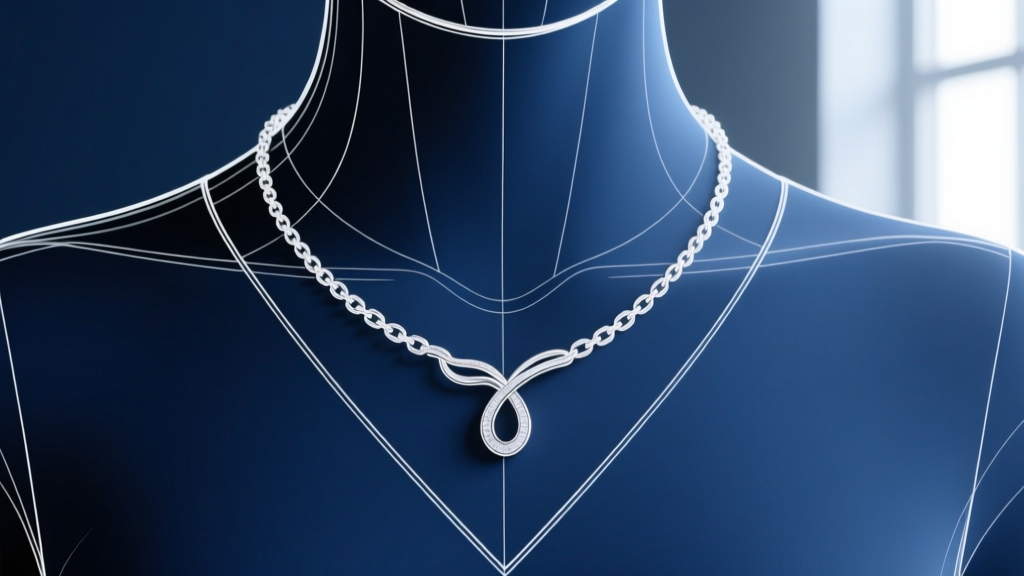
The V-neck is the optimal geometric partner for the 18-inch chain. A standard V-neck plunges to roughly the same 2.5-inch anterior drop as the chain. This creates parallel lines that draw the eye downward, elongating the neck and torso. The pendant at the center of an 18-inch chain will naturally rest precisely in the negative space of the V-neck, maximizing visibility without competing with the garment's structure.
The Crew Neck Clearance
Crew necks sit tightly at the base of the neck (approx. 14.5 to 15.5 inches). An 18-inch chain provides exactly 1 to 1.5 inches of clearance below the fabric collar. This is the classic "layered" look, but it requires a chain gauge of at least 1.5mm; anything thinner will visually vibrate against the heavy cotton or wool of a crew neck sweater, losing its definition.
Metallurgical Tensile Strength at 18 Inches
The length of a chain directly impacts its tensile vulnerability. An 18-inch chain has more individual soldered links than a 16-inch choker, meaning there are more potential failure points when subjected to lateral stress. When selecting an 18-inch chain for daily wear, the alloy composition is paramount.
According to metallurgical data from the Gemological Institute of America (GIA), 14k gold (58.5% pure gold, alloyed with copper, silver, and zinc) offers significantly higher tensile strength and scratch resistance than 18k gold (75% pure gold). For an 18-inch chain that will bear a pendant weighing more than 5 grams, 14k gold or platinum is highly recommended. The harder alloy matrix prevents the microscopic stretching of the link solder joints that frequently occurs in softer 18k or 22k chains at this specific length.
Sourcing and Hallmark Verification
When procuring an 18-inch chain, always verify the hallmark stamps. Authentic pieces will bear a quality mark (e.g., 14K, 585, 925, PT950) and a maker's mark. Because the 18-inch length is the most counterfeited size in the mass-market jewelry sector, utilize a digital caliper to verify the gauge thickness matches the manufacturer's specifications. A chain advertised as 1.5mm that measures 1.1mm on a caliper is not only a misrepresentation of material weight but will also fail to support the pendant bail ratios outlined in the compatibility matrix above.
Ultimately, mastering the styling of an 18 in necklace on woman requires treating it not just as an accessory, but as a precise instrument of proportion. By aligning gauge weight with clasp physics, matching bail dimensions to chain thickness, and respecting the spatial geometry of garment necklines, you elevate the 18-inch chain from a basic staple to a masterclass in technical styling.


