The Abracadabra Necklace: Technical Guide to Talismanic Jewelry
Explore the metallurgy, engraving techniques, and chain engineering behind the abracadabra necklace. A technical guide for collectors and jewelers.

The Anatomy of an Abracadabra Necklace: Beyond the Incantation
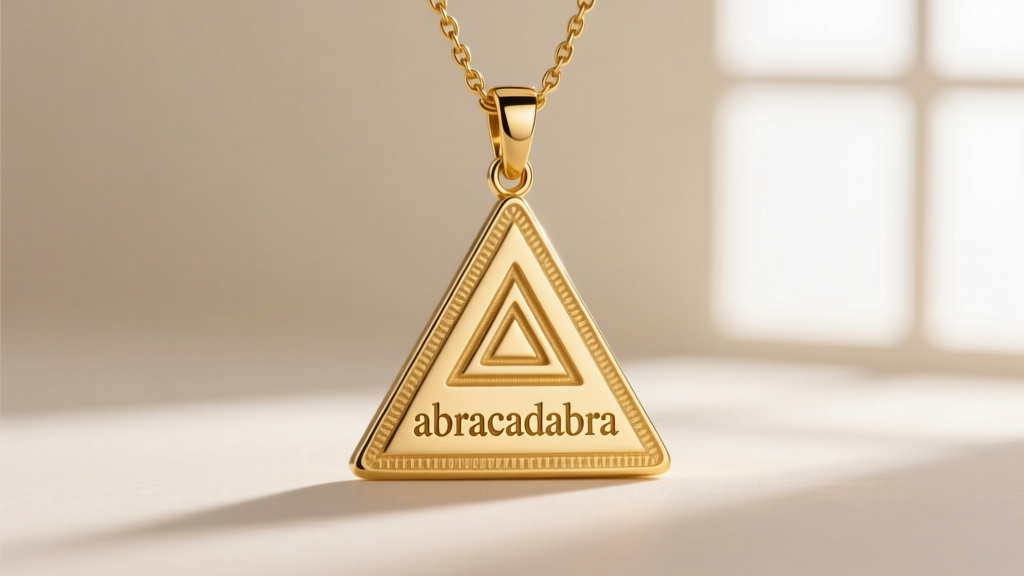
While the term 'abracadabra' is commonly associated with stage magic, in the realm of fine jewelry and historical amulets, an abracadabra necklace represents a highly specific category of talismanic design. Originating from Aramaic and Gnostic traditions, the classic abracadabra amulet features a diminishing triangle of text. The word is written out in eleven lines, subtracting one letter per line until only the 'A' remains. Historically, this was believed to gradually diminish a wearer's ailment or ward off negative energy as the word disappeared.
From a lapidary and jewelry design perspective, translating this 65-letter geometric pattern onto a modern pendant presents unique technical challenges. Fitting eleven rows of micro-text onto a standard 25mm x 20mm oval or shield-shaped blank requires a font height of roughly 0.8mm to 1.2mm. This demands absolute precision in both the digital layout phase and the physical engraving process. Modern jewelers crafting an abracadabra necklace must balance historical authenticity with contemporary wearability, selecting appropriate metal alloys and chain architectures that can support the often substantial weight of a solid cast or stamped talisman.
Metallurgical Breakdown: Choosing the Right Alloy
The longevity and legibility of the micro-engravings on an abracadabra necklace depend heavily on the base metal. Soft metals will cause the fine lines to wear away from skin friction over time, while overly hard metals can make hand-engraving nearly impossible without specialized equipment. According to the Gemological Institute of America (GIA), the alloy composition dictates not just the color, but the Vickers Hardness (HV) of the piece.
| Material | Vickers Hardness (HV) | Tarnish Resistance | Best Engraving Method |
|---|---|---|---|
| 925 Sterling Silver | 60 - 75 | Low (Requires Rhodium or Patina) | Hand Burin / Pneumatic Graver |
| 14k Yellow Gold | 130 - 150 | High | Fiber Laser / Hand Burin |
| 18k Yellow Gold | 110 - 125 | High | Hand Burin (Softer alloy) |
| Jeweler's Bronze | 90 - 110 | Very Low (Oxidizes rapidly) | Rotary Tool / Acid Etch |
For collectors seeking a historically accurate feel, 925 sterling silver is the standard. However, because silver is relatively soft (HV 60-75), the microscopic serifs of the diminishing triangle can blur over decades of wear. 14k gold offers a superior hardness profile (HV 130-150), ensuring the micro-text remains crisp for generations, making it the preferred choice for heirloom-quality abracadabra necklaces.
Engraving Techniques: Laser Ablation vs. Hand Burin
The method used to inscribe the 65 letters of the abracadabra triangle fundamentally alters the texture, light reflection, and value of the necklace. There are two primary techniques utilized in modern bench jewelry:
1. MOPA Fiber Laser Engraving
Modern production abracadabra necklaces are typically engraved using a 20W to 30W MOPA (Master Oscillator Power Amplifier) fiber laser. Unlike standard YAG lasers, a MOPA laser allows the jeweler to adjust the pulse width. On precious metals like silver and gold, the laser does not merely scratch the surface; it creates a micro-melt pool that results in a frosted, matte texture within the letters. This provides excellent contrast against a high-polish background without removing significant metal mass. The depth of cut is usually minimal (0.02mm to 0.05mm), which is sufficient for visual contrast but leaves the text vulnerable to aggressive polishing.
2. Pneumatic Hand Engraving
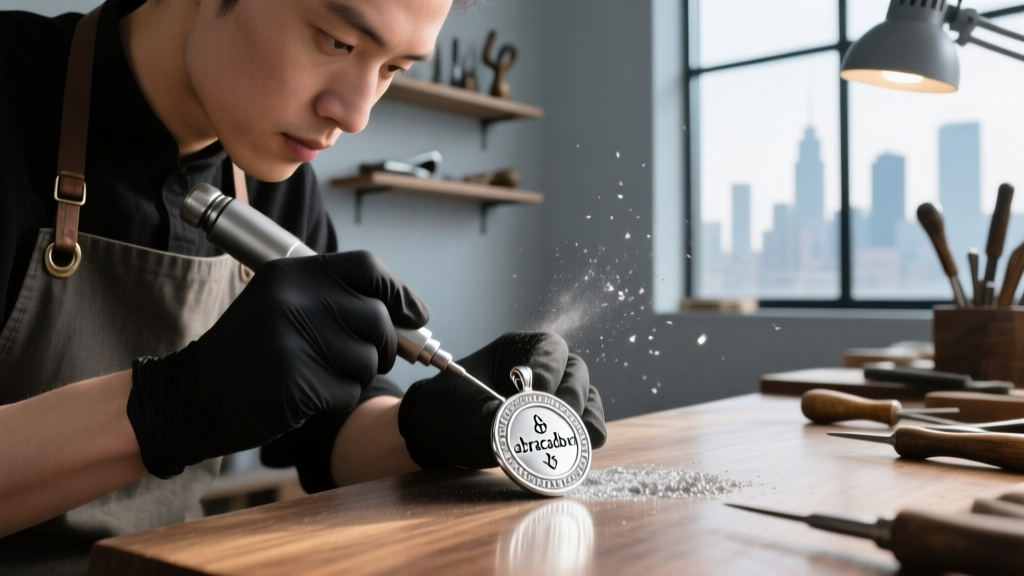
For bespoke or high-end artisan pieces, master engravers use a pneumatic hand graver (such as a GraverMax system) equipped with a 90-degree square or onglette graver. This technique physically displaces and removes metal, carving V-shaped channels approximately 0.15mm to 0.25mm deep. The resulting cuts have sharp, clean walls that catch the light beautifully. Hand-engraved abracadabra pendants are highly prized because the displacement of metal creates a microscopic 'burr' along the edges of the letters, giving the text a distinctive, organic shimmer that lasers cannot replicate.
Chain Engineering: Supporting Heavy Amulet Pendants
An often-overlooked aspect of designing an abracadabra necklace is the structural integrity of the chain. Talismanic pendants, especially those cast in solid 14k gold or thick sterling silver, frequently weigh between 12 and 25 grams. Suspending this weight requires specific chain weaves and bail engineering.
- Rope Chains (2.5mm - 3.5mm): Rope chains possess exceptional tensile strength due to their twisted, multi-link helix structure. A 3.0mm solid 14k rope chain can withstand over 15 pounds of tensile force, making it ideal for heavy amulets.
- Wheat (Spiga) Chains: Featuring woven, figure-eight links, wheat chains offer a rigid, smooth drape that prevents the heavy pendant from constantly flipping over and tangling.
- Avoid Cable and Curb Chains: Standard cable chains, particularly those under 2.0mm, rely on single soldered jump rings. The constant pendulum motion of a heavy abracadabra pendant will cause metal fatigue at the solder joints, leading to eventual failure.
Furthermore, the bail (the loop connecting the pendant to the chain) must be proportionate. A hidden bail soldered directly to the back of the pendant, featuring a 5mm x 8mm inner diameter, ensures the chain sits flush and the heavy pendant hangs perfectly flat against the sternum.
Patina Management and Antiquing Techniques
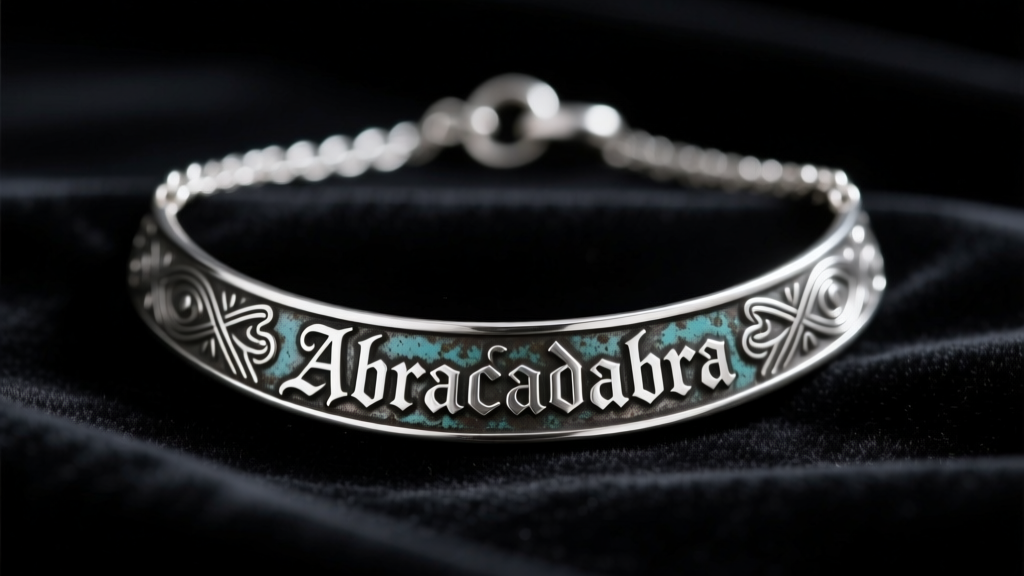
To maximize the legibility of the diminishing triangle, jewelers employ chemical oxidation. As noted in GIA's silver care guidelines, silver naturally reacts with sulfur in the environment. Jewelers accelerate this using Liver of Sulfur (potassium polysulfide).
The pendant is submerged in a diluted liver of sulfur solution (typically a 1:100 ratio in warm water) until the entire piece turns a deep, matte charcoal black. Once dried, the jeweler uses a radial bristle brush mounted on a flex shaft rotary tool, spinning at roughly 5,000 RPM. This selectively polishes the high surfaces and the raised burrs of the hand-engraved text back to a brilliant white-silver finish, while leaving the recessed V-channels pitch black. This high-contrast antiquing is what gives a vintage-style abracadabra necklace its striking, readable depth.
Sourcing: Identifying Authentic Vintage vs. Modern Reproductions
When acquiring an antique or vintage abracadabra necklace, collectors must scrutinize the manufacturing marks. True Victorian or Edwardian-era amulets were typically die-struck or hand-engraved. Under a 10x jeweler's loupe, hand-engraved antique pieces will show slight variations in letter width and microscopic tool marks at the terminus of each stroke. Conversely, modern reproductions often utilize CAD/CAM milling or laser etching, resulting in mathematically perfect, uniform letters with a distinct frosted or 'orange peel' texture at the base of the engraving. Understanding these metallurgical and fabrication nuances ensures that collectors and enthusiasts can accurately evaluate the craftsmanship and historical significance of their talismanic jewelry.


