Africa Continent Necklace Gold: Purity & Material Guide
Compare 14k, 18k, and plated gold for your Africa continent necklace. Learn about edge durability, hardness, and the best chains for map pendants.

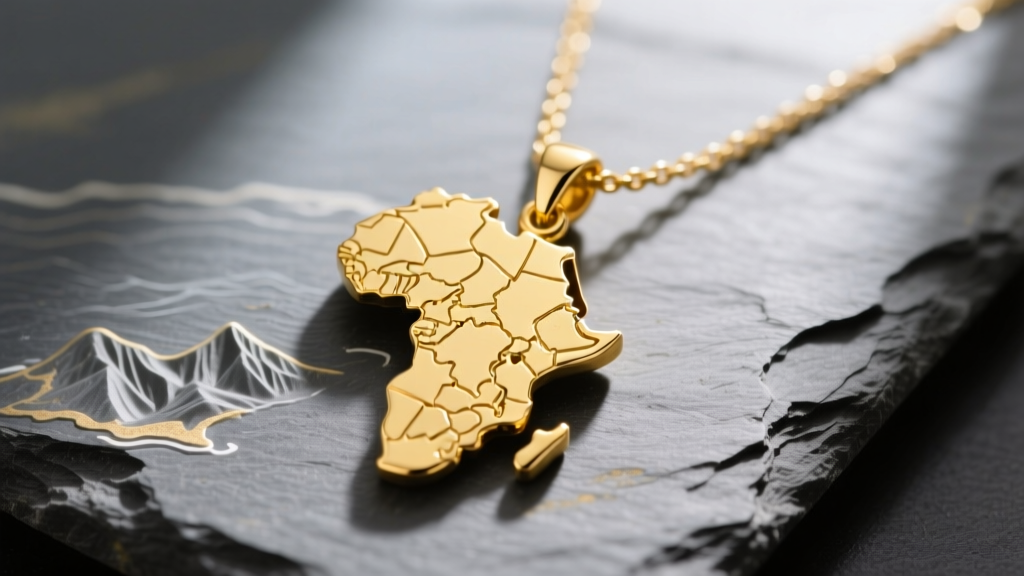
Wearing a geographical map pendant is a powerful way to display heritage, pride, and a deep personal connection to a place. However, when evaluating an africa continent necklace gold piece, buyers often focus solely on the karat stamp or the price tag while ignoring the metallurgical realities of the design. The African continent features a highly complex, asymmetrical perimeter—from the sharp protrusion of the Horn of Africa to the delicate curve of the Gulf of Guinea and the isolated landmass of Madagascar. These intricate geographical features create unique structural vulnerabilities that dictate which gold alloys, thicknesses, and manufacturing methods will actually survive daily wear without bending, snapping, or wearing through to a base metal.
The Engineering Challenge of Map Pendants
Unlike a simple geometric circle or a smooth teardrop pendant, a continental outline is fraught with stress concentrators. In metallurgy, a stress concentrator is a sharp corner or narrow bridge where mechanical stress is amplified. On an Africa map pendant, the narrow strait between the mainland and Madagascar, the sharp point of the Cape of Good Hope, and the thin eastern horn act as structural weak points. If the gold is too soft, these extremities will bend out of shape when caught on clothing. If the pendant is too thin (below 0.8mm), the entire piece can warp under the tension of a heavy chain. Therefore, selecting the right material is not just about color or prestige; it is an engineering necessity.
Solid Gold Alloys: 14k vs. 18k vs. 24k for Continental Outlines
Pure gold is remarkably malleable, which is why it must be alloyed with metals like copper, silver, and zinc to achieve the structural integrity required for jewelry. According to the Gemological Institute of America (GIA), the karat system dictates the percentage of pure gold, which directly correlates to the metal's Vickers Hardness (HV) score.
- 24k Gold (99.9% Pure): With a Vickers hardness of roughly 25 HV, 24k gold is far too soft for an intricate map pendant. The sharp points of the continent would bend within days of daily wear, and the bail (the loop connecting the pendant to the chain) would quickly warp open.
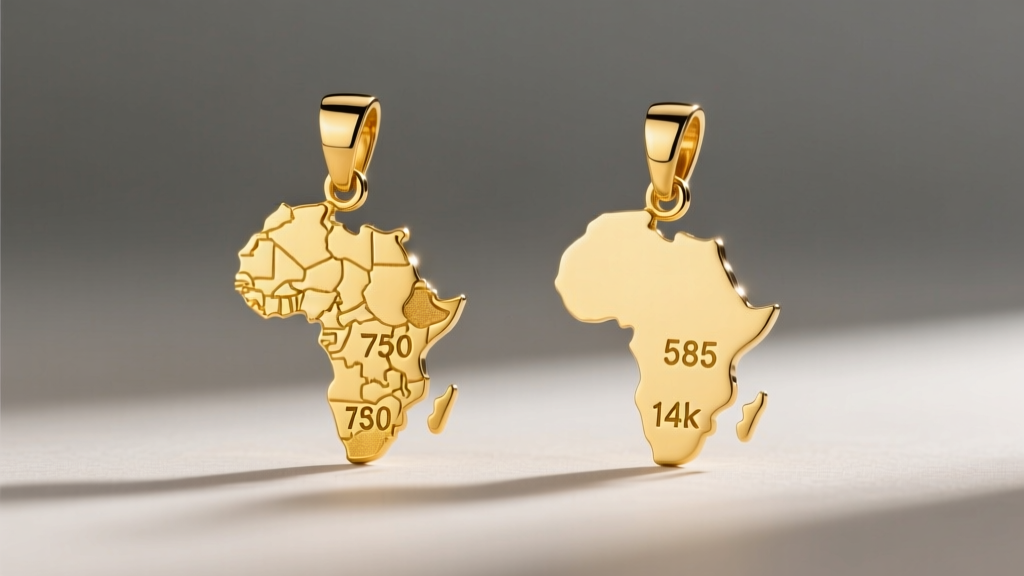
- 18k Gold (75% Pure): Alloyed to reach approximately 120-135 HV, 18k gold offers a richer, deeper yellow hue that many buyers prefer for cultural jewelry. It provides adequate durability for occasional wear, though the finer points of the map may still require occasional professional straightening if subjected to impact.
- 14k Gold (58.3% Pure): The undisputed champion for daily-wear map pendants. Sitting at 140-160 HV, 14k gold possesses the tensile strength to maintain the sharp geographical borders of the continent without warping, while still retaining a beautiful, warm gold color.
Material Hardness and Pricing Comparison
| Alloy Type | Gold Content | Vickers Hardness (HV) | Edge Durability | Avg. Price (1.5g Pendant) |
|---|---|---|---|---|
| 24k Solid | 99.9% | 25-30 HV | Poor (Bends easily) | $140 - $160 |
| 18k Solid | 75.0% | 120-135 HV | Good | $110 - $130 |
| 14k Solid | 58.3% | 140-160 HV | Excellent | $85 - $105 |
| Vermeil | 2.5μm over Silver | 90-100 HV (Base) | Fair (Edge wear) | $35 - $55 |
Plated Alternatives: Vermeil vs. Gold-Filled
For buyers on a stricter budget, plated alternatives offer the look of gold at a fraction of the cost. However, the complex geometry of an Africa continent necklace exposes the inherent flaws of plated jewelry.
The Vermeil Edge-Wear Problem
Gold vermeil consists of a sterling silver base plated with a minimum of 2.5 microns of gold. While the sterling silver core provides decent structural hardness, the friction points of a map pendant are highly problematic. The sharp edges of the continent act like tiny scrapers against the wearer's skin and clothing. Over time, the gold plating on these extremities—particularly the Horn of Africa and the southern tip—will wear away, revealing the bright silver underneath. This creates a two-tone effect that is difficult to polish out without removing more plating.
Gold-Filled Stamping Limitations
Gold-filled wire and sheet metal consist of a brass core mechanically bonded to a thick outer layer of gold (usually 5% of the total weight). While highly durable for simple shapes, manufacturing an Africa continent pendant from gold-filled sheet metal requires laser cutting or die-stamping. This cutting process inevitably slices through the outer gold layer, exposing the raw brass core along the entire perimeter of the continent. Unless the jeweler meticulously seals these edges with a specialized clear coat or electroplating bath, the exposed brass will oxidize and turn the wearer's skin green.
Manufacturing Methods: Casting vs. Laser Cutting
How the pendant is made is just as important as the metal it is made from. There are two primary methods for producing map necklaces, each with distinct failure modes.
- Lost-Wax Casting: This method involves carving a 3D wax model, encasing it in plaster, burning out the wax, and pouring molten gold into the cavity. Casting allows for beautiful 3D beveling, giving the continent a raised, topographical look. However, if the gold is not heated correctly, microscopic porosity (tiny air bubbles) can form inside the metal. If a porous area happens to be located at the narrow bridge near Madagascar, the pendant will snap cleanly under minimal tension.
- Laser Cutting from Sheet: A CNC laser cuts the continent outline from a flat sheet of 0.9mm or 1.2mm gold. This results in incredibly precise, sharp geographical borders. The downside is that laser-cut edges are initially sharp and can scratch the skin. High-quality jewelers will tumble and polish the edges to create a micro-bevel, ensuring the pendant is comfortable against the collarbone.
The Madagascar Soldering Vulnerability
One of the most critical design choices in an Africa continent necklace is how the island of Madagascar is handled. In cheaper or poorly designed pendants, Madagascar is completely detached from the mainland, requiring a hidden solder joint or a fragile, nearly invisible wire bridge. Over time, the solder joint can become brittle and fail. When shopping, look for designs where Madagascar is either intentionally fused into the mainland mass for structural continuity, or connected via a thick, visible 14k gold bridge that can withstand lateral pulling forces.
Chain Pairing and Bail Mechanics
An Africa map pendant is heavily top-weighted due to the broad expanse of North Africa, tapering down to a narrow point in the South. This asymmetrical weight distribution means the pendant will naturally tilt if hung on a flimsy chain. To counteract this, the bail (the loop at the top) must be oversized and reinforced. Pair the pendant with a 1.2mm to 1.5mm rope chain or a box chain. Avoid snake chains or herringbone chains, as their rigid, interlocking links cannot easily navigate the reinforced bail and are prone to permanent kinking when subjected to the uneven weight pull of a map pendant.
Ethical Sourcing and Fairmined Gold
Given the cultural significance of the pendant, many buyers are increasingly concerned with the origin of the metal. The Fairmined Standard ensures that gold is sourced from responsible, artisanal, and small-scale mining organizations that meet strict environmental and labor standards. Opting for a 14k or 18k Africa continent necklace crafted from Fairmined or recycled gold adds a layer of ethical integrity to the piece, aligning the symbolism of the jewelry with sustainable practices that benefit the continent's mining communities.
Care and Maintenance for Intricate Gold Pendants
Maintaining the crisp borders of your gold map pendant requires specific care routines. Avoid using harsh bristle brushes, which can scratch the polished surface and dull the laser-cut edges. Instead, use a mild dish soap and warm water solution, gently agitating the pendant with a soft microfiber cloth. If the pendant becomes bent—a common issue with 18k or lower-quality 14k casts—do not attempt to bend it back into shape with your fingers. The repeated stress will cause work-hardening, leading to a micro-fracture. Take it to a professional jeweler who can anneal the metal (heat it to relieve internal stress) and press it flat using a specialized nylon-jawed pliers.
"A map pendant is a testament to identity. Treating it with the metallurgical respect it deserves ensures that the symbol of your heritage outlasts the fleeting trends of fast fashion jewelry."


