Amethyst Cross Necklace: A Gemological & Metallurgical Guide
Discover the technical details of buying an amethyst cross necklace. Learn about gem grading, metal settings, and chain pairings in our expert guide.

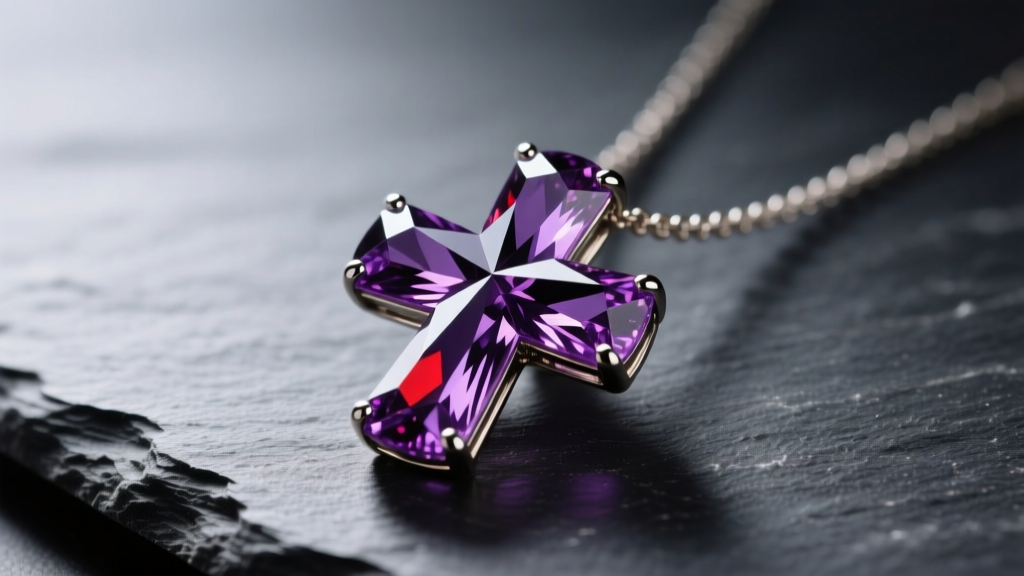
Selecting the perfect amethyst cross necklace requires looking beyond superficial aesthetics and understanding the underlying gemological and metallurgical mechanics. As a silhouette, the cross demands structural symmetry, while amethyst—a macrocrystalline variety of quartz—presents unique lapidary challenges. This expert deep dive explores the precise grading standards, alloy pairings, and chain engineering required to curate a high-quality, enduring amethyst cross pendant.
The Gemological Standard: Grading Amethyst for Cross Pendants
Not all amethyst is created equal. When evaluating an amethyst cross necklace, the primary value driver is color saturation and distribution. According to the Gemological Institute of America (GIA), the most prized amethyst exhibits a strong reddish-purple hue without visible color zoning. In the trade, this top-tier color is often referred to as 'Siberian' amethyst, characterized by a primary purple hue of 75-80% with 15-20% secondary red and blue flashes under incandescent light.
Cutting a cross shape from a raw amethyst crystal is inherently problematic due to the stone's natural hexagonal crystal habit and angular color zoning. Lapidaries must carefully orient the rough to ensure the horizontal and vertical arms of the cross display uniform saturation. Lower-grade stones often exhibit 'zebra stripes' or uneven color bands that become glaringly obvious when cut into geometric shapes like a cross.

Regarding clarity, amethyst is classified as a Type II gemstone. This means that while eye-clean specimens are standard for fine jewelry, minor inclusions such as 'tiger stripes' (stress fractures) or two-phase fluid inclusions are common and generally accepted if they do not compromise the structural integrity of the cross's slender arms.
Metallurgical Pairings: Selecting the Right Alloy for the Setting
The metal setting of an amethyst cross necklace dictates both the longevity of the piece and the optical performance of the gemstone. Because amethyst possesses a vitreous luster and deep violet tones, the chosen alloy must provide adequate contrast and structural support.
| Metal Alloy | Hardness (Mohs) | Aesthetic Synergy | Price Range (Setting Only) |
|---|---|---|---|
| Sterling Silver (925) | 2.5 - 3.0 | High contrast; modern gothic aesthetic. Prone to sulfur tarnish. | $40 - $120 |
| 14K White Gold | 3.5 - 4.0 | Requires rhodium plating. Bright reflection enhances purple depth. | $180 - $350 |
| 14K Rose Gold | 3.5 - 4.0 | Copper alloys amplify the secondary red flashes in Siberian amethyst. | $190 - $380 |
| Platinum (950) | 4.0 - 4.5 | Ultimate durability for prong settings; heavy, premium feel. | $450 - $900+ |
For intricate cross designs with slender arms, 14K white or rose gold offers the optimal balance of tensile strength and malleability. Sterling silver, while cost-effective, is highly susceptible to galvanic corrosion and bending if the cross pendant is subjected to lateral stress.
Lapidary Anatomy: Step-Cut vs. Cabochon Crosses
The lapidary technique applied to the amethyst drastically alters the pendant's light return and overall silhouette. There are two primary cutting styles for amethyst crosses:
- Faceted Step-Cuts: Utilizing parallel rows of facets, step cuts (like the emerald cut) create a 'hall of mirrors' effect. This style demands high-clarity rough, as the large, open table facets will expose any internal fractures or color zoning. Step-cut crosses project a sophisticated, Art Deco elegance.
- Cabochon (Domed) Crosses: Cut and polished into a smooth, convex dome without facets. Cabochons are ideal for heavily included amethyst or stones with dramatic color zoning. The smooth surface scatters light softly, giving the cross a velvety, glowing appearance that pairs exceptionally well with vintage-inspired bezel settings.
- Composite Crosses: Due to the low yield of cutting a large, solid cross from a single crystal, many commercial pendants are constructed from five separate faceted amethyst stones (one center, four arms) set into a metal cross armature. While structurally sound, purists generally prefer solid monolithic carvings.
'When evaluating a solid amethyst cross, examine the junction where the horizontal and vertical arms meet. A skilled lapidary will execute a crisp, 90-degree interior corner without chipping, a testament to precise faceting or carving technique.'
Chain Mechanics: Gauge, Length, and Clasp Engineering
An amethyst cross pendant, particularly one carved from solid quartz, carries significant mass. Quartz has a specific gravity of 2.65, meaning a solid 30mm x 20mm amethyst cross can easily weigh between 8 and 14 grams. Pairing this weight with an inadequate chain is a common failure point in jewelry design.
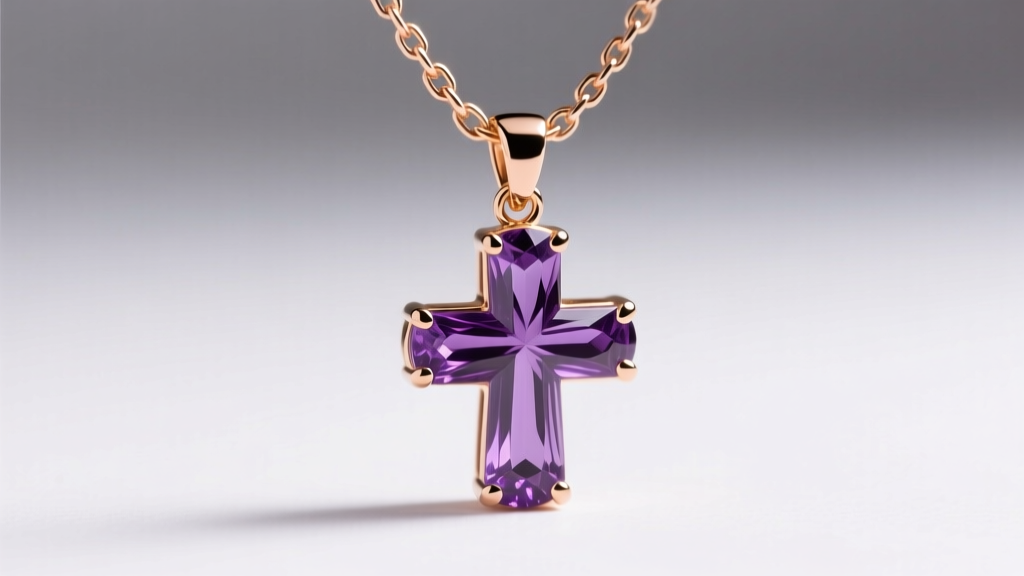
To ensure longevity, adhere to the following chain engineering specifications:
- Gauge Thickness: Avoid chains thinner than 0.9mm. For pendants weighing over 10 grams, a 1.2mm to 1.5mm gauge is mandatory to prevent the chain from stretching or snapping at the solder points.
- Chain Style: Box chains and wheat (spiga) chains offer superior tensile strength and resist kinking compared to delicate cable or snake chains. The rigid geometry of a box chain also visually complements the structured lines of a cross pendant.
- Clasp Mechanics: Discard standard spring-ring clasps for heavy pendants. Opt for a lobster claw clasp with a reinforced jump ring, or ideally, a locking box clasp with a figure-eight safety latch for pendants exceeding 15 grams.
- Bail Proportions: Ensure the pendant's bail (the loop connecting the cross to the chain) has an interior diameter at least 0.5mm larger than the chain's exterior width to prevent friction wear.
Authenticity Verification: Spotting Synthetics and Glass
The market is saturated with synthetic alternatives. Hydrothermal synthetic amethyst is chemically identical to natural quartz but is grown in a laboratory over a few weeks. Furthermore, purple glass or cubic zirconia are frequently passed off as genuine amethyst in mass-market cross necklaces.
According to mineralogical data from Mindat.org, natural amethyst exhibits specific crystallographic traits. Under a polariscope, natural amethyst will display 'Brazil twinning'—alternating bands of right-handed and left-handed quartz crystals that create a distinctive zebra-stripe interference pattern. Hydrothermal synthetics typically lack this complex twinning or exhibit a uniform, unnatural extinction pattern. Additionally, natural stones will feature microscopic mineral inclusions (like goethite or hematite needles), whereas glass imitations will contain perfectly spherical gas bubbles and flow lines.
Care and Maintenance Protocols
Amethyst registers a 7 on the Mohs hardness scale, making it highly resistant to scratching from everyday dust (which contains quartz particles). However, it is vulnerable to thermal shock and prolonged UV exposure.
Never clean an amethyst cross necklace using an ultrasonic cleaner if the stone has surface-reaching fractures, as the high-frequency vibrations can cause the arms of the cross to fracture. Furthermore, prolonged exposure to direct sunlight or high heat (such as leaving the necklace on a car dashboard) can cause the iron impurities responsible for the purple color to oxidize, permanently fading the stone to a yellowish-brown citrine hue. For routine maintenance, soak the pendant in lukewarm water with a mild, phosphate-free dish soap, gently agitate with a soft-bristled brush, and dry with a microfiber cloth to maintain the metal's polish and the gem's optical clarity.


