Mastering the Vintage Necklace Display: Archival Mounting & Care
Learn expert techniques for archival vintage necklace display. Discover mounting materials, tension mapping, and preservation tips for antique jewelry.

The Chemistry of Display: Why Standard Busts Destroy Antiques
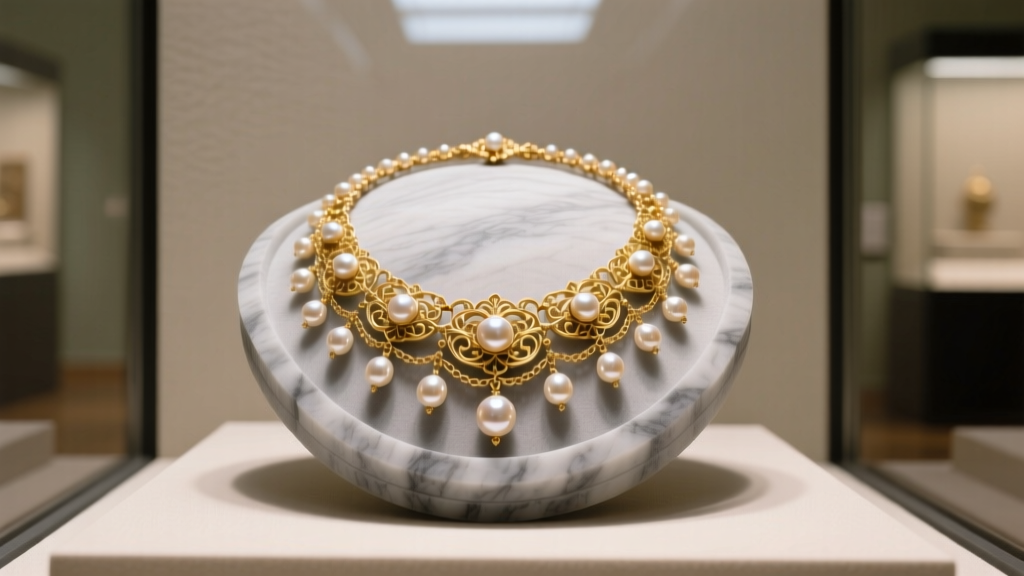
Curating a professional vintage necklace display requires far more than aesthetic arrangement; it demands a rigorous understanding of material chemistry. The vast majority of commercial jewelry busts are constructed from polyurethane foam and wrapped in dyed velvet or synthetic suede. While visually appealing, these materials are highly destructive to antique jewelry. Polyurethane degrades over time, releasing acidic vapors that accelerate the tarnishing of silver and the corrosion of base metal alloys. Furthermore, standard velvet often contains sulfur-based dyes, which react catastrophically with sterling silver, causing rapid, deep-black tarnishing that requires abrasive polishing to remove—thereby stripping away historical patina and microscopic layers of precious metal.
To execute a museum-grade vintage necklace display, conservators rely on chemically inert substrates. According to guidelines published by the Smithsonian Museum Conservation Institute, all materials coming into direct contact with antique jewelry must pass the Oddy Test, a standardized accelerated aging test that identifies off-gassing pollutants. For professional and high-end private collectors, this means abandoning commercial displays in favor of custom-built mounts utilizing unbleached cotton, acid-free mat board, and closed-cell polyethylene foams.
Tension Mapping for Era-Specific Silhouettes
Gravity is the silent enemy of vintage neckwear. Different historical eras utilized distinct stringing materials and structural geometries that require highly specific support mechanisms during display. Applying uniform tension across a delicate antique piece can lead to silk thread snapping, metal fatigue, or the permanent deformation of fragile wirework.
Victorian Festoons and Seed Pearls
Victorian festoon necklaces, characterized by their multiple swags and drops, were frequently strung on natural silk thread. When displayed flat or hung vertically by the clasp, the cumulative weight of the glass beads, gold pampilles, or seed pearls places immense sheer stress on the primary silk knotting. A proper vintage necklace display for these pieces requires a contoured, sloped mount that supports the weight of each individual swag. By carving precise channels into archival foam, the display surface bears the gravitational load, leaving the silk threads entirely slack and free from tension.
Art Deco Platinum Lariats and Sautoirs
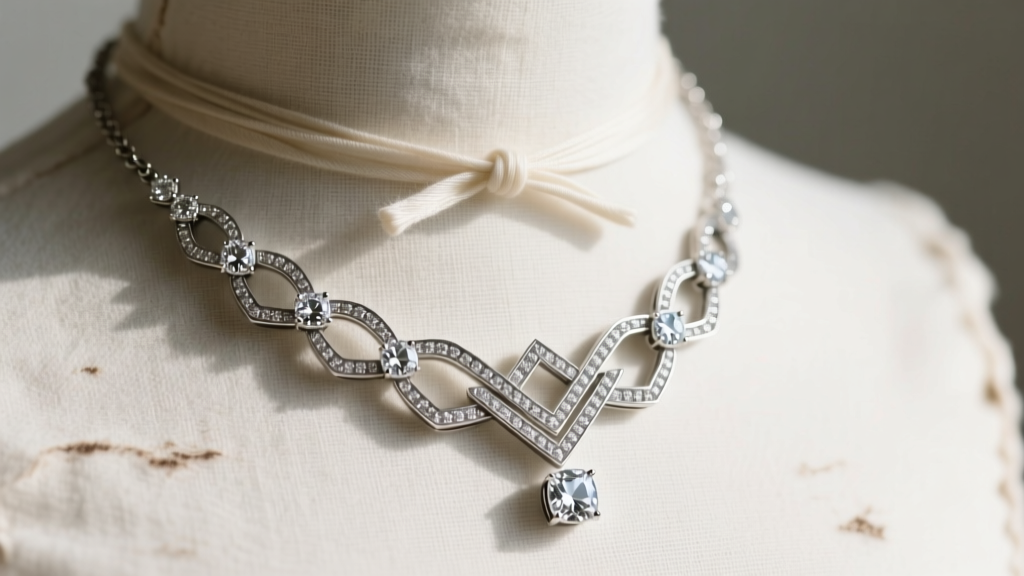
Conversely, 1920s Art Deco sautoirs and platinum lariats present a different challenge. Platinum is incredibly strong but highly susceptible to work-hardening and metal fatigue if subjected to micro-vibrations or sharp folding. When displaying long, heavy platinum and diamond lariats, the necklace should never be draped over a sharp 90-degree edge. Instead, utilize a broad, gradual curve with a minimum radius of three inches. Invisible polyester monofilament ties (such as Melinex) should be used to gently secure the lariat's terminal tassel, preventing it from swinging and causing kinetic stress to the upper chain links.
Archival Material Compatibility Matrix
Selecting the correct mounting material is critical for preventing chemical migration. Below is a technical matrix detailing the appropriate substrates for various antique necklace components, drawing on conservation standards from the Getty Conservation Institute.
| Display Material | pH Level | Off-Gassing Risk | Best Used For | Strictly Avoid With |
|---|---|---|---|---|
| Volara (Polyethylene Foam) | Neutral (7.0) | None | Custom carving, heavy gold, platinum | N/A (Universally safe) |
| Unbleached Cotton Muslin | 6.5 - 7.5 | Low | Draping, silver chains, beadwork | Sharp gemstones (can snag) |
| Acid-Free Mat Board | 8.0 - 8.5 | None | Backing boards, rigid flat displays | Direct contact with pearls |
| Polyester Film (Melinex) | Neutral | None | Ties, barriers, window mounts | Heavy items (slippery surface) |
| Standard Dyed Velvet | 4.0 - 6.0 | High (Sulfur) | Non-archival props only | Silver, copper, organics |
Lighting and Microclimate Control
A flawless vintage necklace display is useless if the ambient environment degrades the piece. Lighting must be strictly controlled based on the material composition of the necklace. While diamonds, platinum, and gold are relatively light-stable, many Victorian and Edwardian necklaces incorporate organic materials such as jet, amber, tortoiseshell, coral, and natural pearls.
Organic gems are highly susceptible to photochemical degradation. Exposure to ultraviolet (UV) and high-intensity visible light causes amber to craze (develop microscopic surface cracks) and jet to fade and brittle. For any vintage necklace display featuring organic components, illumination must be capped at 50 lux. Furthermore, the light source must be LED with a Color Rendering Index (CRI) of 95 or higher to accurately represent the subtle hues of antique gemstones without emitting the UV radiation inherent in halogen or fluorescent bulbs.
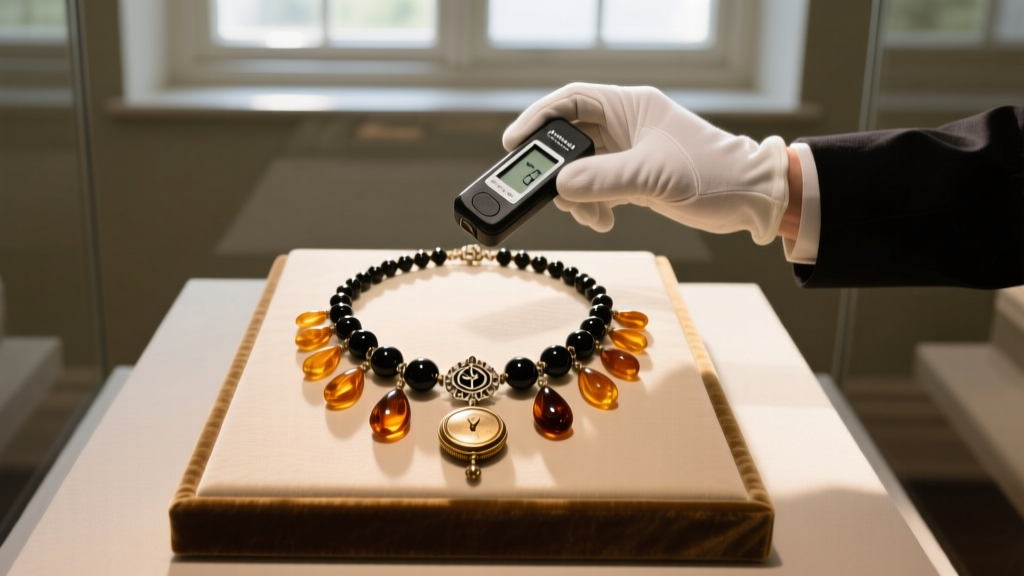
Beyond lighting, microclimate control is essential. Fluctuations in relative humidity (RH) cause natural pearls to crack and silk threads to stretch or rot. High-end display vitrines should incorporate conditioned silica gel cassettes (such as Prosorb) hidden beneath the mount to maintain a stable RH of 45-50%. Never use standard desiccant packets, as they can over-dry the environment and cause irreversible damage to organic inlays.
Step-by-Step: Building a Custom Volara Mount
For collectors and curators looking to build a bespoke vintage necklace display, Volara Type A (2mm or 6mm thickness) is the industry standard closed-cell foam. Here is the professional workflow for creating a custom mount:
- Template Creation: Lay the necklace on a sheet of acid-free tissue paper. Trace the exact outline of the chain, pendants, and clasp using a soft graphite pencil.
- Adhesion: Mount the Volara foam to a rigid, acid-free backing board using Paraloid B-72, an ethyl methacrylate copolymer adhesive favored by conservators for its reversibility and chemical stability. Never use hot glue or PVA, which off-gas acetic acid.
- Carving: Using a fresh scalpel blade, carve shallow channels into the foam following your template. The channels should be just wide and deep enough to cradle the chain, preventing lateral movement without pinching the metal.
- Smoothing: Use a thermal spatula set to a low temperature to gently melt and smooth the edges of the carved channels. This removes any microscopic foam burrs that could catch on delicate filigree or prong settings.
- Securing the Piece: Once the necklace is seated in the channels, use microscopic stitches of unbleached cotton thread or narrow strips of Melinex to secure the heaviest focal points (like a central locket or large pendant) to the foam, ensuring zero stress on the chain's jump rings.
Preserving History Through Technical Precision
Executing a proper vintage necklace display is an exercise in preventative conservation. By understanding the chemical vulnerabilities of antique metals, mapping the gravitational tension of historical stringing methods, and strictly controlling the photometric and hygroscopic environment, collectors can ensure these wearable artifacts survive for future generations. The investment in archival-grade materials and custom carving techniques pays dividends not only in the preservation of the jewelry's financial value but in the safeguarding of its irreplaceable historical integrity.