2026 Artistry Necklace Trends: Sculptural & Mixed-Media Styling
Discover 2026 artistry necklace trends, exploring sculptural mixed-media designs, titanium anodization, styling frameworks, and expert care protocols.

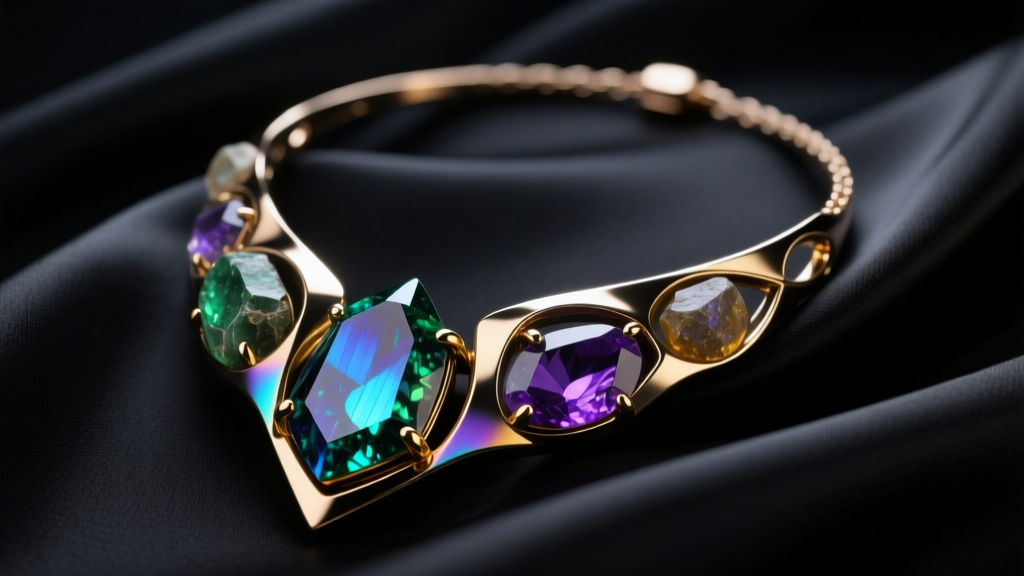
The Evolution of the Artistry Necklace in 2026
The jewelry landscape of 2026 has decisively pivoted from the understated "quiet luxury" of previous years toward bold, expressive wearable sculpture. At the forefront of this movement is the modern artistry necklace—a category that transcends the traditional chain-and-pendant formula. Today’s artistry necklaces are engineered as unified, mixed-media compositions that blend high jewelry techniques with avant-garde industrial design. Rather than serving as mere accents, these pieces act as the structural anchor of a wardrobe, utilizing asymmetrical geometry, raw uncut gemstones, and advanced metallurgical treatments.
According to market analyses by The Business of Fashion, consumer demand for "statement craftsmanship" has surged, driven by a desire for investment pieces that showcase visible, tactile artistry. The 2026 artistry necklace is defined by its material contrasts: the warmth of recycled precious metals clashing against the matte, oxidized finishes of alternative alloys. This trend is not just about visual impact; it represents a fundamental shift in how we perceive the relationship between the human form and adornment, treating the décolletage as a dynamic canvas for three-dimensional art.
Core Materials Defining the Modern Artistry Necklace
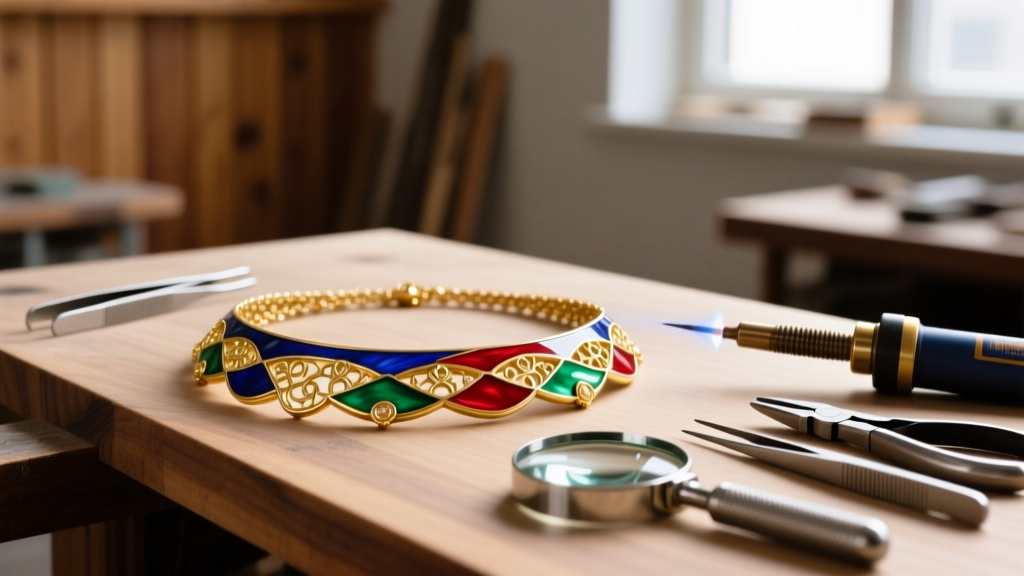
The structural integrity and visual depth of a contemporary artistry necklace rely heavily on material innovation. Jewelers are moving beyond standard sterling silver and 14k gold, opting for materials that offer unique mechanical properties and aesthetic possibilities.
Grade 5 Titanium (Ti-6Al-4V) and Anodization
Titanium has emerged as the backbone of the 2026 sculptural necklace. Specifically, Grade 5 titanium offers a Vickers hardness (HV) of approximately 349, compared to the 130 HV of standard 18k yellow gold. This immense strength-to-weight ratio allows artisans to craft expansive, 60mm-wide structural collars that weigh less than 35 grams. Furthermore, titanium undergoes electrolytic anodization—a process that alters the thickness of its surface oxide layer to produce vibrant, permanent colors (from deep purples to iridescent golds) without the use of dyes or plating that can wear off over time.
18k Recycled Gold and Plique-à-Jour Enamel
While titanium provides the architecture, 18k (750 purity) recycled gold provides the luxury finish and malleability required for intricate stone settings. In 2026, we are seeing a massive revival of plique-à-jour vitreous enamel. Unlike traditional opaque enamel, this technique creates a translucent, stained-glass effect within the gold framework. Because it lacks a metal backing, light passes directly through the enamel, creating a luminous, multi-dimensional effect that is highly prized in high-end artistry necklaces.
"The true mark of a 2026 artistry necklace is the seamless integration of conflicting materials. Fusing the industrial rigidity of titanium with the fragile, light-bending properties of vitreous enamel requires a mastery of thermal expansion rates that separates true artisans from mass manufacturers." — Gemological Institute of America (GIA) Metals & Materials Report.
Wearability vs. Sculptural Weight: A Technical Breakdown
A common failure mode in poorly designed sculptural jewelry is the underestimation of dynamic load. A heavy artistry pendant will exert significant kinetic force on the chain and clasp during normal movement. Below is a technical breakdown of material configurations and their necessary hardware requirements.
| Material Composition | Avg. Weight (45cm) | Clasp Requirement | Price Tier (USD) | Maintenance Risk |
|---|---|---|---|---|
| Solid 18k Gold & Raw Beryl | 55g - 85g | 10mm Magnetic Barrel w/ Safety | $8,500 - $22,000 | High (Stone fracture risk) |
| Grade 5 Titanium & Enamel | 25g - 40g | Double-Ring Spring Ring | $2,200 - $6,500 | Medium (Enamel chipping) |
| Oxidized Silver & Resin | 40g - 60g | Heavy-Duty Lobster (12mm) | $450 - $1,200 | Low (Resin scratching) |
Notice that standard 5mm lobster clasps are entirely omitted from the high-weight categories. The "whiplash effect" of a heavy pendant can easily deform a standard clasp's spring mechanism, leading to catastrophic loss. Always inspect the clasp hardware when evaluating an artistry necklace; the presence of a secondary safety chain or a high-grade neodymium magnetic clasp is a hallmark of thoughtful engineering.
Styling Frameworks: Necklines and Proportions

Styling an artistry necklace requires an understanding of spatial geometry and the "Rule of Thirds" as applied to the human torso. Because these pieces possess significant visual weight, pairing them with the wrong neckline can result in a cluttered, unbalanced silhouette.
- The Deep V-Neck (Sternum Drop): For necklaces with a drop length of 20 to 24 inches, a deep V-neck or scoop neck is mandatory. The negative space of the neckline frames the sculptural pendant, allowing the eye to follow the V-shape down to the focal point of the jewelry. Avoid high collars, which will cause the pendant to tangle and lay flat against the fabric, destroying its three-dimensional profile.
- The Asymmetrical / One-Shoulder (Collarbone Statement): Sculptural chokers and collar-length artistry necklaces (14 to 16 inches) pair exceptionally well with asymmetrical necklines. The rigid, often off-center geometry of the necklace complements the diagonal line of the garment, creating a cohesive, avant-garde look.
- The Boatneck / Bateau (Solar Plexus Elongation): A wide boatneck creates a strong horizontal line across the shoulders. To break this visual block, utilize an extra-long artistry necklace (28 to 32 inches) featuring a heavy, vertical pendant. This draws the eye downward, elongating the torso and preventing the upper body from looking overly broad.
When layering is desired, the 2026 protocol dictates mixing textures rather than chains. Pair a matte, anodized titanium artistry collar with a single, high-polish 18k gold lariat to create depth without visual chaos.
Identifying True Craftsmanship vs. Mass-Produced Imitations
As the artistry necklace trend grows, so does the market for CAD/CAM mass-produced imitations designed to look hand-fabricated. True E-E-A-T in jewelry appraisal requires looking past the surface polish and examining the structural joints.
Authentic artistry necklaces are typically fabricated—meaning they are sawed, forged, and soldered from sheet metal and wire. Under a 10x jeweler's loupe, fabricated pieces exhibit crisp, razor-sharp geometric edges and clean, flowing solder seams. Conversely, mass-produced pieces are usually created via lost-wax casting. Cast metal naturally develops a microscopic granular surface (porosity) and requires heavy tumbling and polishing to smooth out. This aggressive polishing inevitably rounds off sharp edges, giving the piece a slightly soft, melted appearance. Furthermore, cast pieces are more brittle and prone to snapping at stress points, such as the bail connecting a heavy pendant to the chain.
Always check for proper hallmarking. According to guidelines monitored by the Jewelry News Network, legitimate mixed-media pieces will feature laser-engraved purity marks (e.g., "750" for 18k gold) on the primary precious metal components, alongside the maker's mark, ensuring accountability and material authenticity.
Investment and Care Protocols for Mixed-Media Pieces
The complex material fusion in a 2026 artistry necklace demands specialized care protocols. The most common mistake owners make is utilizing ultrasonic cleaners. The high-frequency vibrations of an ultrasonic bath will shatter raw, uncut gemstones (like raw emeralds or tourmalines) and cause microscopic fractures in vitreous enamel, leading to immediate structural failure.
Instead, adopt a gentle, chemical-free cleaning regimen. Use a diluted non-ionic surfactant solution (such as a specialized jewelry wash or a mild, phosphate-free dish soap) and a soft goat-hair brush to gently dislodge oils and cosmetics from the intricate crevices of the sculpture. For titanium components, a simple wipe-down with a microfiber cloth dampened with isopropyl alcohol is sufficient to restore its anodized brilliance. Store the necklace flat in a climate-controlled environment, ideally suspended by its ends in a shadow box or lined drawer, to prevent the chain from kinking under the weight of the sculptural pendant.


