The Expert Guide to Choosing an Authentic Buddha Jade Necklace
Learn how to authenticate, grade, and style a genuine Buddha jade necklace. Explore jadeite types, carving details, and expert buying tips.

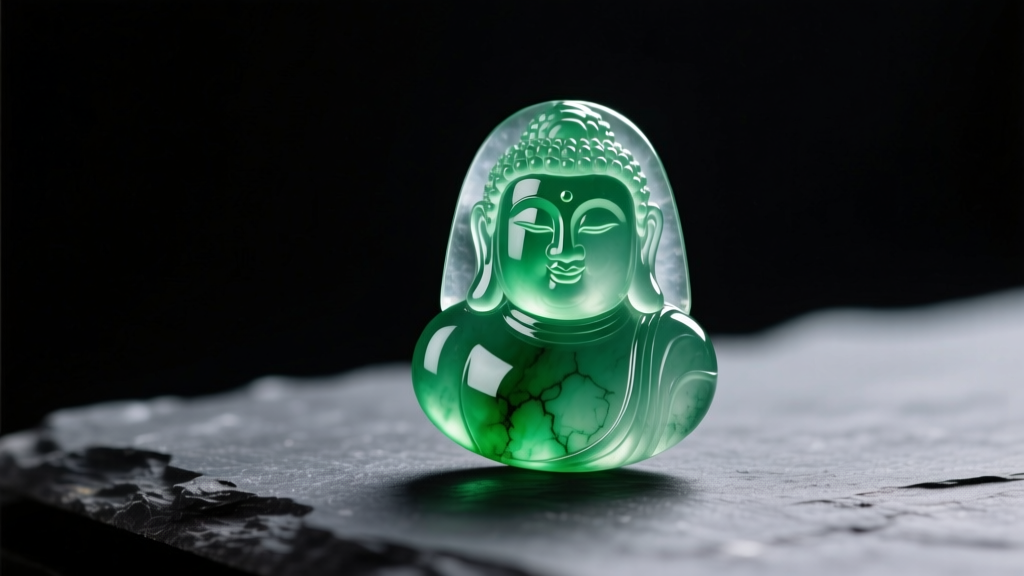
The Mineralogical Reality: Jadeite vs. Nephrite
When collectors and spiritual practitioners seek a buddha jade necklace, they are often unaware that the term "jade" encompasses two entirely distinct metamorphic minerals: jadeite and nephrite. Understanding this mineralogical divergence is the first step in expert-level acquisition.
Chemical Composition and Hardness
Jadeite is a sodium- and aluminum-rich pyroxene with the chemical formula NaAlSi2O6. It registers between 6.5 and 7 on the Mohs hardness scale, allowing it to achieve a brilliant, glass-like vitreous luster when polished. Nephrite, conversely, is a calcium- and magnesium-rich amphibole (Ca2(Mg,Fe)5Si8O22(OH)2). While slightly softer (6 to 6.5 on the Mohs scale), nephrite possesses a higher tensile strength due to its interlocking fibrous crystal matrix, making it exceptionally resistant to chipping.
Most high-end, translucent Buddha pendants on the luxury market are carved from Burmese jadeite. Nephrite, historically sourced from Hetian, China, or British Columbia, Canada, is prized for its deep, mutton-fat white or rich spinach green hues and is typically carved into more rustic, heavily textured Buddha figures.
The Treatment Spectrum: Navigating Type A, B, and C Jade
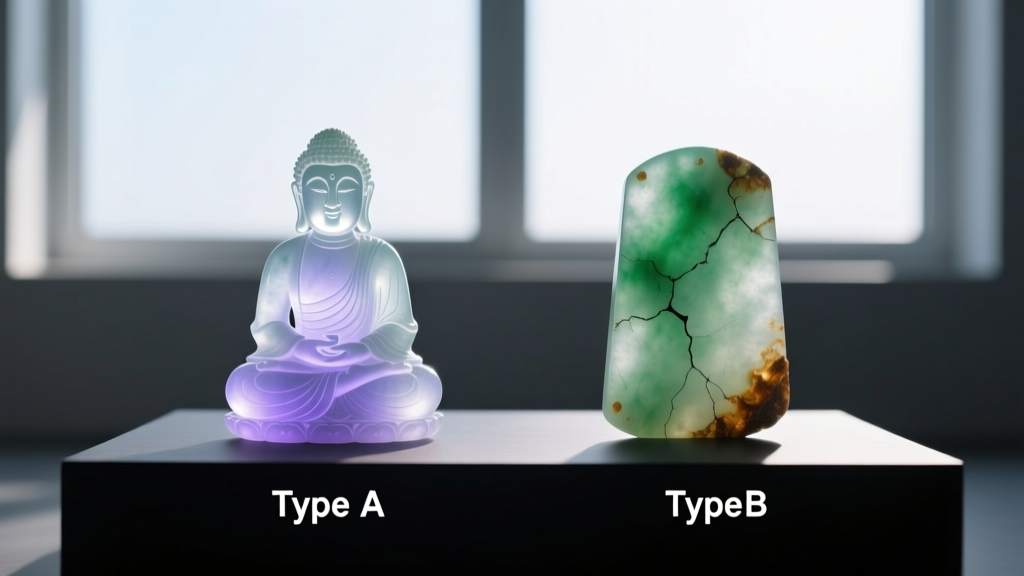
The most critical technical hurdle in purchasing a Buddha jade necklace is identifying chemical treatments. The gemological community categorizes jade into three distinct treatment types. According to the Gemological Institute of America (GIA), only Type A jade holds long-term investment and spiritual value.
- Type A (Untreated): 100% natural jadeite or nephrite. The only acceptable enhancement is a traditional surface polishing with natural beeswax or plum juice to enhance luster. This is the only grade suitable for heirloom-quality Buddha pendants.
- Type B (Bleached and Polymer-Impregnated): Lower-quality jade is soaked in hydrochloric or nitric acid to remove brown or yellow oxidation stains. This process destroys the crystal structure, leaving microscopic voids that are subsequently filled with optically clear epoxy resins. Over 5 to 10 years, the polymer yellows and becomes brittle, ruining the pendant.
- Type C (Dyed): Jade is heated and submerged in chemical dyes to mimic rare colors like Imperial Green or lavender. The dye concentrates in microscopic fractures and fades under prolonged UV exposure.
Expert Authentication Techniques
While laboratory testing via Fourier Transform Infrared Spectroscopy (FTIR) is the only definitive way to detect polymer resins, field experts rely on specific visual cues. Under 40x magnification, Type B jade exhibits a "spiderweb" or "acid-etched" surface pitting where the acid has eaten away at the grain boundaries. Furthermore, shining a long-wave UV light (365nm) on a suspect Buddha pendant will often reveal a chalky blue-white fluorescence if polymer resins are present.
Evaluating Transparency: The "Water" Grading System
In the Asian gem markets, the transparency of jadeite is referred to as its "water" (shui). When selecting a Buddha carving, the water grade dictates how light interacts with the stone, profoundly affecting the carving's perceived depth and spiritual resonance.
"A high-water jadeite Buddha pendant does not merely reflect light; it captures and diffuses it internally, creating a glowing halo effect known as the 'fluorescent bloom' or 'qi'."
The Four Primary Water Grades
- Glass Species (Bo Li): Near-perfect transparency, resembling optical glass. Extremely rare and commands auction-level premiums.
- Ice Species (Bing Zhong): Semi-transparent with a crystalline, icy appearance. The most sought-after grade for premium Buddha necklaces, balancing translucency with structural integrity.
- Sticky Rice Species (Nuo Mi): Translucent to opaque, resembling the semi-clear look of cooked sticky rice. Excellent for detailed carvings where opacity helps define facial features.
- Bean Species (Dou Zhong): Opaque with visible, coarse crystal grains. Generally used for mass-market, low-cost tourist pendants.
Iconography and Carving Precision
The technical execution of the carving is just as vital as the material. A master carver utilizes the natural color variations (qiao se) and structural flaws of the rough jade to inform the design. When inspecting a Buddha jade necklace, evaluate the following technical parameters:
Proportions and Symmetry
For a Laughing Buddha (Budai), the facial proportions must be perfectly symmetrical, with the earlobes elongated and touching the shoulders—a hallmark of master-level carving. The transition from the highly polished facial features to the matte-finished robes should be crisp, with zero visible rotary tool marks under 10x magnification.
Undercutting and Depth
Advanced carvers utilize deep undercutting to separate the Buddha's arms from the torso or to create the illusion of layered robes. This technique is highly risky; a single miscalculation can fracture the stone. Pendants featuring deep, clean undercuts without micro-fractures indicate exceptional craftsmanship and command a 30% to 50% premium over flat, relief-style carvings.
Mounting Mechanics: Cords, Chains, and Hardware
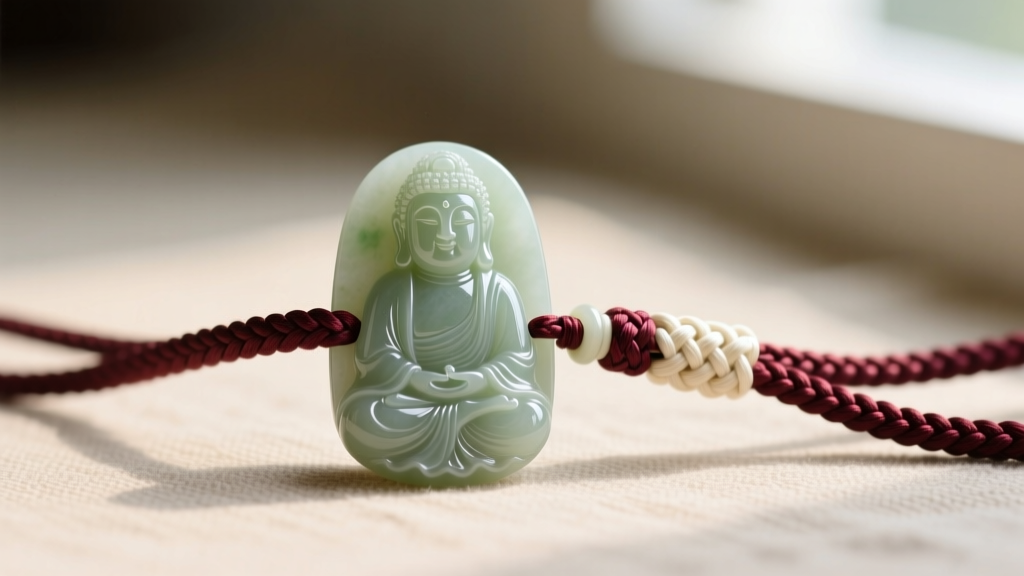
The structural mounting of a Buddha jade necklace requires careful consideration of weight distribution and material compatibility. Jade is heavy, and improper mounting leads to bail failure or cord snapping.
Hardware Selection
Avoid cheap base-metal bails plated in gold; the plating will wear off, and the underlying brass or nickel can cause skin irritation and chemically react with the jade's surface oils. Expert buyers insist on solid 18k gold, platinum, or titanium bails. The bail's internal loop must be smoothly polished; any microscopic burrs will act like a saw against the silk cord, eventually severing it.
Cord vs. Chain
While 18k gold box chains offer a luxurious aesthetic, they are prone to kinking under the pendulum-like weight of a dense jadeite Buddha. The traditional and structurally superior choice is a hand-braided silk or nylon cord. Nylon is preferred for daily wear due to its resistance to sweat and moisture degradation. The knotting technique should employ a sliding macrame closure, eliminating the need for a metal clasp that could scratch the pendant when stored.
Market Valuation and Pricing Matrix
Pricing a Buddha jade necklace requires synthesizing the material grade, color, and carving quality. The following matrix provides a baseline for Type A Burmese Jadeite pendants (approximately 15-25 carats) in the current market, as supported by data from authoritative dealers like Mason-Kay Fine Jade Jewelry.
| Grade / Species | Color Profile | Carving Quality | Estimated Retail Price (USD) |
|---|---|---|---|
| Bean Species | Mottled Green / White | Machine-carved, flat relief | $50 - $250 |
| Sticky Rice | Even Apple Green | Hand-carved, standard polish | $400 - $1,200 |
| Ice Species | Colorless / Icy White | Master-carved, deep undercut | $2,500 - $8,000 |
| Ice Species | Vivid Imperial Green | Master-carved, flawless | $15,000 - $50,000+ |
| Glass Species | Intense Emerald Green | Museum-grade, signed artist | $100,000+ (Auction) |
Final Considerations for the Collector
Acquiring an authentic, high-quality Buddha jade necklace is an exercise in mineralogical scrutiny and aesthetic appreciation. Always demand a recent gemological certificate from a tier-one laboratory such as the Swiss Gemmological Institute (SSEF), GIA, or Gubelin for any pendant exceeding $2,000. By prioritizing Type A natural jade, evaluating the precision of the carving, and selecting structurally sound mounting hardware, you ensure that your pendant remains both a spiritually significant talisman and a durable, appreciating asset.


