Authentic Necklace Indian Craftsmanship: A Technical Deep Dive
Explore the technical depths of the traditional necklace Indian artisans craft. Learn about BIS hallmarking, Kundan vs. Polki settings, and weight metrics.

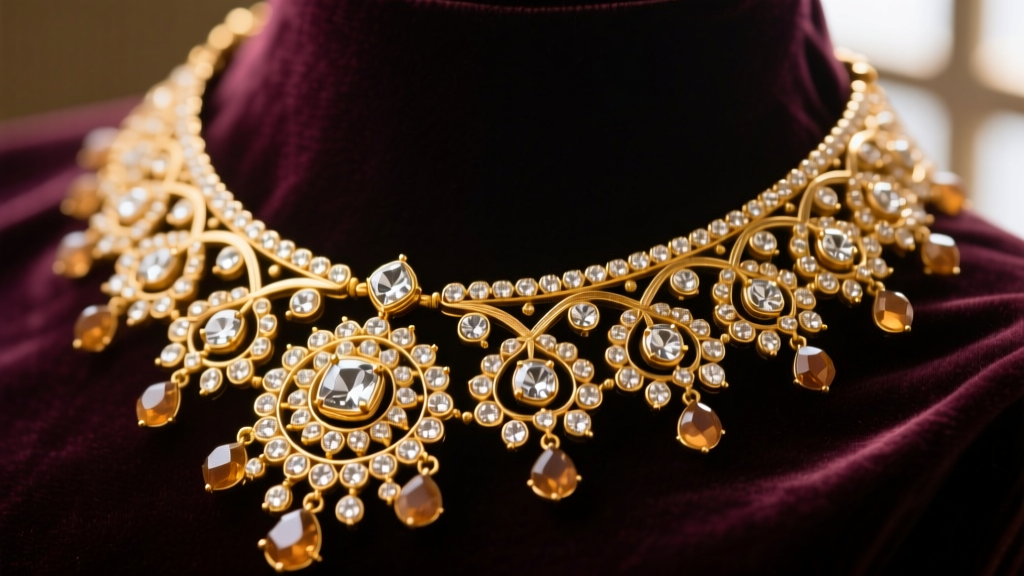
Introduction to Heritage Metallurgy and Structural Design
To truly appreciate a handcrafted necklace Indian artisans produce, one must look far beyond the superficial brilliance of the gemstones and understand the rigorous metallurgical and structural engineering involved. Traditional Indian jewelry is not merely decorative; it is a complex assembly of high-karat alloys, cold-soldering techniques, and tension-distribution mechanisms designed to support immense weight. In 2026, as global demand for heritage craftsmanship surges, distinguishing between authentic artisanal techniques and mass-produced cast imitations requires a granular understanding of metal purity, setting mechanics, and hallmarking protocols.
This technical deep dive dissects the anatomy of heritage Indian necklaces, focusing on the material science of 22-karat gold, the gemological realities of uncut diamonds, and the structural frameworks that prevent catastrophic failure in high-mass bridal pieces.
Decoding Metal Purity: The BIS 916 Standard and HUID
The foundation of any authentic Indian gold necklace is its alloy composition. Pure 24k gold (99.9% purity) possesses a Vickers hardness of roughly 25 HV, making it entirely unsuitable for structural jewelry; it will bend, warp, and lose tension under minimal stress. Therefore, Indian master jewelers rely on 22k gold, standardized as 916 purity (91.6% gold, 8.4% alloy metals).
The specific alloy mix dictates the tensile strength and color of the necklace. According to the Bureau of Indian Standards (BIS), the remaining 8.4% typically consists of silver, copper, and trace amounts of zinc. A higher copper ratio yields a rose-gold tint and increases shear strength, while a silver-dominant alloy maintains the traditional yellow hue but remains slightly softer.
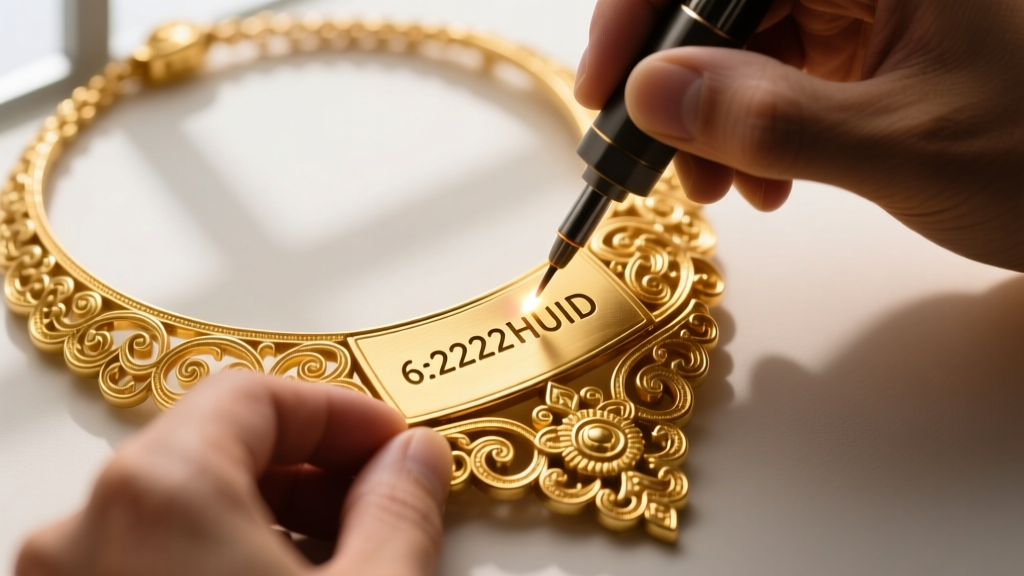
As of 2026, verifying this purity requires checking the 6-digit HUID (Hallmark Unique Identification) code. Unlike older laser stamps, the HUID is linked to a centralized database, ensuring the exact piece you are holding matches the certified assay report. Always inspect the clasp or the primary jump ring for this microscopic laser engraving.
Alloy Composition and Tensile Metrics
| Purity Grade | Gold Content | Primary Alloys | Tensile Strength (Approx.) | Best Application |
|---|---|---|---|---|
| 24K (999) | 99.9% | None | 120 MPa | Kundan foil (adhesive only) |
| 22K (916) | 91.6% | Silver, Copper, Zinc | 250-300 MPa | Chokers, Temple Necklaces, Chains |
| 18K (750) | 75.0% | Copper, Nickel, Zinc | 400-500 MPa | Prong settings, Modern Solitaires |
Gemological Setting Techniques: Jadau, Kundan, and Polki
The terminology surrounding Indian gemstone setting is frequently misunderstood, even by seasoned buyers. The Gemological Institute of America (GIA) notes that "Kundan" and "Polki" refer to entirely different components of the same assembly, yet they are often conflated in retail environments.
The Misconception of "Kundan" Glass
Kundan does not refer to a gemstone. It refers to highly refined, spongy 24k gold foil used as a cold-solder and bezel material. Because 24k gold is malleable, artisans use a specialized metal stylus called a salai to press and burnish the gold foil around the perimeter of a stone, locking it into a gold cavity without the use of heat or prongs. In modern mass-market jewelry, the term "Kundan" has been hijacked to describe faceted glass or cubic zirconia imitations. A true Kundan setting will always feature 24k gold foil and is typically paired with uncut diamonds or precious cabochons.
Polki: The Refractive Reality of Uncut Diamonds
Polki refers specifically to uncut, unfaceted, raw diamonds. Unlike modern brilliant-cut diamonds that rely on precise mathematical facet angles to return light, Polki diamonds are polished using traditional diamond-dust techniques to create a flat, smooth surface. They exhibit a softer, more diffused luminescence. When evaluating a Polki necklace, inspect the stones for natural inclusions and slight asymmetries. In 2026, the market has seen an influx of "lab-grown Polki"—synthetic diamonds that are deliberately left uncut. While chemically identical, their market valuation is a fraction of mined Polki, making independent gemological certification mandatory.
Pacchikam: The Silver Oxidized Alternative
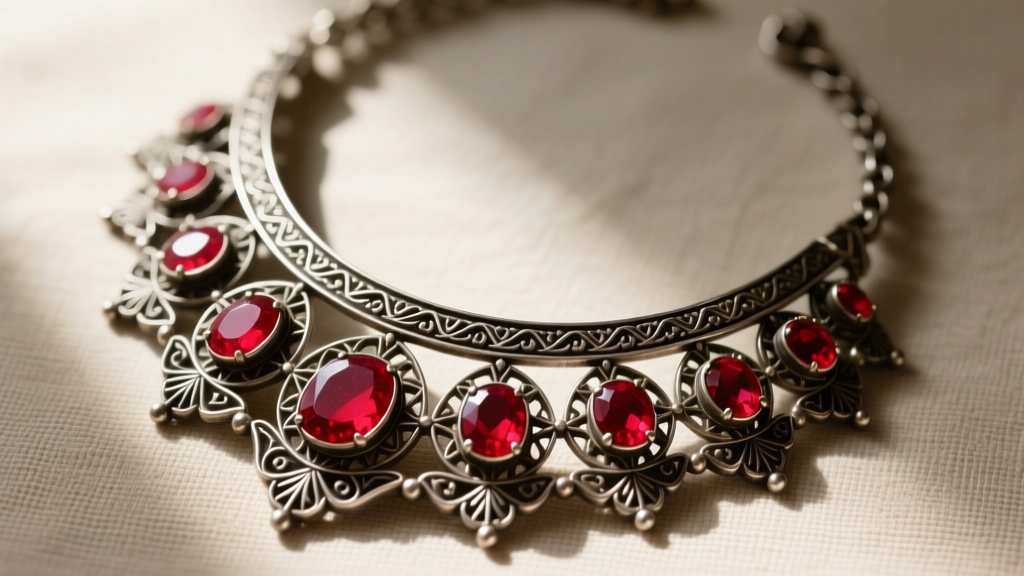
Originating from the Kutch region of Gujarat, Pacchikam is a distinct setting technique that utilizes a silver base rather than gold. The stones (often uncut rubies, emeralds, or glass) are set using a folded silver bezel, and the piece is intentionally oxidized to create a dark, rustic contrast. The backing of a true Pacchikam necklace is often left raw or finished with a simple foil, making it significantly lighter and more affordable than Jadau gold work, while offering a striking, bohemian aesthetic.
Structural Engineering: Managing High-Mass Pendants
A traditional Indian bridal necklace, such as a Rani Haar (queen's necklace) or a heavy Temple choker, can easily weigh between 150 and 300 grams. Suspending this mass entirely from a rigid gold chain creates immense shear stress on the cervical spine and poses a high risk of structural failure at the clasp points.
To mitigate this, heritage Indian jewelry employs specific engineering solutions:
- The Dori (Silk Cord): The posterior segment of heavy necklaces is rarely solid gold. Instead, it transitions into a braided silk or cotton cord (dori). This material possesses a higher tensile yield than 22k gold wire of the same thickness, prevents the necklace from sliding off the shoulders, and allows for micro-adjustments to distribute weight evenly across the trapezius muscles.
- The Lakadi (Wooden Core): To create voluminous, wide chokers without the prohibitive weight and cost of solid gold, master artisans carve a lightweight wooden or resin core (lakadi) and clad it in hammered 22k gold sheets. This reduces the overall mass by up to 40% while maintaining the structural rigidity required to support heavy pendant drops.
- Screw Clasps and Ladiya: Standard lobster clasps will snap under 150 grams of dynamic movement. Authentic heavy pieces utilize threaded screw-barrel clasps, often supplemented by a secondary safety chain and weighted tassels (ladiya) at the back to act as a counterbalance, keeping the primary pendant centered on the sternum.
Valuation Framework: Calculating True Intrinsic Value
Purchasing a heritage Indian necklace requires abandoning the "one-rate" pricing model common in Western retail. According to the World Gold Council, the Indian market operates on a highly transparent, component-based valuation framework. To ensure you are not overpaying for craftsmanship at the expense of intrinsic material value, use the following formula to audit your purchase:
Total Valuation = (Gold Weight × Daily 22k Rate) + (Stone Weight × Carat Rate) + Making Charges (VA) + GST (3%)
Making Charges (Value Addition): This is where jewelers generate profit. For machine-cast chains, making charges should not exceed 10-15% of the gold value. For handcrafted Jadau or Kundan work, making charges legitimately range from 25% to 40% due to the hundreds of hours of skilled labor required. However, you must demand a segregated invoice. If a jeweler refuses to break down the gold weight, stone weight, and making charges separately, walk away. Furthermore, when calculating the gold weight, ensure the jeweler has deducted the weight of any wax, lacquer, or wooden cores used inside hollow components.
By mastering these technical parameters—from verifying the HUID hallmark to understanding the shear strength of a silk dori—you transition from a passive consumer to an informed archivist of one of the world's most complex metallurgical traditions.


