How to Authenticate and Restring a Vintage Jade Bead Necklace
Learn how to authenticate, clean, and professionally restring a vintage jade bead necklace with our step-by-step gemological guide.

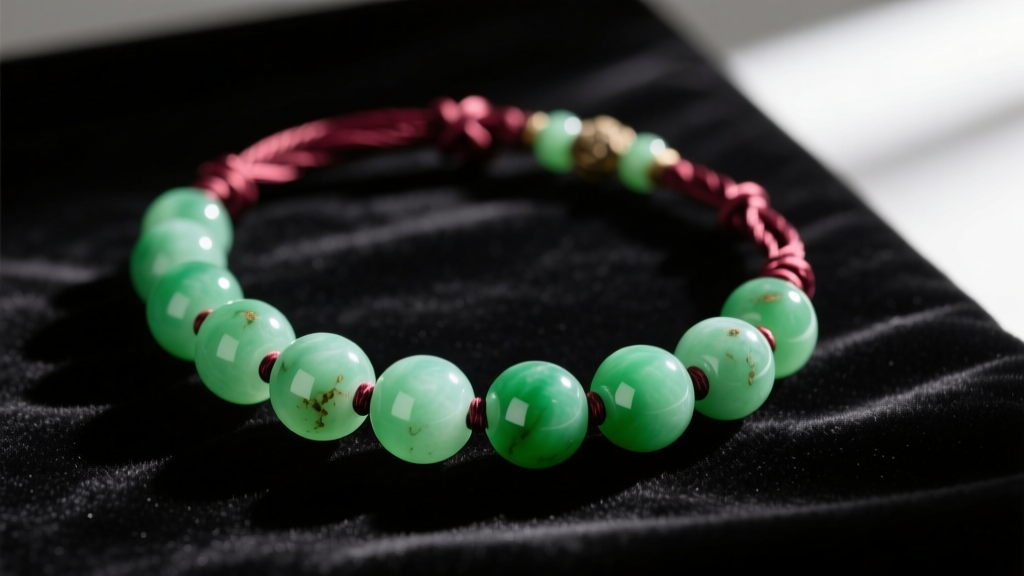
The Allure and Risks of Vintage Jade Jewelry
A vintage jade bead necklace is more than just an accessory; it is a piece of history. Whether inherited from a relative or discovered at an estate sale, vintage jade carries a profound cultural significance and a timeless aesthetic. However, the secondary market for jade is notoriously fraught with misrepresentations, synthetic imitations, and degraded stringing materials. According to the Gemological Institute of America (GIA), jade refers to two distinct minerals: nephrite and jadeite. Vintage pieces from the mid-20th century often feature Burmese jadeite, which is highly prized but frequently subjected to chemical treatments to enhance its color and translucency.
Beyond authentication, the physical integrity of a vintage strand is a major concern. Silk thread, the traditional material used for knotting jade beads, degrades over time due to exposure to skin oils, cosmetics, and environmental humidity. A snapped strand can result in the loss of priceless beads. This comprehensive guide will walk you through the exact gemological steps to authenticate your jade, assess its condition, and professionally restring it using archival-quality materials.
Step 1: Gemological Authentication (Testing the Jade)
Before attempting any physical restoration, you must verify that your beads are genuine jade and not glass, serpentine, or dyed chalcedony. While advanced spectroscopy requires a lab, several highly reliable tests can be performed at home.
Visual and Tactile Inspection
Genuine jade possesses a high thermal conductivity. When pressed against the skin or the inside of your wrist, real jade will feel distinctly cold and will take several seconds to warm up to your body temperature. Glass and plastic imitations will warm almost instantly. Visually, inspect the beads under a 10x jeweler's loupe. Natural jadeite exhibits a fibrous, interlocking granular structure. If you see perfectly uniform color, air bubbles, or a conchoidal (glass-like) fracture pattern near the drill holes, the beads are likely glass or resin.
Advanced Testing: Specific Gravity (SG)
The most definitive non-destructive test for jade is measuring its specific gravity. You will need a precision digital scale (accurate to 0.01g), a cup of water, and a wire basket.
- Weigh the dry necklace on the scale and record the weight (e.g., 45.50g).
- Place the cup of water on the scale and tare it to zero.
- Suspend the necklace in the water using the wire basket, ensuring it is fully submerged but not touching the sides or bottom. Record the suspended weight (e.g., 13.70g).
- Divide the dry weight by the suspended weight (45.50 / 13.70 = 3.32).
Jadeite has an SG of 3.30 to 3.38, while nephrite ranges from 2.90 to 3.03. If your result is around 2.50, you are holding glass. If it is under 2.0, it is likely plastic.
Step 2: Assessing Treatments and Condition
Not all natural jade is created equal. The jewelry industry categorizes jade into three distinct treatment grades, which drastically affect both the value and the cleaning methods you must use.
| Grade | Treatment Process | Durability & Care | Market Value |
|---|---|---|---|
| Type A | Completely natural; only polished with traditional plum wax. | Highly durable. Safe for gentle ultrasonic cleaning. | Premium (Investment grade) |
| Type B | Bleached with acid to remove brown spots, then impregnated with polymer resin. | Brittle. Resin yellows over time. Never use ultrasonic. | Moderate to Low |
| Type C | Dyed to enhance green or lavender colors, often combined with Type B treatments. | Poor. Dye bleeds with heat or harsh chemicals. | Low (Novelty grade) |

The UV Fluorescence Test
To determine if your vintage beads are Type B (polymer-impregnated), use a long-wave (365nm) ultraviolet flashlight in a dark room. Type A jade is generally inert or shows very weak fluorescence. Type B jade, however, will often emit a strong, chalky blueish-white glow due to the polymer resins used to fill the acid-etched pores. If your beads glow brightly, you must avoid all heat, steam, and chemical cleaners during the restoration process.
Step 3: Sourcing Materials for Restringing
Once authenticated, the old, frayed silk must be removed. Carefully snip the thread near the clasp and slide the beads off into a soft, velvet-lined tray. Before restringing, clean the beads using lukewarm water and a single drop of pH-neutral dish soap, gently brushing around the drill holes with a baby hairbrush. Never use ultrasonic cleaners on vintage jade, as the high-frequency vibrations can shatter beads with internal micro-fractures.
For restringing, you need archival-quality materials:
- Thread: Use 100% Chinese silk thread (Size #2 or Size E for 6mm-10mm beads). Silk is preferred over nylon because it knots securely and drapes with a fluid, heavy elegance that nylon cannot replicate.
- French Wire (Gimp): A fine, coiled metal wire used to protect the silk from fraying against the metal clasp.
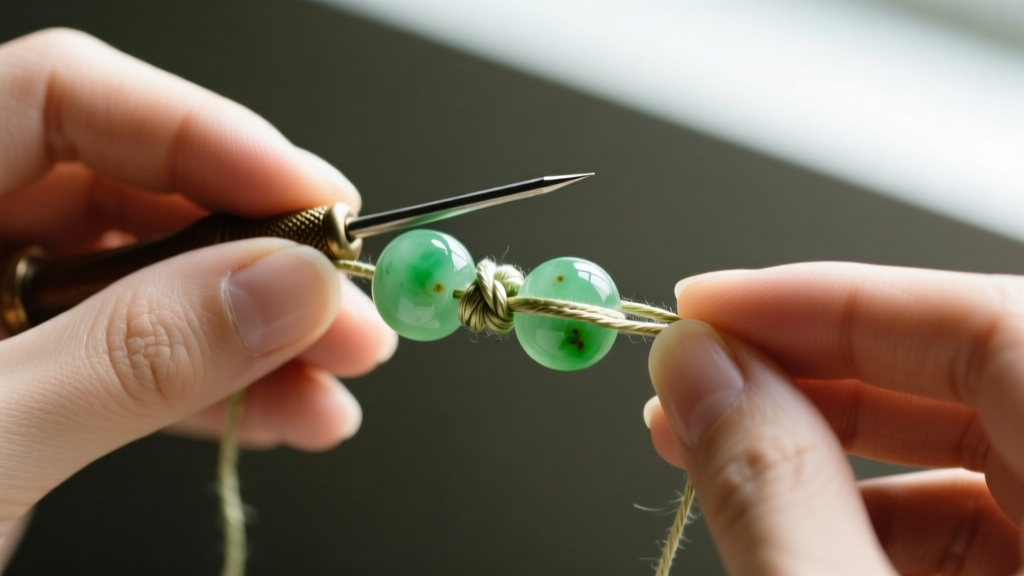
- Bead Awl: A specialized tool with a fine, tapered steel needle used to push knots tightly against the beads.
- Clasp: A solid 14k or 18k gold filigree box clasp with a safety catch. Avoid lobster clasps, as they detract from the vintage aesthetic and lack the security of a box clasp.
Step 4: Step-by-Step Restringing and Knotting
Restringing a jade bead necklace requires patience and precision. The goal is to ensure every bead is individually knotted so that if the strand breaks, only one bead is lost. According to stringing experts at Fire Mountain Gems, proper knotting also prevents the beads from rubbing against each other, which can dull the polish over decades of wear.
- Prepare the Clasp: Cut a 3-inch piece of French wire. Thread your silk through the wire, then through the ring of your clasp. Fold the silk back on itself and tie a secure overhand knot, pulling the French wire snug against the clasp ring to hide the silk.
- Thread the Beads: Using a twisted wire beading needle, thread all your jade beads onto the silk in the desired pattern. Do not knot them yet.
- The First Knot: Pass the needle through the first bead. Tie a loose overhand knot. Insert the tip of your bead awl into the knot, pull it snug against the bead, and slowly tighten the silk while sliding the awl down to the bead's surface.
- Continue Knotting: Repeat this process for every single bead. The knots should be tight enough to prevent bead movement but not so tight that they pucker the silk or cause the necklace to stiffen.
- Finish the Clasp: Once all beads are knotted, attach the second half of the clasp using the French wire method. Apply a microscopic drop of jewelers' epoxy (like G-S Hypo Cement) to the final knot before trimming the excess silk.
Step 5: Proper Cleaning and Long-Term Storage
With your vintage jade bead necklace freshly authenticated and professionally restrung, proper maintenance is crucial to preserving its legacy. Jade is a porous mineral that actually benefits from mild hydration. Wearing the necklace regularly allows natural skin oils to subtly polish the surface, enhancing its luster over time.
Expert Gemologist Tip: Never store vintage jade in a dry, airtight plastic bag or near heat sources like radiators. Severe dehydration can cause the natural wax polish to crack and, in the case of Type B jade, can cause the polymer fillers to shrink and cloud. Store the necklace flat in a fabric-lined jewelry box with a slightly damp (not wet) cotton ball placed in the corner of the drawer to maintain ambient humidity.
Conclusion
Restoring a vintage jade bead necklace is a meticulous process that bridges gemological science and traditional jewelry craftsmanship. By rigorously testing the specific gravity, identifying polymer treatments via UV light, and restringing the beads with knotted silk and French wire, you ensure that the piece remains structurally sound and historically intact. Whether you plan to wear it as a statement piece or pass it down to the next generation, your newly restored jade necklace will continue to radiate its timeless elegance for decades to come.


