How to Authenticate and Style a Carnelian Agate Necklace
Learn how to authenticate, clean, and style a genuine carnelian agate necklace with our expert gemology guide and step-by-step testing methods.

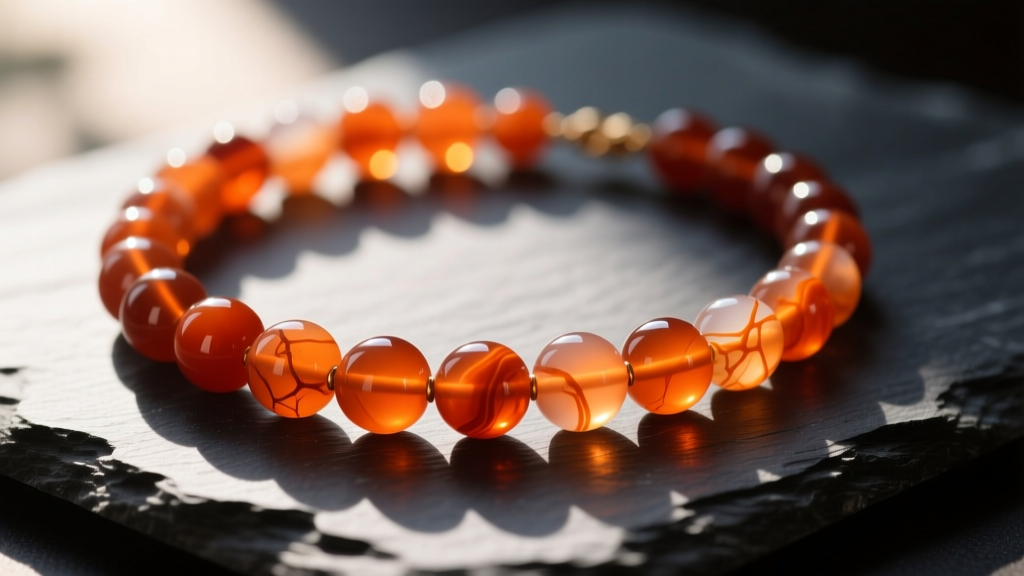
The Gemology of Carnelian Agate: Beyond the Surface
When shopping for warm-toned gemstone jewelry, the carnelian agate necklace remains a perennial favorite. However, the commercial jewelry market is saturated with misrepresented stones. To make informed purchasing decisions, you must first understand the mineralogy of this gem. Carnelian is a variety of chalcedony, which is a cryptocrystalline form of silica (quartz and moganite). Its signature fiery orange to deep reddish-brown hues are caused by iron oxide inclusions, primarily hematite and goethite.
When this material exhibits distinct, parallel banding, it is technically classified as carnelian agate or sardonyx (if the bands alternate with white or brownish layers). According to the Gemological Institute of America (GIA), natural carnelian possesses a refractive index of 1.53 to 1.54 and a specific gravity of 2.58 to 2.64. It ranks at 6.5 to 7 on the Mohs hardness scale, making it durable enough for daily wear, yet vulnerable to specific types of mechanical and thermal stress. Understanding these baseline metrics is the first step in separating high-quality natural specimens from mass-produced imitations.
The Dyeing Epidemic in Commercial Gemstones
Data from Mindat.org and independent gemological labs indicate that up to 90% of the bright red "carnelian" on the market is actually pale gray chalcedony that has been chemically treated. The traditional method involves soaking the porous agate in an iron nitrate solution and baking it, which permanently alters the stone's color. While heat-treated iron is generally accepted and stable, modern cheap alternatives use organic red dyes that fade, bleed, and hold zero intrinsic gemological value. Authenticating your carnelian agate necklace is therefore not just about aesthetics; it is about protecting your investment.
Step-by-Step Guide to Authenticating Your Carnelian Agate Necklace
If you have acquired a carnelian agate necklace and want to verify its origins, follow this systematic testing protocol. You will need a 10x Hastings triplet loupe, pure acetone, cotton swabs, and a 365nm UV flashlight.
Step 1: The Magnification and Inclusion Test
Examine the beads under a 10x loupe in bright, direct light. Natural carnelian agate will display subtle, cloudy translucency and organic, slightly irregular banding. The color distribution should look like a gradient or a natural diffusion. If you notice microscopic "spiderweb" patterns where dark red pigment is heavily concentrated inside tiny surface-reaching fractures or drill holes, you are likely looking at dyed chalcedony. Dye pools in the path of least resistance, creating unnatural, sharp color boundaries that do not align with the stone's structural banding.
Step 2: The Acetone Swab Protocol
Dip a cotton swab in pure, 100% acetone (standard nail polish remover often contains oils and conditioners that will skew results). Gently rub the swab against a single bead, focusing near the drill hole where dye tends to accumulate. If the cotton turns red or orange, the stone has been treated with an unstable organic surface dye. Note: This test will not detect iron-nitrate heat treatment, but it will immediately expose cheap, artificially dyed beads that will eventually stain your skin and clothing.

Step 3: Ultraviolet (UV) Fluorescence
Shine a 365nm UV flashlight over the necklace in a dark room. Natural iron oxide inclusions in genuine carnelian are generally inert and will not fluoresce. Conversely, many synthetic organic dyes used to fake carnelian will exhibit a bright, unnatural green or blue fluorescence under UV light. This is a rapid, non-destructive way to screen an entire strand of beads at once.
Step 4: Backlighting and Transmission
Hold the necklace against a strong LED flashlight. Natural carnelian agate glows with a warm, cloudy, internal fire. The light should scatter through the microcrystalline structure, revealing soft, wavy bands. Dyed agate often appears overly opaque, or if it is translucent, the color will look flat, uniformly saturated, and lacking the deep, multidimensional "glow" characteristic of natural hematite inclusions.
Comparison Chart: Natural vs. Dyed Carnelian Agate
| Characteristic | Natural Carnelian Agate | Organic Dyed Chalcedony | Heat-Treated (Iron Nitrate) |
|---|---|---|---|
| Color Distribution | Gradient, cloudy, natural banding | Pools in fractures, spiderwebbing | Uniform, often overly bright red |
| Acetone Reaction | No color transfer | Red/orange transfer on swab | No color transfer |
| UV Light (365nm) | Inert (no fluorescence) | Often fluoresces green/blue | Inert |
| Market Value | Premium ($5 - $20+ per bead) | Low ($1 - $3 per bead) | Moderate (Accepted treatment) |
Cleaning and Maintenance Protocols
Caring for a carnelian agate necklace requires specific precautions due to its cryptocrystalline structure. While quartz is relatively hard, agates are prone to hidden micro-fractures and thermal shock.
- Avoid Ultrasonic Cleaners: The high-frequency vibrations can cause internal fissures to expand, especially in banded agates where differential hardness exists between layers.
- Thermal Shock Warning: Never clean your necklace with boiling water or steam. Sudden temperature changes can cause the silica structure to fracture or craze.
- The Safe Cleaning Method: Mix lukewarm distilled water with a few drops of pH-neutral dish soap. Use a soft, natural-bristle brush to gently clean around the drill holes and bead knots. Rinse with distilled water to prevent hard water spotting and pat dry with a microfiber cloth.
- Storage: Store the necklace flat or hung to prevent the silk or nylon thread from stretching. Keep it away from prolonged direct sunlight, which can cause heat-treated stones to fade over time.
Styling Frameworks for Warm-Tone Gemstones
A genuine carnelian agate necklace is a statement piece that requires thoughtful styling to integrate seamlessly into a modern wardrobe. The rich, terracotta and burnt-orange tones demand specific metal pairings and neckline considerations.

Metal Pairings and Color Theory
Carnelian sits on the warm side of the color wheel. To enhance its natural fire, pair it with 14k or 18k yellow gold. The golden undertones amplify the hematite inclusions, creating a cohesive, luxurious aesthetic. For a high-contrast, contemporary look, pair the orange-red beads with oxidized sterling silver or darkened rhodium. The cool, dark metal provides a striking backdrop that forces the carnelian to visually pop. Avoid highly polished white gold or platinum, as the stark, cool reflection can sometimes wash out the subtle banding of the agate.
Neckline Mapping and Layering
The length of your carnelian agate necklace dictates how it interacts with your clothing. Use this framework for optimal styling:
- The 16-Inch Choker: Best worn with scoop necks or off-the-shoulder tops. The beads should rest directly on the collarbone, framing the face with warm light.
- The 20-Inch Princess Length: Ideal for V-neck blouses and wrap dresses. The carnelian beads will trace the V-shape of the garment, drawing the eye downward and elongating the neck.
- Layering Technique: If layering, use the carnelian agate necklace as the foundational middle layer (18 inches). Pair it with a delicate 16-inch gold chain and a heavier 22-inch pendant. Ensure the carnelian beads are matte or semi-polished to prevent the necklace from looking overly heavy or cluttered against other metallic elements.
By mastering the gemological identification, proper care, and strategic styling of your carnelian agate necklace, you elevate it from a simple accessory to a curated, historically rich component of your personal jewelry archive.


