How to Authenticate a Vintage Crystal Bead Necklace
Learn how to authenticate, date, and restore a vintage crystal bead necklace with our expert guide on materials, clasps, and restringing techniques.

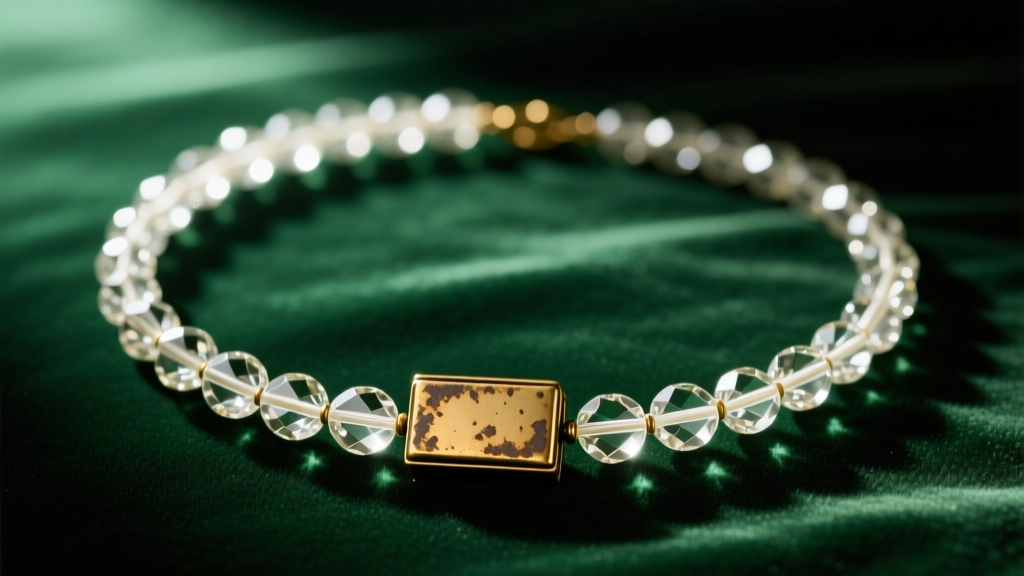
The secondary jewelry market is saturated with reproductions, making the authentication of a crystal bead necklace vintage collectors desire a highly technical endeavor. True vintage crystal is not merely glass; it is a complex material with specific optical and physical properties. Furthermore, the hardware and stringing methods used in the 1920s through the 1980s serve as vital forensic markers for dating and valuation. Whether you are an archivist, a reseller, or a collector, understanding the material science and structural anatomy of these pieces is essential for preservation and accurate appraisal.
The Material Science: Lead Crystal vs. Glass
To authenticate a vintage piece, you must first distinguish true lead crystal from standard soda-lime glass. According to the Gemological Institute of America (GIA), the addition of lead oxide (PbO) fundamentally alters the physical properties of the glass matrix. Vintage full lead crystal typically contains between 24% and 32% PbO, whereas modern 'crystal' (often lead-free due to 2026 EU and global environmental regulations) relies on barium or zinc oxides, which yield a different optical signature.
Key Diagnostic Metrics
- Refractive Index (RI): Standard glass has an RI of approximately 1.52. True vintage lead crystal boasts an RI of 1.70 or higher, giving it the signature 'fire' and brilliance when light hits the facets.
- Specific Gravity (SG): Lead crystal is significantly heavier. It has an SG of 3.10 to 3.20, compared to glass at 2.50. A genuine vintage crystal bead necklace will feel noticeably heavier in the hand than a glass imitation of the same dimensions.
- Acoustic Resonance: When gently tapped with a metal tool or another bead, lead crystal emits a sustained, high-pitched ringing tone, whereas glass produces a dull, short 'clack'.
- Mohs Hardness: Lead crystal is slightly softer (5.0 to 5.5) than standard glass (5.5 to 6.0). Under a 10x loupe, vintage crystal beads may show microscopic facet abrasions or 'wear lines' at the drill holes, which is a strong indicator of age and material softness.
Era Identification: Decoding Clasps and Stringing
The hardware used to secure the necklace is often more revealing than the beads themselves. Clasp evolution provides a reliable timeline for dating unbranded pieces. The Antique Jewelry University notes that manufacturing techniques for findings shifted dramatically post-WWII, allowing us to categorize necklaces into distinct eras.
| Era | Primary Clasp Type | Stringing Material | Bead Cut & Finish |
|---|---|---|---|
| 1920s - 1930s (Art Deco) | Filigree Box Clasp (Push-Pull) | Heavy Cotton or early Silk | Hand-cut geometric facets, matte etching |
| 1940s - 1950s (Mid-Century) | Threaded Barrel Clasp | 100% Silk (Knotted) | Machine-pressed rounds, early Aurora Borealis (AB) |
| 1960s - 1970s (Mod/Disco) | Hook and Eye / Simple Spring Ring | Nylon Monofilament or Silk | Large teardrops, vibrant opaque colors |
| 1980s (Power Dressing) | Magnetic or Large Lobster Claw | Coated Beading Wire (SoftFlex) | Over-sized faceted briolettes, high-lead content |
Technical Restoration: Re-stringing Protocols
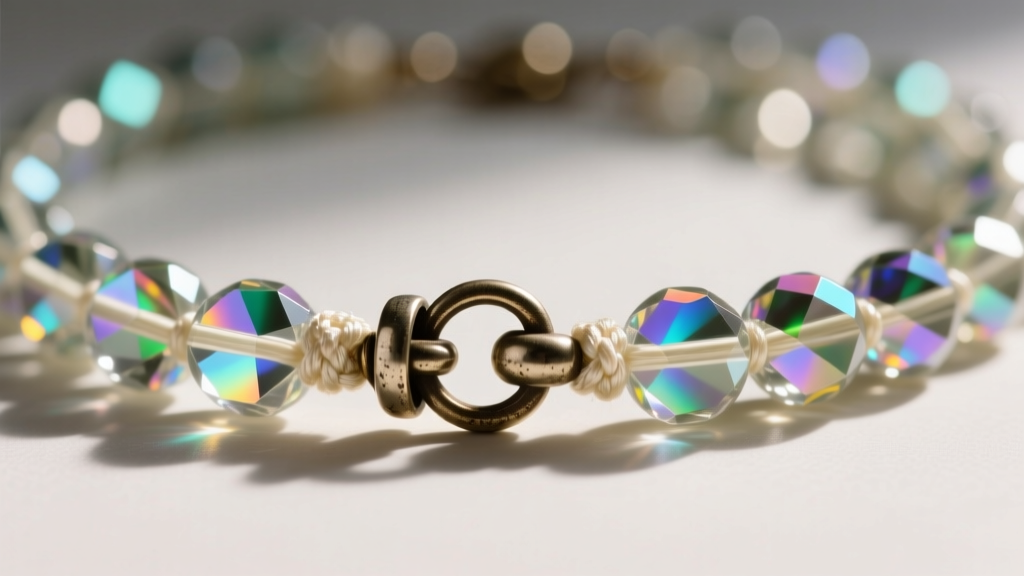
Restoring a vintage crystal bead necklace requires strict adherence to historical methods to maintain its value and drape. A common mistake made by amateur jewelers is re-stringing vintage silk-era necklaces on modern stainless steel beading wire. Wire creates a rigid, unnatural drape and can cause severe internal abrasion to the soft lead crystal drill holes over time.
Selecting the Correct Silk Thread
For authentic restoration, use 100% natural silk thread, such as the industry-standard Griffin brand. The thread size must be matched precisely to the bead's drill hole diameter to prevent excessive friction or sloppy knotting:
- Size #4 (0.55mm): Ideal for micro-beads (2mm - 3mm) with narrow drill holes.
- Size #6 (0.70mm): The most versatile size for standard 4mm - 5mm vintage crystal rounds.
- Size #8 (0.80mm): Required for heavy 6mm+ beads or large briolettes to support the increased specific gravity of the lead crystal.
The Necessity of French Wire (Bullion)
Never tie silk directly to a metal clasp. The friction of the metal against the organic silk fibers will cause the thread to fray and snap within months. You must use French wire (also known as bullion or gimp)—a microscopic, coiled spring of sterling silver or gold-filled wire. A 0.9mm diameter French wire is passed through the clasp ring, and the silk is threaded through the hollow center of the coil. This creates a flexible, abrasion-resistant bridge that protects the structural integrity of the knot.
Common Failure Modes and Diagnostics
When evaluating a piece for purchase or restoration, conduct a thorough diagnostic check for these specific failure modes inherent to vintage crystal jewelry.
Expert Warning: Never use ultrasonic cleaners or commercial jewelry dips on vintage Aurora Borealis (AB) crystal. The AB effect, pioneered by Swarovski and Christian Dior in the 1950s, was created by vacuum-depositing metallic salts onto the glass surface. These microscopic coatings are highly unstable and will permanently delaminate or 'cloud' when exposed to high-frequency vibrations or alkaline chemicals.
1. Silk Rot and Tensile Failure
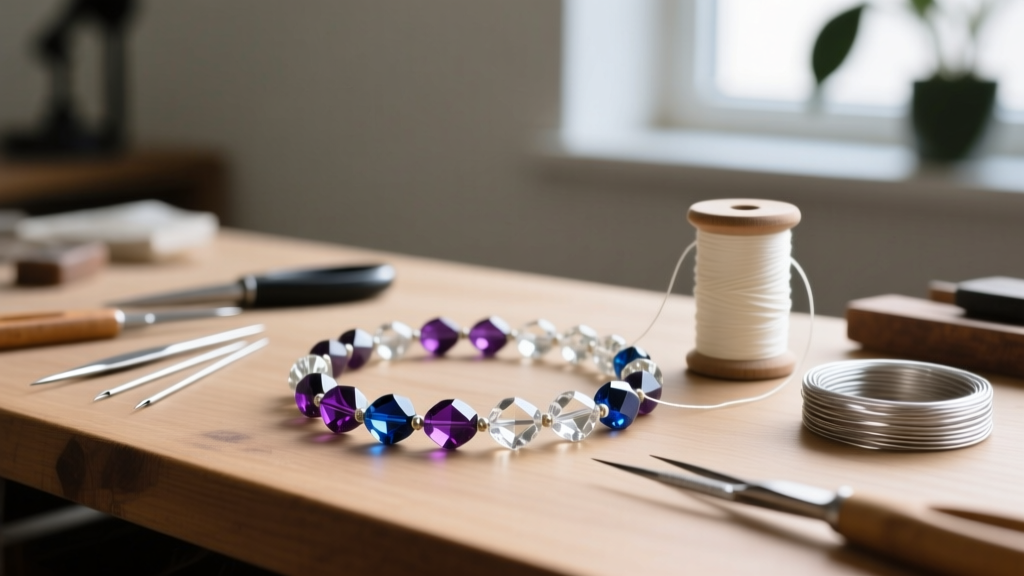
Silk is a protein fiber that absorbs sebum, sweat, and environmental pollutants. Over a 20-year period, the acidic nature of human skin oils degrades the tensile strength of the silk. If you gently pull the thread between two beads and see a gap of more than 1.5mm, the silk has stretched beyond its elastic recovery point and requires immediate re-stringing to prevent catastrophic failure.
2. Clasp Spring Fatigue
Vintage filigree box clasps rely on a tiny, folded metal tension spring inside the female receptacle. Over decades of compression, this spring suffers from metal fatigue and loses its 'click.' If the push-piece slides in without audible resistance, the clasp is a critical failure risk and must be rebuilt by a bench jeweler or replaced with a period-correct salvaged finding.
3. Drill Hole Chipping
Because lead crystal is relatively soft, the edges of the drill holes are prone to micro-chipping, especially if the beads were historically strung on abrasive wire or heavy cotton. Inspect the bead holes under a 10x triplet loupe. Severe chipping reduces the bead's structural integrity and lowers the overall valuation of the necklace by 15% to 30%.
Valuation and Market Pricing in 2026
The market for vintage crystal necklaces is highly stratified based on provenance, brand markings, and condition. Understanding these pricing tiers is crucial for both buyers and sellers.
- Unbranded Art Deco (1920s-1930s): Typically ranges from $120 to $350. Value is driven by the complexity of the hand-cut faceting and the condition of the original filigree hardware.
- Mid-Century Designer Signed (e.g., Miriam Haskell, Trifari): Highly collectible. A pristine, signed Miriam Haskell crystal bead necklace with original Russian gold-plated findings can command $800 to $2,500+ at auction.
- Early Swarovski (Pre-1980s): Pieces featuring the early block 'SC' logo or the pre-1988 swan logo are highly sought after by purists. Expect to pay between $200 and $500 for multi-strand crystal chokers from this era.
Conclusion
Authenticating and preserving a vintage crystal bead necklace requires looking far beyond the surface sparkle. By analyzing the specific gravity of the beads, decoding the historical markers of the clasps, and employing museum-grade restoration techniques like French wire and properly gauged silk, you ensure these wearable artifacts survive for future generations. Always prioritize structural integrity over quick fixes, and consult horological and gemological resources when in doubt about a piece's provenance.


