How to Avoid a Tangled Necklace Chain: Buyer's Guide
Discover how to avoid a tangled necklace chain with our expert buyer's guide. Learn about link geometry, gauge thickness, and tangle-free chain types.

The Physics of a Tangled Necklace Chain
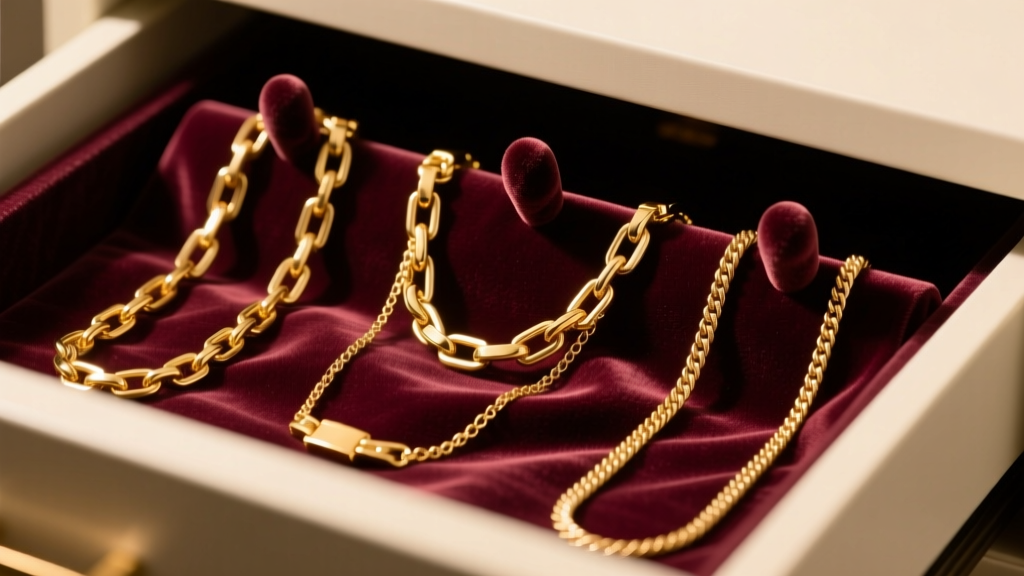
There are few things more frustrating in jewelry ownership than reaching into your jewelry box and pulling out a hopelessly tangled necklace chain. While it might feel like bad luck, chain entanglement is actually a predictable outcome of physics, specifically a concept related to 'random walk theory' and structural topology. When a flexible chain is placed in an enclosed space and subjected to movement, the kinetic energy causes the links to fold over one another. If the chain is thin and flexible enough, the ends will eventually thread through a closed loop, creating a knot.
However, not all chains are created equal. The likelihood of encountering a tangled necklace chain depends heavily on the link geometry, the wire gauge (thickness), the surface friction coefficient, and even the clasp mechanism. By understanding these variables, you can make informed purchasing decisions and build a collection of necklaces that remain pristine and ready to wear. According to educational resources from the Gemological Institute of America (GIA), understanding the structural integrity and physical properties of jewelry metals is the first step in proper jewelry care and selection.
Chain Link Profiles: Tangle-Prone vs. Tangle-Resistant
The geometry of the chain link dictates how easily it can catch on itself, your hair, or your clothing. Flat chains and tightly interlocking flush chains are notorious for causing issues. Below is a structural breakdown of common chain types and their inherent tangle risks.
| Chain Type | Link Geometry | Optimal Anti-Tangle Gauge | Tangle Risk (1-10) |
|---|---|---|---|
| Snake | Flush tubular | N/A (Catches hair/skin) | 8/10 |
| Herringbone | Flat interlocking | N/A (Kinks permanently) | 9/10 |
| Box | Cubic interlocking | 1.2mm - 1.5mm | 4/10 |
| Cable | Uniform oval | 1.5mm+ | 3/10 |
| Figaro | Alternating oval | 2.0mm+ | 2/10 |
| Rope | Twisted helical | 1.5mm+ | 1/10 |
| Mariner | Oval with crossbar | 2.5mm+ | 1/10 |
As a general rule, chains with a crossbar (like the Mariner) or a twisted helical structure (like the Rope) are virtually immune to severe knotting because their 3D geometry prevents the links from lying flat enough to thread through one another. Conversely, the Jewelers of America frequently notes that flat chains like Herringbone are highly susceptible to permanent kinking, which creates rigid nodes that act as anchors for future tangles.
The Bend Radius Rule: Why Wire Gauge Matters
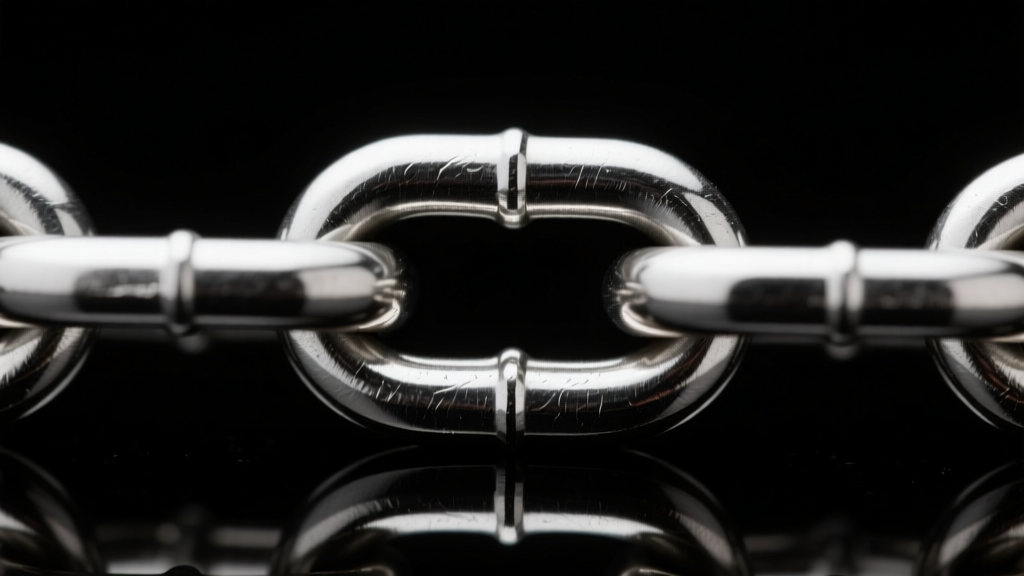
One of the most critical, yet overlooked, factors in preventing a tangled necklace chain is the wire gauge, usually measured in millimeters. The physics of knotting requires the chain to bend sharply enough to pass through its own internal link diameter. This is known as the 'bend radius'.
Calculating the Tangle Threshold
Consider a standard cable chain where each oval link is 4mm long with an internal opening of 2mm. For this chain to knot, it must be flexible enough to fold back on itself within a 2mm space. If you purchase a delicate 0.8mm version of this chain, it possesses the extreme flexibility required to achieve that tight fold, making it highly prone to tangling. However, if you upgrade to a 2.5mm wire gauge, the structural rigidity of the thicker metal physically prevents the chain from bending into a 2mm loop. It simply cannot fold tightly enough to thread through itself. When shopping, always look for chains that are at least 1.5mm in thickness for daily wear to leverage this physical limitation.
Pendant and Bail Dynamics
The pendant itself plays a massive role in chain entanglement. A pendant acts as a pendulum, swinging and rotating as you move. If the bail (the loop connecting the pendant to the chain) has a high friction coefficient or is too tight, the chain will twist as the pendant swings. Over the course of a day, this continuous micro-rotation introduces torsional stress into the chain, effectively twisting it into a tight coil that eventually collapses into a knot.
What to look for: Always examine the bail before purchasing. Look for pendants with lined bails (often featuring a small Teflon or polished gold insert) or integrated jump rings that allow the chain to glide freely. A freely spinning bail dissipates kinetic energy, preventing the chain from absorbing the twisting motion.
Surface Finish and Fabric Interaction
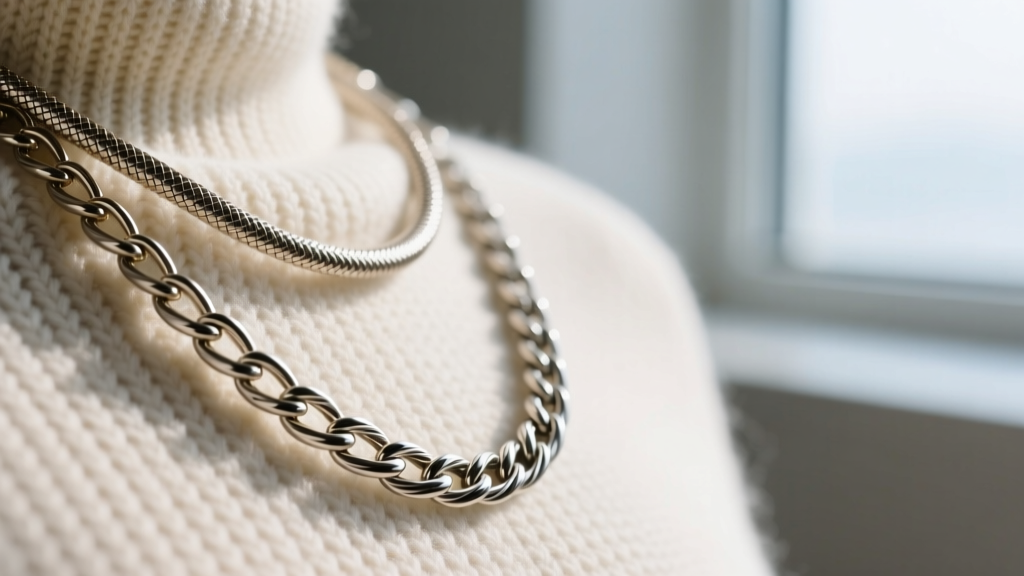
The microscopic texture of the metal dictates how it interacts with your environment. Many buyers are drawn to 'diamond-cut' chains because the micro-facets catch the light and create a sparkling effect. However, these tiny facets act like microscopic hooks. When you wear a diamond-cut chain over a knit sweater or even fine cotton, the facets catch on the textile fibers. Every time you move, the chain is pulled, stretched, and released, creating the exact kinetic conditions required for knotting.
For a truly tangle-free experience, prioritize a high-polish finish. A mirror-like high polish minimizes the surface friction coefficient, allowing the chain to glide smoothly over clothing and skin without catching. If you prefer the sparkle of a diamond-cut chain, reserve it for occasions where it will be worn directly against bare skin, away from textured fabrics.
Clasp Mechanics: The Whip Effect
The moment a necklace is unfastened is when it is most vulnerable to tangling. Traditional spring-ring clasps rely on a tiny internal coil spring. When you release the lever, the clasp snaps shut with a sudden release of kinetic energy, causing the lightweight end of the chain to 'whip' through the air. If this happens inside a jewelry box or a drawer, that whipping motion is often enough to thread the end through a nearby link.
The Solution: Upgrade to a Neodymium N52 magnetic clasp. Magnetic clasps eliminate the mechanical spring entirely. To remove the necklace, you simply pull the two halves apart, and to close it, you let them snap together gently. This completely neutralizes the whip effect, drastically reducing the chances of the chain knotting during the removal and storage process.
Storage and Maintenance Framework
Even the most tangle-resistant chain can succumb to entropy if stored improperly. Implement this structural storage framework to maintain your collection:
- The Velvet Roll Method: For travel, lay the chain flat on a microfiber or velvet jewelry roll. The high-friction fabric grips the links, preventing them from sliding and overlapping during transit.
- Vertical Suspension: In your home, store chains vertically on a jewelry tree or wall-mounted hooks. Gravity keeps the chain pulled taut, making knotting physically impossible.
- The Straw Trick: If you must pack a delicate chain in a standard suitcase, thread one end of the chain through a plastic drinking straw and clasp it. The rigid straw acts as a splint, preventing the chain from bending or folding.
"A tangled necklace chain is rarely a matter of bad luck; it is almost always a failure of geometry and storage. By respecting the bend radius and minimizing surface friction, you can eliminate 90% of daily jewelry frustrations."
By prioritizing link geometry, wire thickness, and smooth finishes, you can confidently invest in necklaces that remain elegant, untangled, and ready to elevate your wardrobe at a moment's notice.


