How to Style and Authenticate a Light Green Jade Bead Necklace
Learn how to authenticate, restring, and style a light green jade bead necklace with our expert gemological and jewelry-making guide.

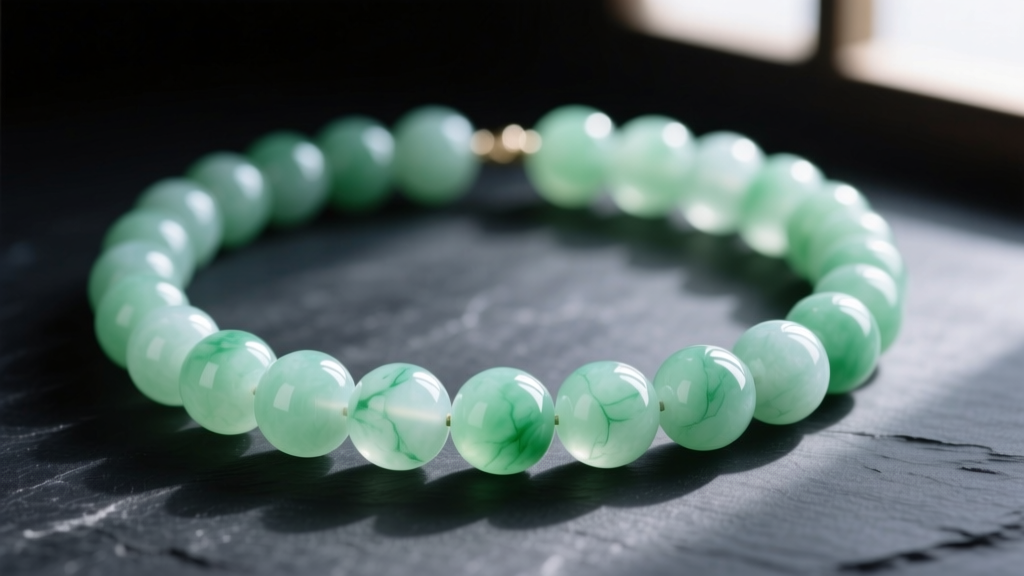
A light green jade bead necklace is more than just a striking piece of jewelry; it is a wearable asset steeped in cultural heritage and gemological complexity. Whether you have inherited a vintage strand, purchased a contemporary piece, or are looking to restring an heirloom, understanding the material science and structural requirements of jade is critical. In this comprehensive guide, we will walk you through the exact steps to authenticate your beads, properly restring them to prevent catastrophic failure, and style them for modern aesthetics.
The Gemological Profile: Jadeite vs. Nephrite
The term 'jade' is a commercial umbrella that covers two distinct metamorphic minerals: jadeite and nephrite. When you are examining a light green jade bead necklace, you are almost certainly looking at jadeite. Nephrite typically presents in deeper, mottled greens, creamy whites, or dark spinach hues, whereas jadeite is prized for its vibrant, translucent colors, including the highly sought-after celadon and apple green shades.
From a mineralogical standpoint, jadeite is a sodium aluminum silicate (NaAlSi2O6) with a Mohs hardness of 6.5 to 7. Nephrite is a calcium magnesium iron silicate with a slightly lower hardness (6.0 to 6.5) but vastly superior toughness due to its interlocking fibrous structure. According to the Mindat.org mineral database, jadeite's granular, interlocking crystal structure gives it a characteristic 'flies' or 'interlocking grain' appearance under magnification, which is vital for identifying natural, untreated stones.
Step-by-Step Authentication: Identifying Type A, B, and C Jade
The market is saturated with treated jade, making authentication a mandatory step before purchasing or insuring a light green jade bead necklace. The gemological community categorizes jade into three distinct treatment types:
- Type A (Untreated): Completely natural jadeite, possibly polished with a traditional, mild wax coating that does not alter the internal structure.
- Type B (Bleached and Polymer-Impregnated): Jade that has been soaked in hydrochloric acid to remove brown or yellow impurities, leaving a porous, brittle structure that is then vacuum-impregnated with a polymer resin to restore translucency and stability.
- Type C (Dyed): Jade that has been artificially colored using organic or inorganic dyes, often combined with polymer treatments (Type B+C).
Visual and Tactile Inspection
Examine the surface of the beads under a 10x triplet loupe. Type A jade will show a smooth, continuous surface with minor natural polishing lines. Type B jade often exhibits a 'spiderweb' or 'acid-etched' pitting on the surface where the acid has eaten away at the softer mineral boundaries. Tactilely, Type A jade feels dense and cool to the touch, taking longer to warm to your skin than polymer-heavy Type B beads.
UV Fluorescence Testing
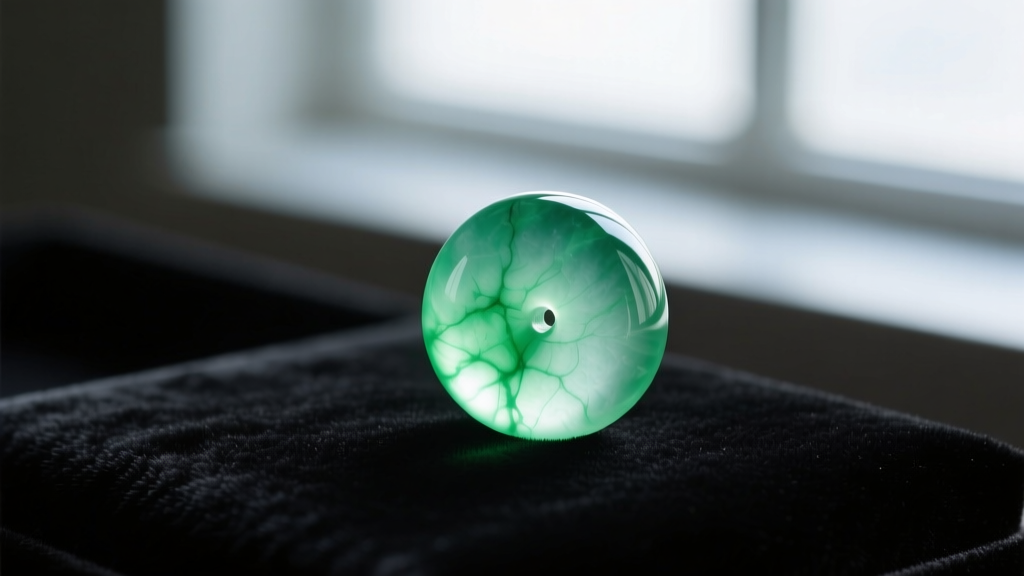
Using a standard 365nm long-wave ultraviolet flashlight is one of the most effective at-home screening methods. In a dark room, shine the UV light over the necklace. Natural Type A light green jadeite is typically inert or shows very weak, chalky white fluorescence. If the beads emit a strong, uniform bluish-white or greenish glow, the polymer resins used in Type B treatments are fluorescing. The Gemological Institute of America (GIA) strongly recommends UV testing as a primary diagnostic tool for identifying polymer-impregnated jadeite.
Spectroscopic Analysis for Dyes
If you suspect your light green beads are Type C (dyed), a handheld diffraction grating spectroscope can reveal the truth. Natural green jadeite transmits light through the green and yellow-green spectrum while absorbing in the violet. Dyed green jade, however, will often show a broad, unnatural absorption band in the red region (around 630-670 nm) caused by the synthetic dyes used to mimic the color of premium imperial or apple green jadeite.
How to Restring and Knot a Jade Bead Necklace
Jadeite is dense, with a specific gravity ranging from 3.30 to 3.38. This means an 8mm jade bead weighs significantly more than an 8mm quartz or glass bead. If a jade bead necklace is strung without knots between the beads, the heavy stones will constantly collide, leading to surface abrasion, chipping around the drill holes, and catastrophic string failure. Knotting is not just an aesthetic choice; it is a structural necessity.
Material Selection
For a traditional, high-end light green jade bead necklace, 100% natural silk thread is the gold standard. It provides excellent knot security and drapes beautifully. We recommend Griffin 100% natural silk. For 6mm to 8mm beads, use Size F (0.40mm thickness). For heavier 10mm to 12mm beads, step up to Size G (0.50mm) or Size H (0.60mm). To protect the silk from fraying against the metal clasp, you must use French wire (also known as bullion or gimp)—a micro-coiled metal spring that acts as a flexible guard.
Step-by-Step Knotting Process
- Prepare the Clasp:Thread your silk through the jump ring of your clasp, slide on a 1-inch piece of French wire, and pass the needle back through the first jade bead to create a protected loop.
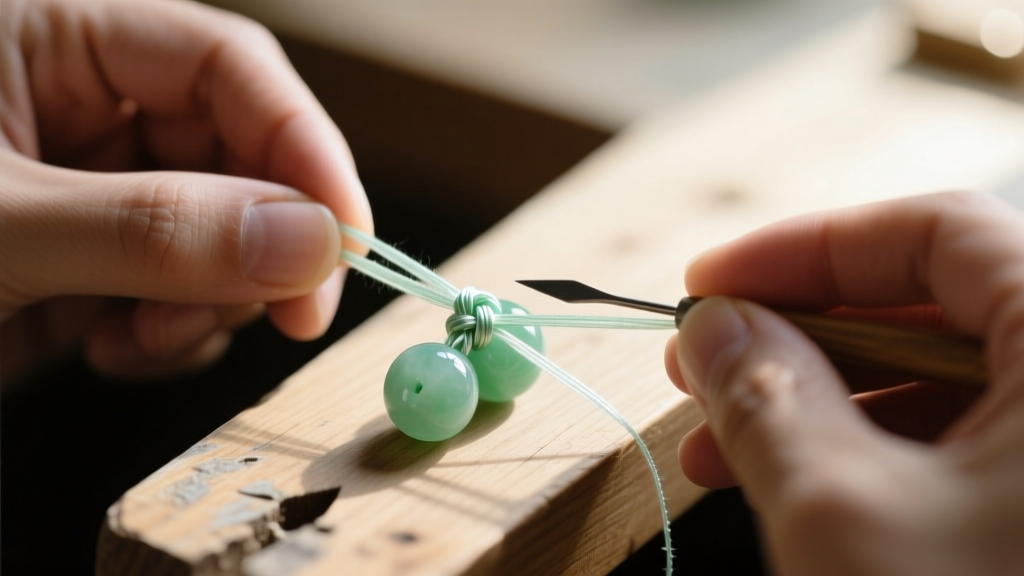
- The Overhand Knot:Slide the next bead down to the French wire. Tie a standard overhand knot in the silk, but do not pull it tight yet.
- Seat the Knot:Insert the tip of a fine beading awl into the loop of the loose knot. Slide the knot down the thread until it rests flush against the bead. Pull the awl and thread simultaneously to lock the knot tightly against the bead's surface.
- Repeat and Finish:Continue this process for every bead. At the clasp end, tie off with a surgeon's knot, apply a microscopic drop of flexible jewelry adhesive (like G-S Hypo Cement), and pull the tail through the adjacent bead to hide the finish.
| Material | Tensile Strength | Knot Security | Best Use Case |
|---|---|---|---|
| Natural Silk (Size G) | Moderate | Excellent (grips itself) | Traditional heirloom jade, high-end pearls |
| Nylon (Silk Substitute) | High | Good (slippery, needs glue) | Heavy beads requiring water resistance |
| Beading Wire (49-strand) | Very High | Poor (cannot be knotted) | Heavy, abrasive stones; requires crimps |
Styling Frameworks: Necklines and Layering
A light green jade bead necklace is incredibly versatile, but its styling potential depends heavily on the bead size and strand length. The soft, luminous quality of celadon or apple green jade pairs exceptionally well with warm metals and natural fibers.
Length and Neckline Pairings
Princess Length (18 inches): This length sits perfectly on the collarbone. It is ideal for V-neck blouses, scoop necks, and open-collared linen shirts. An 18-inch strand of 6mm light green beads offers a delicate, refined look suitable for office environments and daytime events.
Matinee Length (24 inches): Falling just above the bust, a matinee strand of larger 10mm beads makes a bold statement. This length is perfect for layering over solid-colored turtlenecks, silk blouses, or even tailored blazers. The length draws the eye downward, creating a flattering vertical line.
The Art of Layering
To modernize a traditional jade bead necklace, layer it with delicate gold chains. The warm, rich tones of 14k or 18k yellow gold complement the yellow-green undertones of apple green jade beautifully. Try pairing an 18-inch jade strand with a 20-inch 18k gold paperclip chain featuring a small, bezel-set diamond or morganite pendant. The contrast between the organic, opaque-to-translucent jade beads and the highly polished, geometric gold links creates a sophisticated, contemporary aesthetic that bridges the gap between vintage and modern design.
Care and Maintenance Protocols
Despite its impressive toughness, jadeite requires specific care protocols to maintain its polish and structural integrity over decades of wear.
- Avoid Ultrasonic Cleaners: Never place a jade bead necklace in an ultrasonic cleaner. The high-frequency vibrations can easily shatter Type B or C treated jade by destabilizing the polymer resin. Even Type A jade can suffer micro-fractures if natural internal inclusions are present.
- Thermal Shock Prevention: Jade is sensitive to sudden, extreme temperature changes. Avoid wearing your necklace in saunas, hot tubs, or while cooking over high-heat open flames, as thermal shock can cause internal stress fractures.
- Routine Cleaning: The safest way to clean your light green jade bead necklace is to wipe it down with a soft, lint-free microfiber cloth after each wear to remove skin oils and cosmetics. For deeper cleaning, use lukewarm water and a drop of mild, ammonia-free dish soap. Gently brush the knots with a soft baby toothbrush, rinse thoroughly, and lay the necklace flat on a towel to air dry completely before storing.
By understanding the gemological nuances of jadeite, employing proper restringing techniques, and utilizing modern styling frameworks, your light green jade bead necklace will remain a secure, breathtaking centerpiece in your jewelry collection for generations to come. For further reading on gemstone treatments and identification, consult the extensive educational resources provided by Lotus Gemology, a world-renowned laboratory specializing in Asian gem markets and jade authentication.


