Engineering the Perfect Baseball Balance Necklace: A Technical Guide
Discover the physics and engineering behind the baseball balance necklace. Learn how jewelers use counterweights and offset bails to prevent pendant flipping.

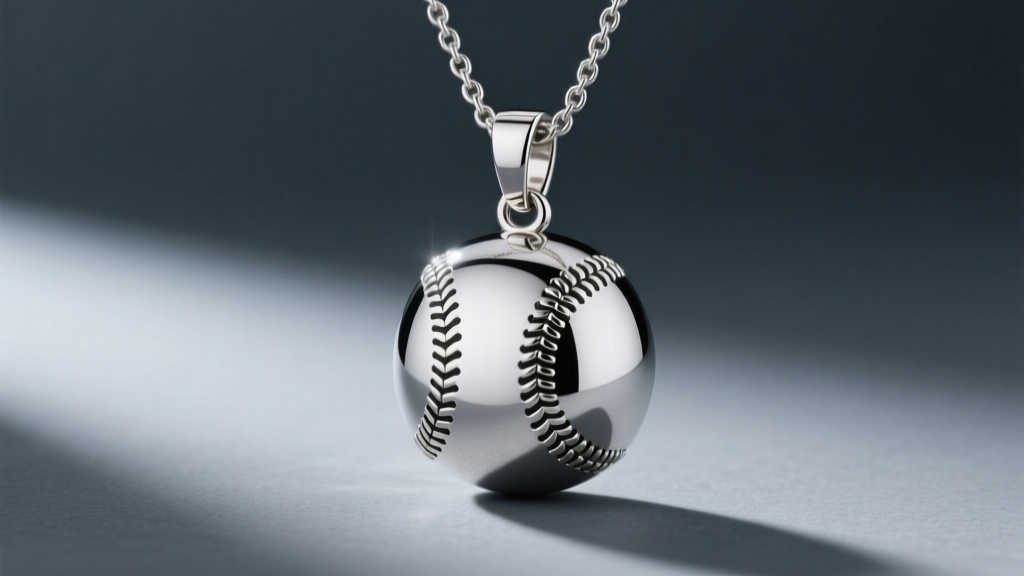
In the specialized world of sports-motif jewelry, the baseball balance necklace represents a unique intersection of athletic aesthetics and mechanical engineering. Unlike flat, stamped pendants that naturally rest parallel to the chest, a spherical or asymmetrical baseball pendant introduces complex gravitational challenges. If poorly designed, the pendant will constantly flip backward, hiding the raised seams or enamel detailing against the wearer's skin. To solve this, master jewelers employ advanced metallurgical techniques, hidden counterweights, and kinetic bail systems. This technical deep dive explores the exact physics, material grades, and manufacturing tolerances required to engineer a flawless baseball balance necklace.
The Physics of Pendant Balance: Center of Mass vs. Center of Geometry
The primary failure mode of any spherical sports pendant is the misalignment between its Center of Geometry (CoG) and its Center of Mass (CoM). A standard baseball features a distinct, asymmetrical seam pattern. When a jeweler casts a solid sterling silver baseball with raised wire-inlaid seams, the side of the pendant containing the dense cluster of seam curves becomes inherently heavier than the smooth side.
When suspended from a bail placed exactly at the geometric top (the North Pole of the sphere), gravity exerts a rotational torque on the heavier side. According to the principles of classical mechanics, the pendant will rotate until the CoM is positioned directly below the suspension point. Consequently, the beautiful seam detailing flips inward, facing the wearer's chest, while the smooth, uninteresting back faces outward. According to manufacturing research presented at the Santa Fe Symposium on jewelry technology, correcting this torque requires manipulating the pendant's internal density or altering the suspension vector.
Engineering the Bail: Offset Drilling and Vector Correction
The most common and cost-effective method for achieving visual balance in a solid cast baseball pendant is offset bail drilling. Instead of placing the bail hole at the exact geometric apex, the jeweler shifts the suspension point toward the heavier side of the seam cluster.
Calculating the Offset Tolerance
For a standard 20mm diameter sterling silver baseball pendant weighing approximately 14 grams, the seam cluster can create a mass discrepancy of up to 1.2 grams. To neutralize the rotational torque, the bail must be offset by exactly 1.5mm to 2.5mm toward the heavier hemisphere. This shifts the suspension vector so that it passes directly through the true Center of Mass. While this requires extreme precision during the CAD (Computer-Aided Design) phase, it ensures the pendant hangs perfectly flat without the need for moving parts.
The Tungsten Micro-Sphere Counterweight Technique
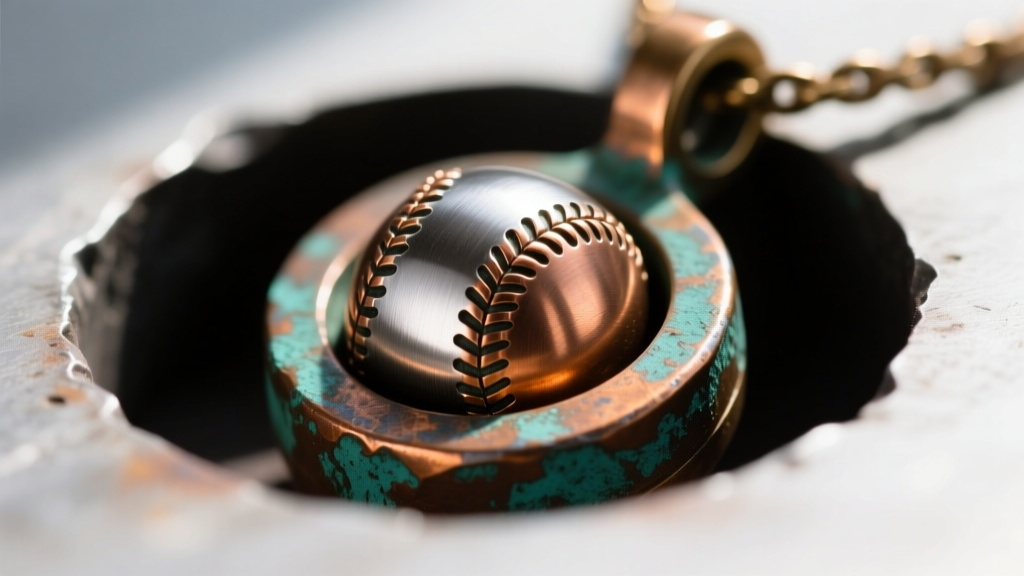
For hollow or semi-hollow baseball pendants—often manufactured to keep the overall weight under 10 grams for comfort—offset drilling is insufficient because the shell thickness is uniform. In these cases, expert fabricators utilize internal counterweighting. By embedding a high-density tungsten carbide micro-sphere (specific gravity of 15.6) into the hollow cavity on the lighter side of the pendant, jewelers can artificially shift the CoM back to the geometric center. A mere 2mm tungsten bead can effectively counterbalance up to 4 grams of sterling silver (specific gravity 10.4), allowing the bail to remain perfectly centered at the apex while maintaining flawless visual balance.
The Fulcrum Variant: Balancing the Bat and Ball
A highly sought-after variation of this jewelry style is the kinetic 'bat-and-ball' balance necklace, where a miniature baseball bat rests horizontally across the top of a baseball. This design operates on the principle of the fulcrum. Because a baseball bat is heavily weighted toward the barrel, its Center of Mass is located far from its geometric midpoint.
To engineer this, the jeweler must use a laser welder to attach the suspension ring to the bat at its exact node of equilibrium. If the weld is off by even 0.4mm, the bat will tilt aggressively to one side. Advanced manufacturers use digital density mapping in their CAD software to pinpoint the exact fulcrum node before milling the wax prototype, ensuring the bat remains perfectly parallel to the ground when worn.
Material Density and Weight Distribution Matrix
The choice of metal profoundly impacts the balance and drape of a baseball necklace. Heavier metals require more robust chain support and precise bail engineering. Below is a technical matrix comparing common materials used in high-end sports pendants.
| Material Grade | Specific Gravity | Casting Shrinkage | Balance Application & Notes |
|---|---|---|---|
| Sterling Silver (925) | 10.4 | 1.8% - 2.0% | Standard for solid casts; requires offset bail or seam-thinning to manage CoM. |
| Bronze (Silicon) | 8.2 | 1.5% | Lighter alternative; prone to flipping if hollow; requires thicker outer shells. |
| Tungsten Carbide | 15.6 | N/A (Sintered) | Used exclusively as internal micro-counterweights or ultra-heavy premium inserts. |
| 316L Stainless Steel | 8.0 | N/A (CNC Milled) | Ideal for precision-milled kinetic bails and fulcrum components due to high tensile strength. |
Chain Selection: Mitigating Torsional Energy
A perfectly balanced baseball pendant will still fail if paired with the wrong chain. Heavy, spherical pendants (15g+) generate significant lateral friction against the collarbone. When worn on a standard rope or cable chain, this friction causes the chain links to twist, storing torsional potential energy. Eventually, this energy releases, snapping the pendant upside down.
To prevent this, structural jewelry designers recommend specific chain profiles that minimize torsional wind-up:
- CNC-Milled Box Chains (3.0mm - 4.5mm): The flat, interlocking geometric links resist twisting and provide a wide, stable surface area for the bail to glide across. The Gemological Institute of America (GIA) frequently notes that flat-profile chains drastically reduce localized wear on heavy pendant bails.
- Flat Cuban Links: Excellent for heavy tungsten-inlaid baseball pendants. The wide, flush links lay flat against the sternum, anchoring the chain and preventing rotational energy transfer.
- Avoid Rope and Wheat Chains: The helical structure of rope chains acts like a coiled spring. When paired with a heavy, asymmetrical sports pendant, they will almost guarantee continuous flipping and accelerated bail wear.
Maintenance of Moving Parts and Bail Wear
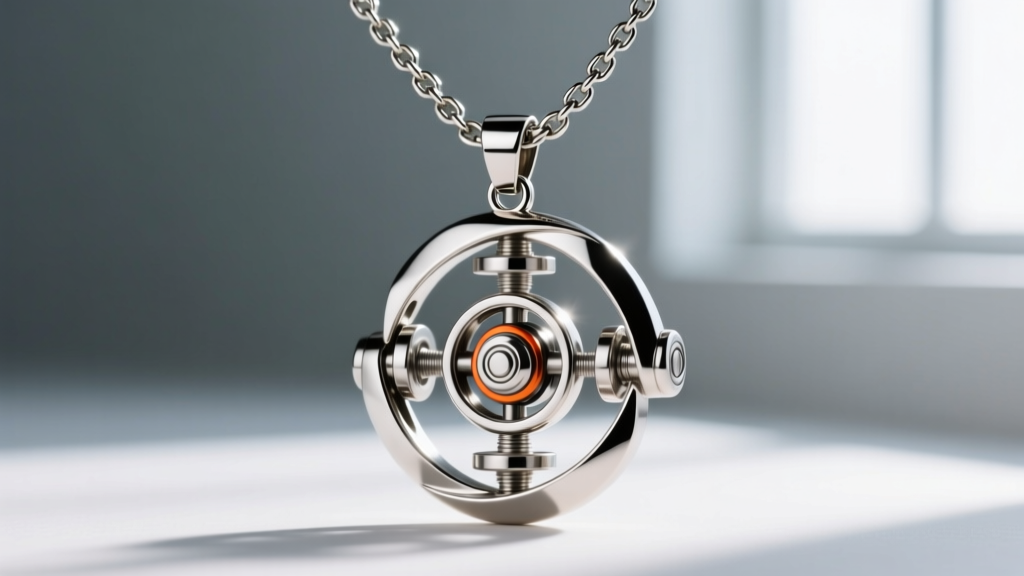
For baseball balance necklaces that utilize a dual-axis kinetic gimbal bail (allowing the pendant to spin freely independent of the chain), maintenance is critical. The micro-bearings or friction pins inside a gimbal bail are typically crafted from 316L stainless steel to resist shear forces. Over time, skin oils, cosmetic powders, and environmental dust can infiltrate the bail mechanism, increasing the friction coefficient and causing the pendant to stick or flip erratically.
Owners of kinetic sports pendants should avoid ultrasonic cleaners, as the high-frequency cavitation can force microscopic debris deeper into the bail's pivot points. Instead, the recommended maintenance protocol involves a monthly flush with a high-pressure stream of distilled water, followed by the application of a single drop of synthetic watchmaker's oil (such as Moebius 9010) to the pivot joints. This ensures the pendant maintains its engineered equilibrium and continues to display the baseball's intricate detailing perfectly outward.


