The Beginner's Guide to Buying a Baguette Tennis Necklace
Discover everything about the baguette tennis necklace. Learn about stone settings, metal grades, pricing tiers, and how to style this elegant piece.

What Exactly Is a Baguette Tennis Necklace?
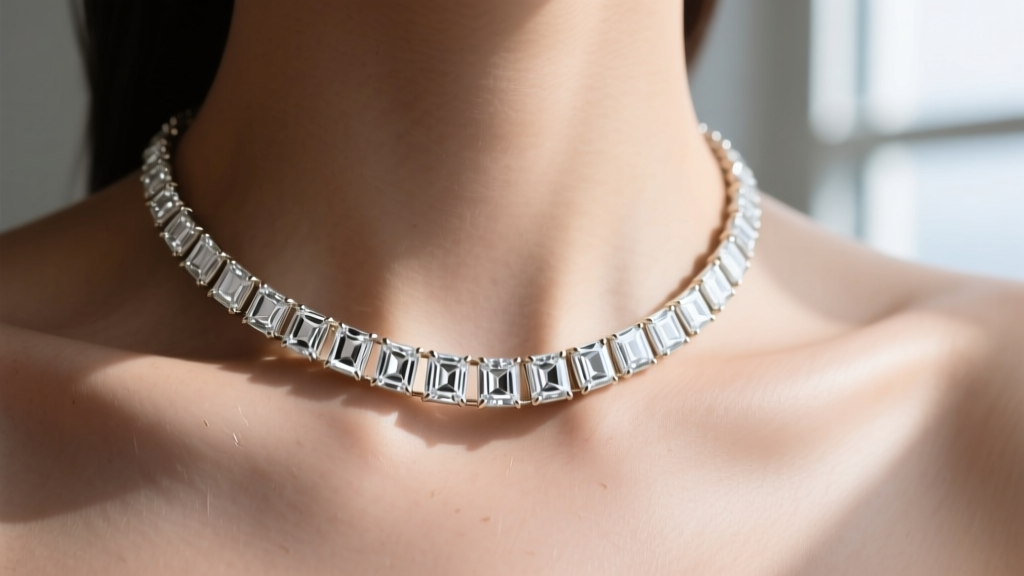
When most people hear the term "tennis necklace," they immediately picture a continuous strand of round brilliant-cut diamonds. While the classic round tennis necklace remains a staple, the baguette tennis necklace has emerged as a sophisticated, Art Deco-inspired alternative for those seeking a more architectural and modern aesthetic. Instead of circular stones, this design features rectangular, step-cut diamonds known as baguettes.
Unlike round brilliant cuts that are engineered for maximum scintillation (the rainbow flashes of light), baguette diamonds are step-cut. This means their facets are parallel to the stone's edges, creating a "hall of mirrors" effect. According to the Gemological Institute of America (GIA), step cuts emphasize a diamond's clarity and luster rather than its fiery brilliance. This makes the baguette tennis necklace an incredibly elegant, understated piece that catches the light in sleek, sophisticated flashes rather than overwhelming sparkles.
For beginners stepping into the world of fine jewelry, understanding the unique structural and gemological requirements of a baguette tennis necklace is crucial. Because of their sharp 90-degree corners and linear setting requirements, these necklaces demand specific metal grades and setting techniques to ensure longevity.
The Security Factor: Channel vs. Prong Settings
The most critical decision you will make when purchasing a baguette tennis necklace is the setting style. Baguette diamonds are notoriously vulnerable at their sharp corners. If a corner is struck against a hard surface, it can chip or fracture. Therefore, the setting must protect the stone while securing it against the natural movement of the neck.
| Setting Type | Security Level | Light Performance | Best For |
|---|---|---|---|
| Channel Set | High (Corners fully protected by metal walls) | Moderate (Metal walls block some side light) | Everyday wear, minimalist aesthetics, active lifestyles |
| Prong Set | Moderate (Corners may be exposed depending on prong placement) | High (More surface area exposed to light) | Special occasions, alternating designs (e.g., baguette and round) |
| Bezel Set | Very High (Complete metal rim surrounds the stone) | Low (Significantly reduces light entry) | Vintage Art Deco reproductions, ultra-secure heirloom pieces |
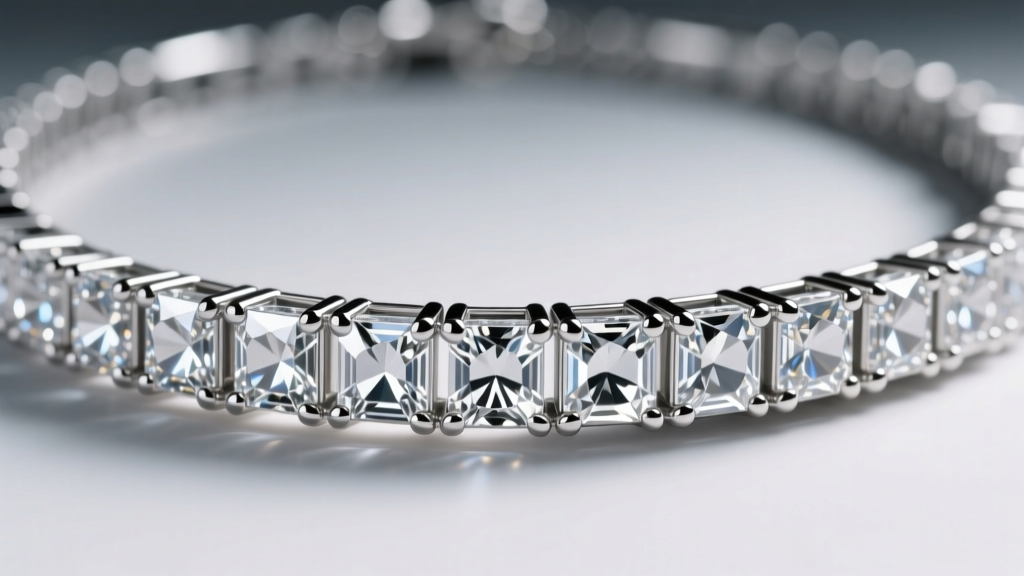
For a continuous baguette tennis necklace, the channel setting is the industry standard. In this configuration, the rectangular stones are slid into a metal track, and the top edges of the metal are pressed over the girdle of the diamonds. This completely hides the vulnerable corners. However, beginners must be aware of a common failure mode: channel wall wear. Over years of friction against clothing and skin, the thin metal walls can thin out, eventually allowing the stones to slide out. Having a jeweler check the channel wall thickness annually is a non-negotiable maintenance step.
Metal Grades: Why Platinum and 14k Gold Win
The metal you choose for your baguette tennis necklace dictates both its color profile and its structural integrity. Because baguettes are often channel-set, the metal must be malleable enough for a jeweler to push over the stone's edge during setting, yet rigid enough to hold its shape over decades of wear.
- Platinum (950 Grade): The ultimate choice for high-carat baguette necklaces. Platinum is incredibly dense and durable. When it scratches, the metal is merely displaced, not lost, meaning the channel walls will not thin out as quickly as gold. It also provides a naturally white backdrop that enhances the colorless appearance of the diamonds.
- 14k White Gold: A highly practical and popular choice. It offers excellent rigidity for channel walls and is more affordable than platinum. However, it requires rhodium plating every few years to maintain its bright white finish, as the underlying alloy has a slight yellowish tint.
- 18k Yellow or Rose Gold: Chosen for aesthetic contrast. The warm tones of 18k gold beautifully complement lower-color-grade baguettes (such as J or K color diamonds), creating a vintage, warm aesthetic. Note that 18k gold is softer than 14k, making it slightly less ideal for heavy, high-carat channel settings.
Articulation: The Secret to a Perfect Drape
One of the most frequent complaints from buyers of lower-quality tennis necklaces is that the piece feels stiff, kinks easily, or flips over on the neck. This is an articulation issue. Baguette diamonds are rigid, rectangular blocks. If they are set too closely together without proper spacing or hinged links, the necklace will behave like a stiff collar rather than a fluid chain.
High-end baguette tennis necklaces utilize articulated links—tiny, hinged metal joints between each stone or group of stones. These hinges allow the necklace to fold smoothly in multiple directions, conforming perfectly to the hollow of the collarbone. When shopping, lay the necklace flat on a surface. It should be able to form a tight, fluid circle without any of the stones overlapping or the metal buckling. If the necklace resists bending or forms hard, angular corners, the articulation is inadequate, and it will not drape elegantly when worn.
Pricing Breakdown: Lab-Grown vs. Natural Diamonds
The rectangular shape of a baguette diamond means it retains more of the original rough crystal compared to a round brilliant cut. However, finding rough material that is perfectly suited for long, uniform baguettes with high clarity is challenging, as step cuts act like windows, making inclusions highly visible. The advent of lab-grown diamonds has dramatically shifted the pricing landscape for baguette tennis necklaces, making larger carat weights accessible to a broader audience.
| Total Carat Weight (CTW) | Lab-Grown Diamond Price Range | Natural Diamond Price Range | Visual Spread (Approximate Length) |
|---|---|---|---|
| 5.00 - 7.00 CTW | $1,800 - $3,500 | $9,000 - $16,000 | 16 inches (Choker/Collarbone) |
| 8.00 - 12.00 CTW | $3,500 - $6,500 | $18,000 - $35,000 | 17 inches (Standard Princess) |
| 15.00+ CTW | $7,000 - $12,000 | $45,000 - $80,000+ | 18+ inches (Matinee length) |
According to market analysts and organizations like Jewelers of America, lab-grown diamonds possess the exact same chemical, physical, and optical properties as mined diamonds. For a baguette tennis necklace, where clarity is paramount, lab-grown stones often offer superior visual purity (VVS or VS clarity grades) at a fraction of the cost, allowing buyers to prioritize larger stone sizes without compromising on the "clean" look required for step cuts.
Maintenance: Avoiding the "Cloudy" Step-Cut Trap
Because baguette diamonds are step-cut, they have large, open, parallel facets. While this creates beautiful flashes of light, it also means that baguettes show oil, lotion, and dirt much faster than round brilliant cuts. A round cut's complex facet pattern helps scatter light and hide minor smudges, but a dirty baguette will quickly look cloudy and dull.
"The most common failure point in a baguette tennis necklace isn't the stone chipping; it's the channel walls wearing down from friction against clothing, eventually allowing the stones to slide out. Combine that with the fact that step cuts show skin oils instantly, and you realize these pieces require a strict regimen of gentle cleaning and annual professional inspections." — Master Bench Jeweler
To maintain your necklace, avoid wearing it while applying skincare products or perfumes. Clean it weekly using a soft-bristled baby toothbrush and a solution of warm water with a few drops of mild, ammonia-free dish soap. Crucial Warning: Never use an ultrasonic cleaner on a channel-set baguette tennis necklace unless a jeweler has recently verified the tightness of the channel walls. The high-frequency vibrations of an ultrasonic machine can easily shake a loosely held baguette right out of its track and into the bottom of the tank.
Styling Your Baguette Tennis Necklace
The architectural lines of a baguette tennis necklace make it a masterclass in modern minimalism. It pairs exceptionally well with structured necklines, such as a crisp button-down shirt, a tailored blazer, or a classic strapless evening gown. Because the piece inherently carries a strong geometric presence, it is best worn as a standalone statement piece rather than layered with delicate, chaotic chains that might detract from its clean, continuous lines. For a contemporary 2026 aesthetic, pair a 16-inch choker-length baguette necklace with a deep V-neck silk slip dress, allowing the linear diamonds to frame the collarbone with uncompromising elegance.


