Anatomy of a Blade Necklace: Chain Engineering & Pendant Metallurgy
Explore the technical anatomy of a blade necklace, from interlocking chain link engineering to pendant metallurgy, safety profiling, and clasp mechanics.

Defining the Blade Necklace Architecture
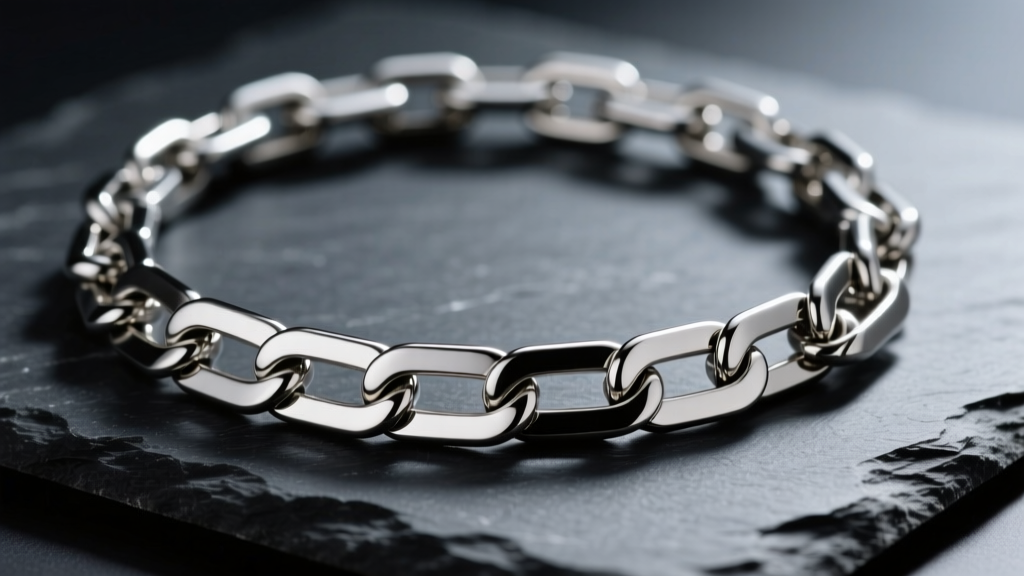
The term 'blade necklace' occupies a unique intersection in contemporary jewelry engineering, referring simultaneously to two distinct structural categories: the interlocking 'blade chain' (a flat, overlapping link design) and the literal blade pendant (a wearable, edged metallic focal point). While streetwear and tactical fashion have popularized these aggressive silhouettes, the underlying manufacturing processes require rigorous adherence to metallurgical science and mechanical engineering. A poorly engineered blade necklace is not merely a fashion failure; it is a structural liability prone to plastic deformation, clasp shearing, and accidental laceration. This deep dive deconstructs the exact specifications, material grades, and failure modes inherent in high-end blade necklace production.
Chain Link Engineering: The Overlapping Blade Mechanism
When jewelers refer to a blade chain, they are typically describing a specialized evolution of the flat curb or herringbone chain, engineered to maximize surface area while maintaining a low-profile, armored aesthetic. The defining characteristic of a true blade chain is its overlapping link geometry, where each flattened link slides partially beneath the next, creating a continuous, scale-like metallic ribbon.
Tensile Strength and Link Tolerances
The primary failure mode of flat-profile chains is lateral kinking. When a blade chain is bent laterally beyond its yield point, the interlocking links undergo plastic deformation, permanently warping the chain's geometry. To mitigate this, premium manufacturers utilize an 18 AWG (1.02mm) to 14 AWG (1.63mm) wire thickness for the base links, combined with precision laser welding rather than traditional torch soldering. Laser welding concentrates heat into a microscopic focal point, preserving the crystalline structure of the surrounding metal and preventing the annealing (softening) that occurs with broad-spectrum heat.
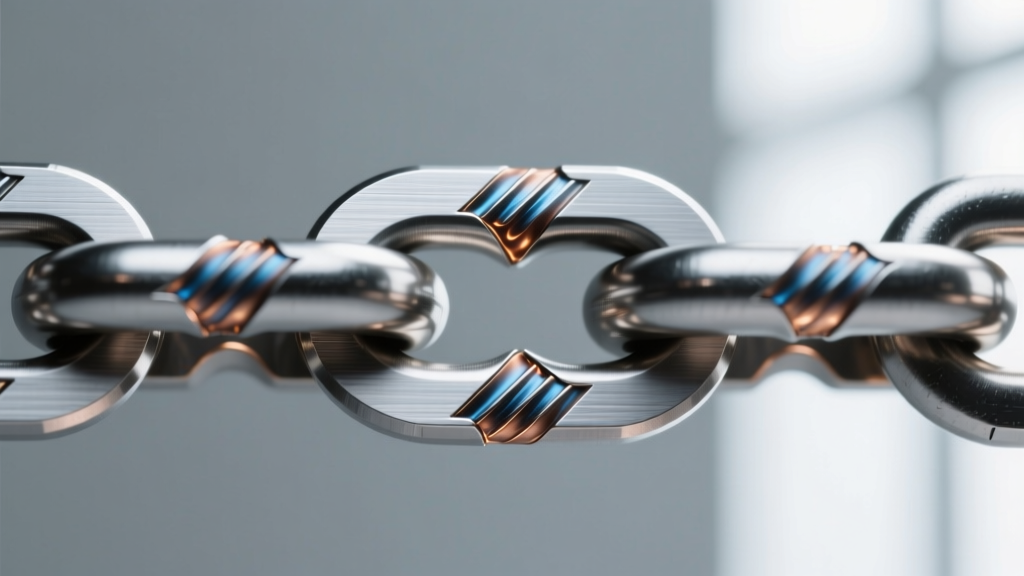
According to data from the British Stainless Steel Association, cold-working 316L stainless steel during the wire-drawing process increases its tensile strength significantly. A properly drawn 316L blade chain can withstand upwards of 485 MPa of tensile stress before yielding, provided the link aspect ratio (length-to-width) is kept below 3:1 to prevent internal torsion.
Pendant Metallurgy: Forging the Edge
If the blade necklace features a literal blade pendant, the choice of alloy dictates not only the weight and corrosion resistance but the fundamental safety and machining methodology of the piece. Jewelers must balance the visual illusion of a razor-sharp edge with the biocompatibility and structural integrity required for daily wear.
Alloy Grade Comparison
| Alloy Grade | Composition Highlights | Hardness Scale | Edge Retention | Corrosion Resistance |
|---|---|---|---|---|
| 316L SS | 16-18% Cr, 10-14% Ni, <0.03% C | 70-90 HRB | Poor | Exceptional |
| 440C SS | 16-18% Cr, 0.95-1.20% C | 58-60 HRC | Excellent | Moderate |
| Ti-6Al-4V | 90% Ti, 6% Al, 4% V | 36-40 HRC | Moderate | Superior |
316L Surgical Stainless Steel: The industry standard for wearable blades. Its austenitic structure makes it highly resistant to oxidation and skin acidity. However, its low carbon content means it cannot be heat-treated to hold a true edge. It is best suited for pendants where the 'blade' is purely aesthetic.
440C Martensitic Stainless Steel: Used by tactical jewelers who want a functional edge. The higher carbon content allows for quenching and tempering, achieving a Rockwell C hardness of 58-60. The trade-off is reduced chromium mobility, making it susceptible to surface rust if exposed to sweat without regular oiling.
Grade 5 Titanium (Ti-6Al-4V): As noted in AZoM Materials Science, this aerospace-grade alloy offers an unparalleled strength-to-weight ratio. A titanium blade pendant will weigh roughly 45% less than an identical 316L piece, reducing neck strain. However, titanium's tendency to work-harden and gall makes it notoriously difficult to machine, requiring specialized CNC tooling and slow feed rates.
Machining vs. Investment Casting
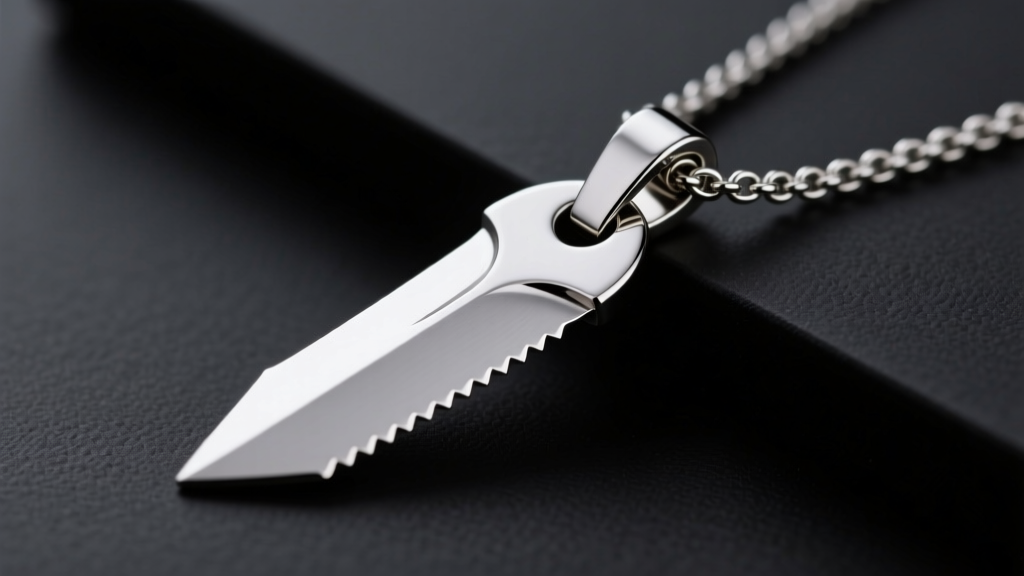
For 316L pendants, investment casting (lost-wax) is the most economical route, allowing for complex, organic hilt designs. However, cast metal is inherently more porous and brittle than wrought metal. For high-stress tactical blades, 5-axis CNC milling from a solid billet of Ti-6Al-4V or 440C is mandatory. Billet machining ensures an unbroken grain structure, eliminating the microscopic voids that can lead to catastrophic snapping under impact.
Edge Profiling and Safety Bevels
A genuine zero-edge on a necklace pendant is a severe laceration hazard. The kinetic energy generated by normal walking, combined with the pendulum effect of a heavy pendant, can easily cause a sharp edge to slice through clothing or skin. Expert jewelers employ a technique known as 'safety beveling' or 'edge profiling'.
- The Micro-Bevel: The cutting edge is ground to a minimum thickness of 0.8mm to 1.2mm. This retains the optical illusion of sharpness when viewed from a distance but is physically incapable of parting skin tissue.
- Spine Jimping: To enhance the tactical aesthetic without adding sharpness, the spine of the blade pendant is often milled with jimping (textured grooves). These grooves must be deburred and tumbled to ensure they do not catch on knit fabrics.
- Tip Radiusing: The point of the blade is never left at a true zero-point. A micro-radius of at least 0.5mm is applied via precision sanding to prevent puncture wounds during accidental impacts.
Clasp Mechanics and Load Distribution
Heavy blade pendants—often exceeding 40 grams—place immense shear stress on the necklace clasp. Standard spring-ring or lightweight lobster clasps are entirely inadequate and will inevitably fail due to metal fatigue at the hinge pin.
The only acceptable closure for a heavy blade necklace is a Box Clasp with a Figure-8 Safety Latch. The box clasp distributes the tensile load across a wide, interlocking tongue-and-groove mechanism, while the figure-8 wire safety catch provides a redundant secondary retention system. If the primary tongue mechanism deforms or slips, the safety latch, typically rated for 15-20 kg of tensile force, prevents the pendant from dropping. For chains wider than 5mm, a double box clasp (featuring two parallel tongues) is required to eliminate rotational torque on the connection point.
Maintenance and Passivation
Maintaining a blade necklace requires an understanding of the metal's passivation layer. For stainless steel and titanium alloys, corrosion resistance is provided by a microscopic, invisible layer of chromium oxide (or titanium oxide). When the pendant is scratched, or exposed to harsh chemicals like chlorine, this layer can be compromised.
To restore the passivation layer, the piece should be cleaned in an ultrasonic bath using a mild, non-chlorinated alkaline detergent, followed by a rinse in distilled water and air drying. For 440C high-carbon steel pendants, a micro-crystalline wax or specialized mineral oil must be applied to the edge bevels monthly to displace ambient moisture and prevent galvanic corrosion. By respecting the metallurgical realities and mechanical tolerances of these components, wearers can ensure their blade necklace remains a structurally sound and visually striking artifact for decades.


