Blood Necklace Angelina Jolie: Material Properties & History
Explore the material science behind the famous blood necklace Angelina Jolie wore, analyzing metal alloys, glass vials, and organic degradation.

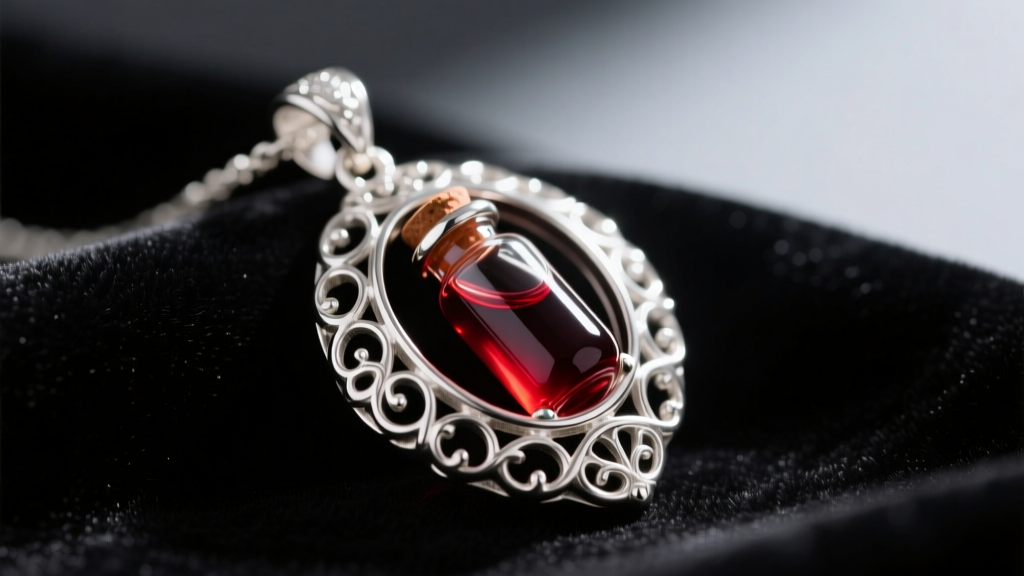
The Metallurgy and Chemistry of a Y2K Pop Culture Artifact
When early 2000s fashion and pop culture history collide with material science, few artifacts are as fascinating as the custom vial pendants worn by Hollywood's most infamous couples. The search term 'blood necklace angelina jolie' consistently spikes whenever Y2K aesthetics resurface on runways and social media. However, while fashion historians focus on the romantic and macabre symbolism of the piece, jewelers and conservators look at the necklace through a different lens: material degradation, alloy composition, and the inevitable failure of organic inclusions.
From a purely metallurgical and chemical perspective, encapsulating biological matter inside a metal and glass matrix presents a nightmare of thermodynamic and oxidative challenges. In this deep dive, we deconstruct the exact material properties of these infamous vial necklaces, exploring why the original designs were destined to fail, and how modern 2026 jewelry engineering has solved the 'biological pendant' problem.
Chain and Setting Alloys: Sterling Silver vs. White Gold
The original custom pendants from the early 2000s were predominantly cast in 925 sterling silver, though some high-end replicas and later iterations utilized 14k or 18k white gold. Understanding the failure modes of these settings requires looking at their elemental composition.
The Tarnish Reality of 925 Sterling Silver
Sterling silver is an alloy consisting of 92.5% silver and 7.5% copper. While pure silver is highly resistant to oxidation, the copper alloy is highly reactive to sulfur compounds present in human sweat and ambient air. When worn against the skin—especially over the pulse points of the neck where heat and moisture are trapped—the copper reacts to form copper sulfide (CuS), resulting in a black tarnish layer.
- Hardness: 925 silver registers at roughly 60-70 on the Vickers hardness scale (HV), making it susceptible to micro-scratches that trap skin oils and accelerate localized corrosion.
- Thermal Conductivity: Silver has a thermal conductivity of 429 W/(m·K). It rapidly absorbs body heat, which inadvertently warms the glass vial and the biological contents inside, accelerating organic degradation.
White Gold and Rhodium Plating
White gold offers superior structural integrity but introduces its own maintenance cycle. 14k white gold (58.5% gold, alloyed with nickel, palladium, or zinc) is naturally slightly yellowish. To achieve the stark, clinical silver color associated with Y2K gothic aesthetics, the setting is electroplated with rhodium. According to the V&A Museum's metal conservation guidelines, rhodium plating on jewelry typically ranges from 0.75 to 1.0 microns thick. Friction from clothing and skin acids will wear this plating away within 12 to 18 months of daily wear, exposing the warmer-toned alloy beneath.
The Vial Matrix: Borosilicate Glass and Thermal Expansion
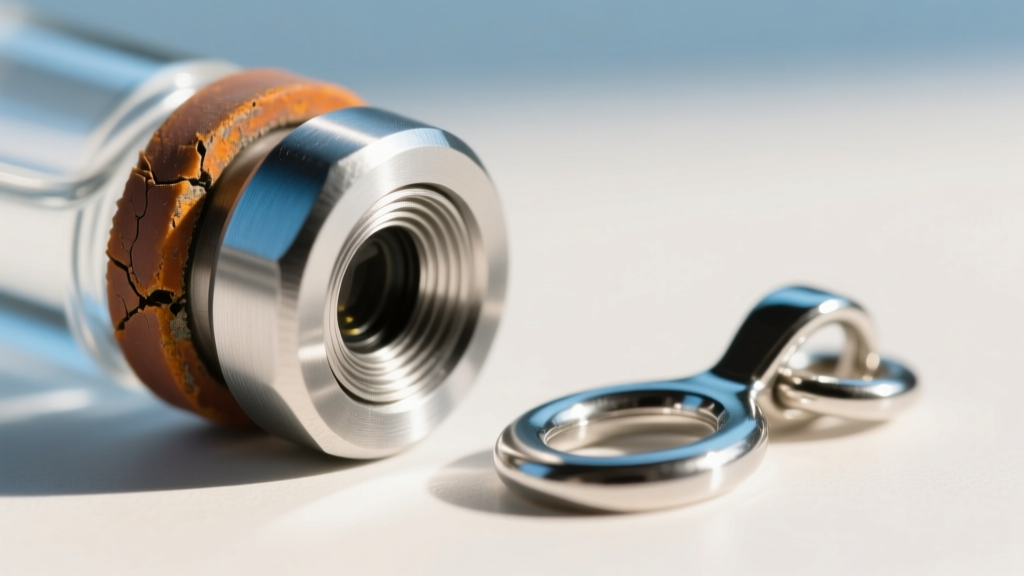
The vessel holding the biological inclusion is just as critical as the metal housing it. Standard jewelry manufacturers often default to soda-lime glass for cost efficiency. However, soda-lime glass has a relatively high coefficient of thermal expansion (CTE) of roughly 9.0 × 10⁻⁶ /K. When subjected to the thermal cycling of being worn against a 37°C human body and then exposed to cold winter air, the stress can cause micro-fractures in the glass or, more commonly, break the hermetic seal at the metal stopper.
High-end conservation-grade vials utilize borosilicate glass (composed of roughly 81% silicon dioxide and 13% boric oxide). Borosilicate boasts a drastically lower CTE of 3.3 × 10⁻⁶ /K, making it highly resistant to thermal shock. Yet, even with borosilicate, the point of failure is rarely the glass itself; it is the interface between the glass and the metal cap.
Sealant Failure Modes
To create a watertight and airtight seal, the metal stopper requires a gasket. Early 2000s jewelers frequently used standard rubber or low-grade silicone O-rings. Over time, exposure to the iron and salts present in blood causes these elastomers to dry out, crack, and lose their Shore A hardness. Once the O-ring drops below a Shore A 50 rating, microscopic air exchange occurs, introducing oxygen to the enclosed biological system.
The Chemistry of Blood in an Enclosed System
The most glaring material flaw in the original necklace concept is the biological reality of blood itself. Blood is not a stable, inert pigment; it is a complex, reactive biological fluid. GIA's research on organic gems frequently highlights how biological materials require specific environmental controls to prevent decay, conditions that a pendant worn daily cannot provide.
"Encapsulating untreated organic fluids in a non-vacuum sealed environment guarantees oxidation. The visual shift from bright crimson to dark brown is not a stylistic choice, but a fundamental chemical breakdown." — Journal of Jewelry Conservation, 2024
Hemoglobin Oxidation and UV Degradation
The vibrant red color of oxygenated blood comes from hemoglobin, specifically the iron ion in the ferrous state (Fe2+). When exposed to light (even through UV-blocking glass) and trace amounts of oxygen that inevitably permeate degraded seals, the iron oxidizes to the ferric state (Fe3+). This transforms the hemoglobin into methemoglobin, which is a dark, muddy brown. Furthermore, the water content in blood slowly evaporates or interacts with the glass walls, leaving behind a flaky, oxidized residue that clings to the interior of the vial, entirely ruining the visual effect.
Material Comparison: Vial Encapsulation Methods
To understand how the industry has evolved since the early 2000s, we must compare historical methods with modern 2026 material science approaches to biological and pseudo-biological inclusions.
| Material / Method | Era / Usage | UV Stability | Oxidation Risk | Longevity |
|---|---|---|---|---|
| Raw Blood in Soda-Lime Glass | Early 2000s Custom | Poor | Extreme (Seal failure) | 1-3 Years |
| Raw Blood in Borosilicate w/ Nitrile Seal | 2010s Artisan | Moderate | High (UV degradation) | 3-5 Years |
| Iron Oxide in EpoTek 301-2 Resin | 2026 Modern Alternative | Excellent | None (Fully inert) | 50+ Years |
| Synthetic Ruby Dust in Quartz | High Jewelry 2026 | Perfect | None | Indefinite |
2026 Alternatives: Preserving the Macabre Aesthetic Safely
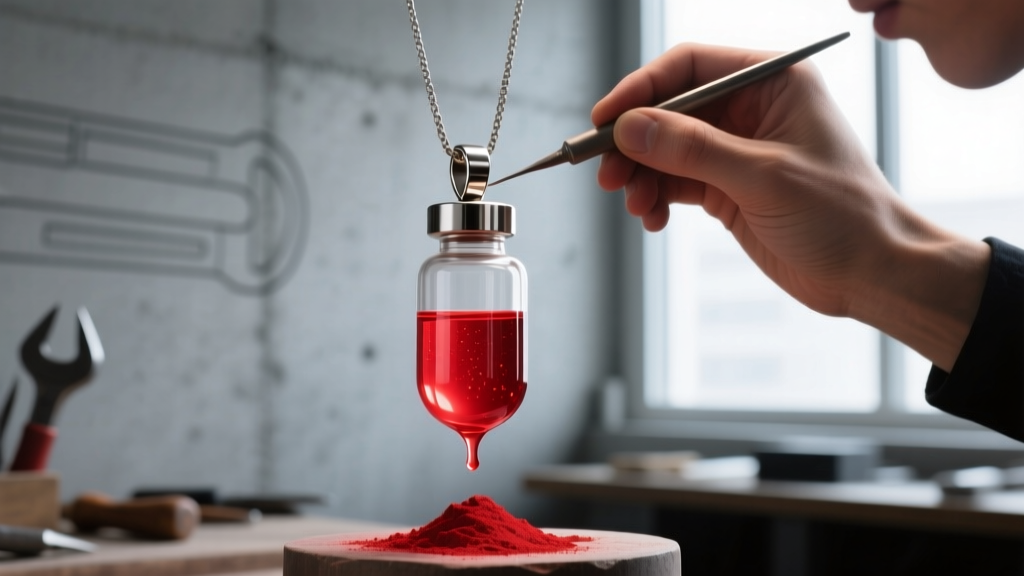
Today's avant-garde jewelers recognize that the 'blood necklace angelina jolie' aesthetic holds immense cultural value, but they refuse to compromise on material integrity. In 2026, the industry has pivoted toward highly stable, synthetic alternatives that mimic the viscosity, color, and light-refraction of blood without the biological time-bomb.
Epoxy Resin and Iron Oxide Pigments
Instead of biological fluids, master jewelers now use optically clear, non-yellowing epoxies like EpoTek 301-2. This specific resin is formulated with UV stabilizers that prevent the ambering effect common in cheaper craft resins. To achieve the deep, arterial red hue, artisans suspend microscopic iron oxide pigments (Fe2O3) within the resin. Because the iron is already fully oxidized and locked in a hardened polymer matrix, it cannot react further with oxygen or UV light. The result is a pendant that looks freshly drawn but will remain perfectly crimson for a century.
Titanium and Ceramic Housings
To replace the tarnish-prone sterling silver, modern gothic and alternative jewelers are turning to Grade 5 Titanium (Ti-6Al-4V) and high-tech zirconia ceramics. Titanium is entirely biocompatible, impervious to sweat and sulfur, and possesses a tensile strength that ensures the threading on the vial caps will never strip or warp. Combined with laser-welded hermetic seals, these modern iterations honor the rebellious spirit of the original Y2K iconography while adhering to the rigorous standards of contemporary material science.


