What Is a Lariat Necklace? A Step-by-Step Styling Guide
Learn exactly what is a lariat necklace and master how to tie, size, and style this versatile Y-chain with our step-by-step expert guide.


What Is a Lariat Necklace? The Anatomy of the Y-Chain
At its core, a lariat necklace is a continuous strand of chain, leather, or cord that lacks a traditional clasp. Instead of fastening at the nape of the neck, it relies on gravity, friction, or a simple loop-and-pull mechanism to stay in place. Often referred to as a Y-necklace or rope necklace, the lariat is defined by its elongated drop that draws the eye vertically down the decolletage.
Understanding what is a lariat necklace requires looking at its three structural components:
- The Main Strand: The continuous length that wraps around the neck, typically ranging from 24 to 45 inches.
- The Drop (or Tail): The section that hangs vertically. This is created either by threading one end through a fixed ring (creating a Y-shape) or by simply crossing the two ends over one another.
- The Terminals: The weighted ends, tassels, or gemstones attached to the tips of the chain. These are not merely decorative; they act as plumb bobs, providing the necessary downward tension to keep the necklace anchored.
Step-by-Step: 3 Ways to Tie and Secure Your Lariat
Because there is no clasp, styling a lariat requires manual manipulation. Here are three expert techniques to secure your piece based on the desired aesthetic.
1. The Classic Thread-Through (The Fixed Y)
For lariats featuring a small metal ring or hoop near one end:
- Drape the necklace around your neck so the ring rests at your sternum.
- Take the opposite terminal end and thread it through the ring from the top down.
- Pull the tail to adjust the drop length. For a standard plunge, leave a 4 to 6-inch tail.
- Pro Tip: If the chain slips, tie a microscopic, loose overhand knot on the tail just below the ring to act as a physical stopper.
2. The Asymmetrical Cross (For Threadless Lariats)
If your lariat is a completely straight strand with no rings:
- Hold both terminals in front of you, making one side roughly 4 inches longer than the other.
- Cross the shorter strand over the longer strand at the base of your throat.
- Wrap the shorter strand behind and over the longer strand, pulling it down through the newly formed loop.
- Adjust the tension so the knot sits loosely, creating an effortless, undone aesthetic.
3. The Double-Wrap Choker Conversion
For extra-long lariats (36 inches or more):
- Wrap the entire strand around your neck twice, creating a layered choker effect.
- Let the remaining 8 to 10 inches of chain drape down the center of your chest.
- Secure the final drop by tucking the terminals into the wrapped layers at your collarbone for a hidden, seamless finish.
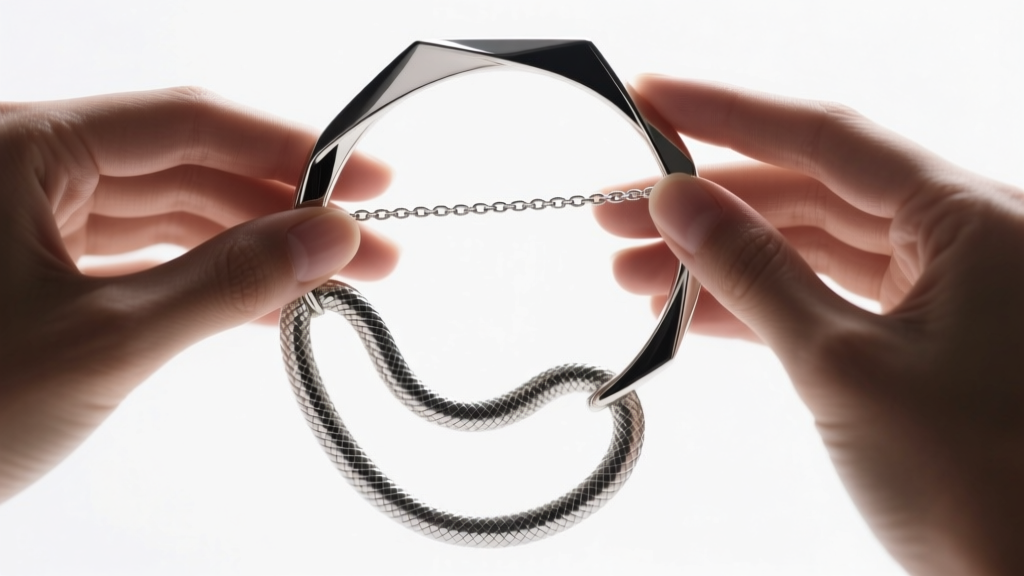
Sizing Matrix: Choosing the Right Length and Gauge
The versatility of the lariat depends heavily on its total length and the thickness (gauge) of the chain. A chain that is too thin will tangle; a chain that is too short will choke. Use this matrix to select your ideal proportions.
| Total Length | Chain Gauge | Ideal Drop | Best Neckline Pairing |
|---|---|---|---|
| 24" - 28" | 0.8mm - 1.2mm | 2" - 4" | Scoop neck, Boat neck |
| 30" - 34" | 1.2mm - 1.8mm | 4" - 7" | Deep V-neck, Button-down |
| 36" - 45" | 1.5mm - 2.5mm | 8"+ | Strapless, Halter, Evening wear |
According to the Jewelers of America, chain gauge drastically affects drape. A 0.8mm snake chain will kink if wrapped tightly, whereas a 1.5mm cable chain offers the structural integrity needed for double-wrapping without permanent deformation.
Material Grades and Hardware: Avoiding the Slip
The most common frustration with lariat necklaces is the chain slipping through the loop, causing the asymmetrical drop to equalize and the necklace to slide off your shoulder. This is a physics issue dictated by metal hardness and surface friction.
The Gold Purity Problem: As noted in GIA's precious metals guide, higher karat gold is softer. An 18k or 22k gold lariat in a thin 1.0mm gauge will stretch and warp at the friction point where the chain rubs against the loop ring. For a daily-wear lariat, 14k gold or platinum is vastly superior. The higher alloy content (like copper and zinc in 14k gold) increases the Vickers hardness, ensuring the loop ring maintains its perfect circular shape under tension.
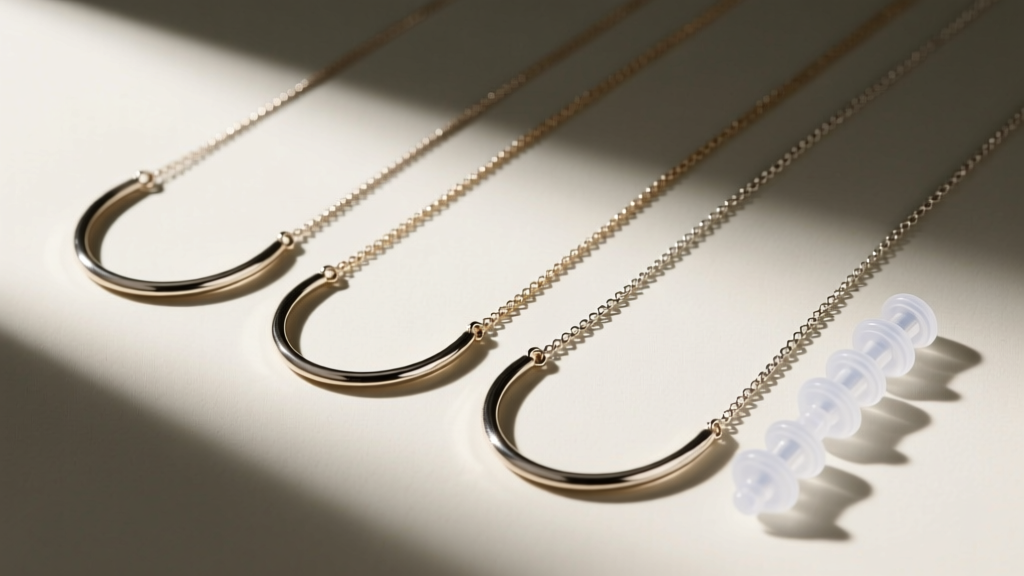
Chain Texture Matters: High-polish chains (like snake or box chains) have near-zero surface friction. If you buy a polished snake chain lariat, you must use a clear silicone jewelry O-ring stopper on the tail to prevent it from slipping. Conversely, rope chains or twisted cable chains have natural grooves that create micro-friction, holding the Y-drop securely in place without extra hardware.
Neckline Pairing Framework
Styling a lariat is about complementing the geometry of your clothing.
- The V-Neck Synergy: A lariat mimics the V-shape of the neckline, elongating the torso. Match the depth of the lariat drop so it ends exactly one inch above the vertex of the shirt's V-neck.
- The Crew Neck Contrast: Wear a shorter (24-inch) lariat tied in a loose knot directly over a tight crew neck t-shirt. The vertical drop breaks up the horizontal block of the collar, adding visual interest to casual basics.
- The Strapless Anchor: For strapless gowns or tube tops, use an extra-long (40-inch) lariat. The heavy vertical line provides a necessary visual anchor to the expanse of bare skin on the chest and shoulders.
Troubleshooting Common Lariat Frustrations
The Chain Keeps Slipping
If your thread-through lariat won't stay put, the terminal weight is too light. You can fix this by having a jeweler solder a small, heavy metal bead or a 2mm gemstone to the bottom terminal. The added mass increases gravitational pull, keeping the tail anchored.
The Loop Ring is Warping
If the metal ring you thread the chain through has become oval-shaped, it is suffering from tensile stress. Take it to a jeweler to have the ring re-soldered and reinforced with a thicker gauge wire, or swap the 14k/18k gold ring for a platinum or titanium jump ring, which offers vastly superior yield strength.
Tangling During Storage
Lariats are notorious for knotting in jewelry boxes. Never store them coiled. Always hang them vertically on a jewelry arbor, or lay them perfectly straight in a velvet-lined drawer. If storing in a pouch, thread the tail through the loop before placing it inside to lock the Y-shape and prevent the ends from whipping around and tangling.
Final Styling Takeaways
Mastering what is a lariat necklace goes beyond simply throwing it over your head. It requires an understanding of chain gauge, metal hardness, and the physics of gravity. By selecting a 14k gold or platinum piece with a textured chain and properly weighted terminals, you secure a versatile, elegant staple that transitions effortlessly from a casual double-wrap choker to a dramatic evening plunge. Treat the lariat not just as jewelry, but as an interactive styling tool that adapts to the geometry of your wardrobe.


