Bolt Ring Necklace Guide: Clasp Mechanics & Hardware Pendants
Master the mechanics of the bolt ring necklace. Explore clasp failure modes, weight capacity matrices, and industrial hardware pendant metallurgy.

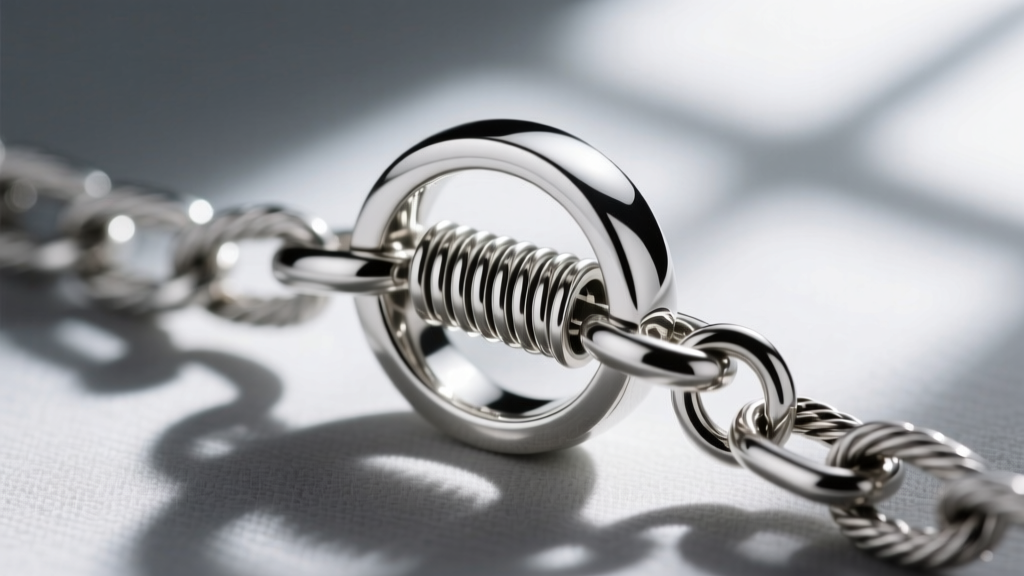
The Dual Identity of the Bolt Ring Necklace
When discussing a bolt ring necklace in the jewelry industry, we are actually navigating two distinct but equally important concepts. In the UK and Commonwealth markets, the "bolt ring" is the ubiquitous circular spring-loaded clasp (known as a spring ring in the US) that secures millions of necklaces worldwide. Conversely, in the avant-garde and contemporary jewelry sectors, a bolt ring necklace refers to a piece featuring literal industrial hardware—nuts, bolts, and heavy metallic rings—as the primary pendant motif. As we evaluate jewelry trends in 2026, both interpretations demand a rigorous technical understanding of metallurgy, structural integrity, and mechanical tolerances.
Whether you are assessing the tensile strength of a 5mm clasp on a delicate gold chain or evaluating the CNC machining tolerances of a Grade 5 titanium hardware pendant, treating your necklace as an engineered system rather than a mere accessory is crucial. This deep dive explores the exact mechanics, failure modes, and material grades that dictate the lifespan and safety of your bolt ring necklaces.
Anatomy of the Bolt Ring Clasp Mechanism
The bolt ring clasp is a marvel of miniaturized mechanical engineering. Despite its simple appearance, it consists of four distinct components that must interact flawlessly under constant tension. According to technical manufacturing standards outlined by Rio Grande, a high-quality bolt ring requires precise metallurgical pairing to prevent galvanic corrosion and mechanical fatigue.
- The Outer Tube: Typically stamped or drawn from 18k gold, 14k gold, or sterling silver. The tube is hollow, with a precise internal diameter that allows the plunger to slide without lateral wobble. A microscopic gap is left in the circle to allow the jump ring to pass through.
- The Internal Spring: This is the most critical component. Because precious metals like 24k or even 14k gold lack the necessary elastic memory, the internal coil spring is almost always manufactured from 302 stainless steel or beryllium copper. This ensures the clasp snaps shut with consistent force over thousands of cycles.
- The Plunger (Trigger): The visible tab you pull back. It is usually soldered or laser-welded to the internal spring and the end cap.
- The Jump Ring: The circular ring on the opposite end of the chain that the bolt ring hooks into. Crucial Note: If this jump ring is not soldered closed, it represents the single greatest point of failure on the entire necklace.
Structural Failure Modes and Weak Points
Jewelry repair benches see thousands of broken bolt ring necklaces annually. Understanding the specific failure modes allows collectors and buyers to inspect their pieces proactively. Master jewelers frequently cite the unsoldered jump ring as the primary culprit for lost pendants, a topic extensively covered in bench guides on Ganoksin.
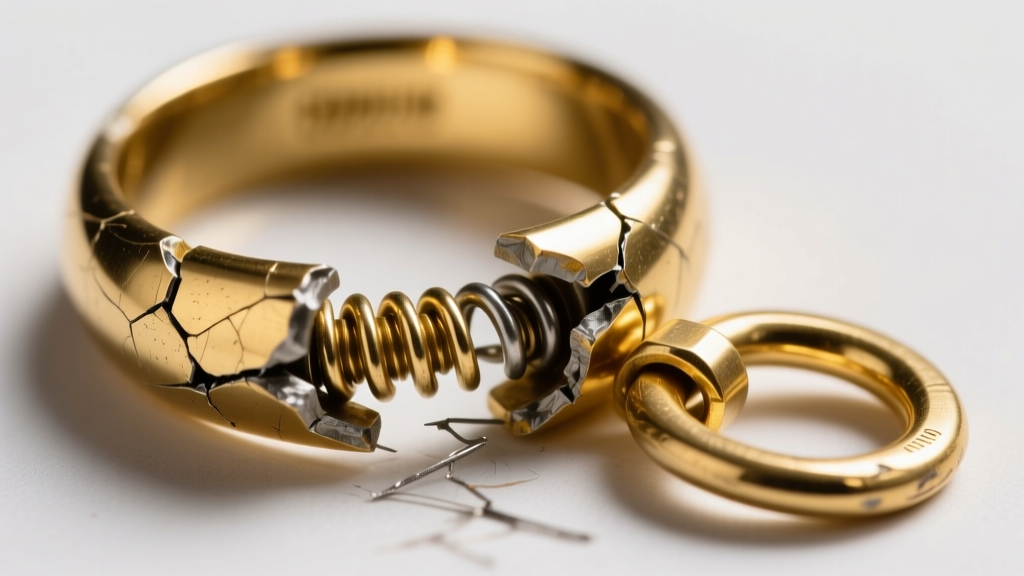
1. Tension Loss and Spring Fatigue
Over time, the beryllium copper or stainless steel spring inside the bolt ring can suffer from metal fatigue. This is accelerated by exposure to chlorinated water, cosmetics, and sweat, which can seep into the hollow outer tube and cause microscopic corrosion on the spring. When the spring loses its elastic memory, the plunger fails to return to the closed position, leaving the gap exposed and the necklace vulnerable to slipping off.
2. The Outer Tube Gap Snag
The outer tube of a bolt ring must have a gap for the jump ring to enter. In lower-quality manufacturing, the edges of this gap are not properly filed or polished, leaving microscopic burrs. These burrs act as saw teeth against the delicate links of a cable or box chain, gradually wearing through the wire gauge of the chain itself until it snaps.
3. Jump Ring Distortion
If the jump ring on the opposite end of the necklace is not soldered, any lateral pull (such as the chain catching on a sweater) will pry the jump ring open. Once the gap exceeds 1mm, the bolt ring will easily slip out. Always inspect your bolt ring necklace with a 10x jeweler's loupe to ensure the jump ring features a flush, soldered seam.
"A bolt ring clasp is only as secure as the jump ring it catches. If the jump ring isn't hard-soldered closed, you aren't wearing a secure necklace; you're wearing a temporary suspension." — Master Bench Jeweler
Weight Capacity and Gauge Matrix
Matching the bolt ring diameter to the chain gauge and pendant weight is a matter of physics. Using an undersized clasp on a heavy chain will result in the clasp migrating to the front of the neck (the "sliding clasp" phenomenon) or failing under the dynamic load of movement. Below is the technical matrix for pairing bolt ring clasps with necklace chains.
| Bolt Ring Diameter | Wire Gauge (Outer Tube) | Max Static Weight Capacity | Recommended Chain Type |
|---|---|---|---|
| 5mm | 22g (0.64mm) | 15 grams | Delicate Cable, Micro-Box |
| 7mm | 20g (0.81mm) | 35 grams | Standard Cable, Rolo, Curb |
| 9mm | 18g (1.02mm) | 60 grams | Wheat, Figaro, Medium Rope |
| 12mm | 16g (1.29mm) | 110 grams | Heavy Cuban, Thick Rope |
Note: Dynamic loads (e.g., jogging, sudden movements) can generate G-forces that temporarily multiply the static weight of a pendant by 2x to 3x. Always factor in a 50% safety margin when selecting your clasp size.
The Industrial Hardware Pendant Trend
Shifting from the clasp to the focal point, the "bolt ring" pendant has become a staple in contemporary and streetwear jewelry. Designers are repurposing the aesthetic of heavy machinery, utilizing literal hex nuts, threaded bolts, and industrial O-rings as pendants. However, there is a massive quality divide between cast replicas and precision-machined hardware.
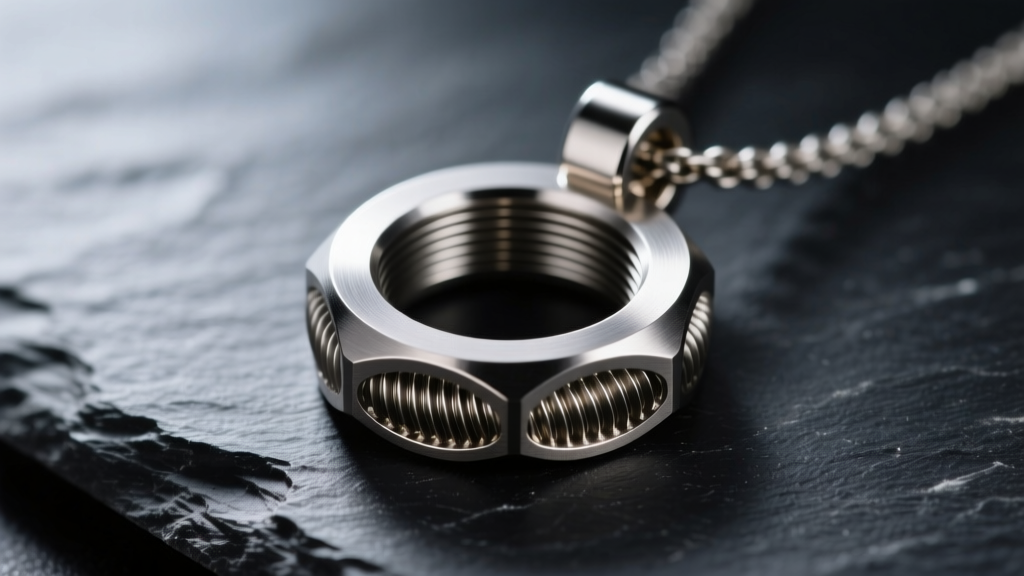
Lost-Wax Casting vs. CNC Machining
Many mass-market brands use lost-wax casting to create bolt pendants in sterling silver or brass. While cost-effective, cast threads are often soft, prone to blurring, and lack the sharp, precise edges of real hardware. Furthermore, cast sterling silver is inherently porous and can harbor skin oils and dirt within the thread grooves.
In contrast, high-end artisan jewelers utilize CNC (Computer Numerical Control) machining to carve pendants from solid billets of aerospace-grade materials. A CNC-machined Grade 5 Titanium (Ti-6Al-4V) bolt ring pendant offers unparalleled durability. Titanium is 45% lighter than steel but boasts an exceptional strength-to-weight ratio, ensuring that a massive, oversized bolt pendant won't cause neck strain or prematurely wear out the chain links it rests upon.
Thread Standards in Jewelry
For necklaces featuring interactive hardware (e.g., a bolt pendant that actually screws into a threaded ring or capsule), jewelers adhere to ISO metric screw thread standards. An M8 or M10 thread pitch is commonly used. The precision of the tap and die process ensures that the components screw together smoothly without cross-threading, which is vital if the pendant houses a hidden compartment or a secondary gemstone setting.
Maintenance and Upgrading Protocols
To maximize the lifespan of your bolt ring necklace, implement a strict maintenance protocol. For the clasp mechanism, use a soft-bristled brush and a mild degreasing solution (like diluted dish soap) to clean the plunger gap monthly. Avoid ultrasonic cleaners for necklaces with bolt ring clasps, as the high-frequency vibrations can lodge microscopic debris deeper into the hollow outer tube, jamming the internal spring.
When to Upgrade to a Lobster or Box Clasp
While the bolt ring is elegant and low-profile, it is not the strongest clasp on the market. If you are attaching a high-value diamond pendant or a heavy solid-gold chain exceeding 80 grams, it is highly recommended to upgrade the bolt ring to a forged lobster claw or a double-tongue box clasp with a figure-eight safety catch. A forged lobster clasp lacks the hollow tubing and internal spring of a bolt ring, relying instead on a solid piece of tensioned metal, making it vastly superior for heavy-duty applications.
Ultimately, whether you are evaluating the microscopic tolerances of a 7mm spring-loaded clasp or admiring the brushed finish of a CNC-machined titanium hardware pendant, the bolt ring necklace remains a triumph of functional design. By understanding the metallurgy and mechanics at play, you can curate a collection that is not only visually striking but structurally engineered to last a lifetime.


