How to Choose a Briolette Diamond Necklace: Expert Guide
Discover what to look for in a briolette diamond necklace. Learn about faceting, drill holes, clarity grades, and mounting styles in our expert guide.

The Allure of the Briolette Cut
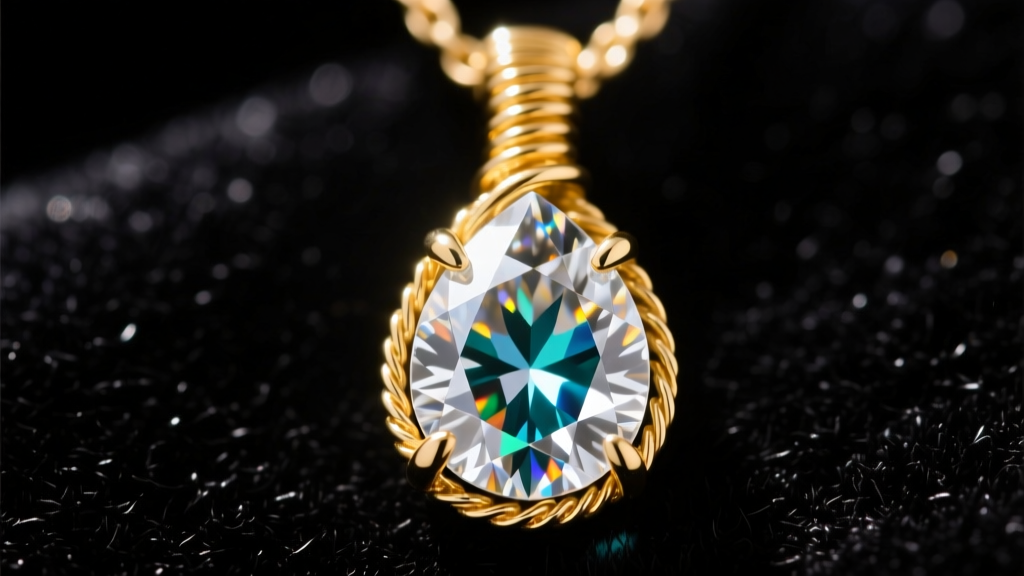
When it comes to light performance and vintage-inspired elegance, few gemstone shapes rival the briolette. A briolette diamond necklace features a three-dimensional, teardrop-shaped stone that is faceted entirely around its surface, typically culminating in a pointed or rounded apex at the top. Unlike traditional brilliant cuts that rely on a flat table to reflect light back to the eye, a briolette diamond acts as a free-swinging prism, dispersing scintillation with every movement of the wearer. However, buying a briolette diamond necklace requires a distinctly different gemological approach than purchasing a standard round brilliant solitaire. This guide breaks down the exact specifications, structural vulnerabilities, and mounting mechanics you must evaluate before making an investment.
Evaluating the 4Cs for Briolette Diamonds
The standard rules of diamond grading shift when applied to fully faceted teardrops. According to the GIA Diamond Buying Guide, the interplay of light in fancy cuts requires prioritizing different characteristics to avoid visual dead zones.
Color and Clarity Trade-offs
Because light enters and exits a briolette from every angle, the stone's body color is more pronounced than in a round brilliant. A diamond graded 'J' or 'K' will show noticeable warmth, which can be desirable if set in 18k yellow gold, but for a crisp, icy look, stick to the G to H color range. Regarding clarity, the dense faceting pattern (usually between 84 and 140 facets) naturally obscures inclusions. You can comfortably step down to SI1 or even eye-clean SI2 without sacrificing beauty, provided there are no black carbon spots located directly beneath the drill hole, which can create a visible shadow effect.
Cut, Symmetry, and the 'Windowing' Effect
The most critical factor in a briolette diamond necklace is the precision of the cut. Poorly proportioned briolettes suffer from 'windowing'—a phenomenon where light leaks out of the bottom of the stone rather than reflecting back, creating a transparent, glassy dead zone in the center. When inspecting a stone, roll it between your fingers under direct light. The triangular and diamond-shaped facets should be perfectly symmetrical, and the scintillation should remain consistent across the entire belly of the teardrop.

The Drill Hole: Structural Integrity and Mounting
Unlike standard pendants that use a metal bail, most briolettes are top-drilled to allow a wire or chain to pass directly through the apex. This introduces a unique structural vulnerability. If the drill hole is not executed with laser precision, or if the entry and exit points are uneven, the diamond can develop micro-fractures that may cause the apex to chip over time. As noted by gemological historians at Lang Antiques, antique briolettes were often hand-drilled, resulting in larger, more fragile apices, whereas modern stones utilize microscopic laser drilling for superior structural integrity.
| Mounting Style | Pros | Cons | Best For |
|---|---|---|---|
| Wire-Wrapped (18k/22k) | Allows maximum light entry; highly secure if done by a master jeweler. | Wire can tarnish or bend if subjected to heavy pulling. | Organic, artisanal, or vintage-style necklaces. |
| Bezel Cap / Cone Bail | Protects the fragile drilled apex; provides a uniform, polished look. | Blocks light from entering the top 15% of the stone. | Modern, streamlined, and everyday wear designs. |
| Direct Chain Thread | Minimalist aesthetic; stone swings freely. | Friction from the chain can widen the drill hole over decades. | Delicate, micro-briolette layering pieces. |
Chain Selection and Layering Mechanics
A briolette is inherently bottom-heavy. If paired with a chain that is too delicate, the necklace will constantly flip over, hiding the stone against the skin. To maintain proper drape and keep the diamond facing outward, the chain must possess enough structural weight to counterbalance the stone.
- For 0.50ct - 1.00ct Briolettes: Use a 1.0mm to 1.2mm box chain or wheat chain. These chains have a high tensile strength and a smooth surface that won't abrade the drill hole.
- For 1.50ct - 3.00ct Briolettes: Opt for a 1.5mm to 2.0mm rope or curb chain. The heavier links provide the necessary counterweight.
- Clasp Hardware: Always ensure the chain features a solid lobster clasp or a spring ring with a reinforced jump ring. The focal weight of a swinging briolette puts continuous kinetic stress on the clasp mechanism.

2026 Pricing Expectations and Market Realities
The market for briolette diamond necklaces has evolved. While round brilliants command a premium for their standardized demand, briolettes are often cut from rough that is unsuitable for traditional shapes, sometimes making them slightly more affordable per carat. However, high-clarity, perfectly symmetrical briolettes remain rare collector items. Below is a realistic pricing matrix for a single, unmounted briolette diamond based on current market conditions.
| Carat Weight | Color / Clarity Grade | Estimated Price Range (USD) |
|---|---|---|
| 0.50ct - 0.75ct | G-H / SI1 | $800 - $1,400 |
| 1.00ct - 1.50ct | F-G / VS2 | $2,200 - $4,500 |
| 2.00ct - 3.00ct | D-E / VS1 | $6,000 - $12,000+ |
Note: Custom wire-wrapping or 18k gold bezel cap settings will add between $250 and $600 to the final retail price, depending on the jeweler's bench fees.
Final Pre-Purchase Checklist
Never buy a briolette diamond based solely on a laboratory certificate. The 2D plotting diagram on a GIA or AGS report cannot convey the 3D light performance or the physical stability of the drill hole. Always demand a high-definition, 360-degree macro video.
Before finalizing your purchase, verify the following:
- Apex Integrity: Inspect the top drill hole under 10x magnification for any radiating stress fractures or chipping.
- Light Return: Ensure there is no central 'windowing' when the stone is viewed straight on.
- Facet Alignment: Check that the horizontal girdle line (if present) is level, ensuring the stone hangs perfectly plumb.
- Chain Compatibility: Confirm the diameter of the chain or wire can pass through the drill hole without forcing, which could snap the diamond.
By prioritizing structural integrity and dynamic light performance over traditional grading dogmas, you can secure a briolette diamond necklace that serves as a mesmerizing, kinetic centerpiece in your jewelry wardrobe.


