Buddha Necklace Gold: Expert Guide to Karats, Casting & Chains
Discover expert insights on selecting a buddha necklace gold pendant. Compare 14k, 18k, and 22k gold, casting methods, and ideal chain pairings.

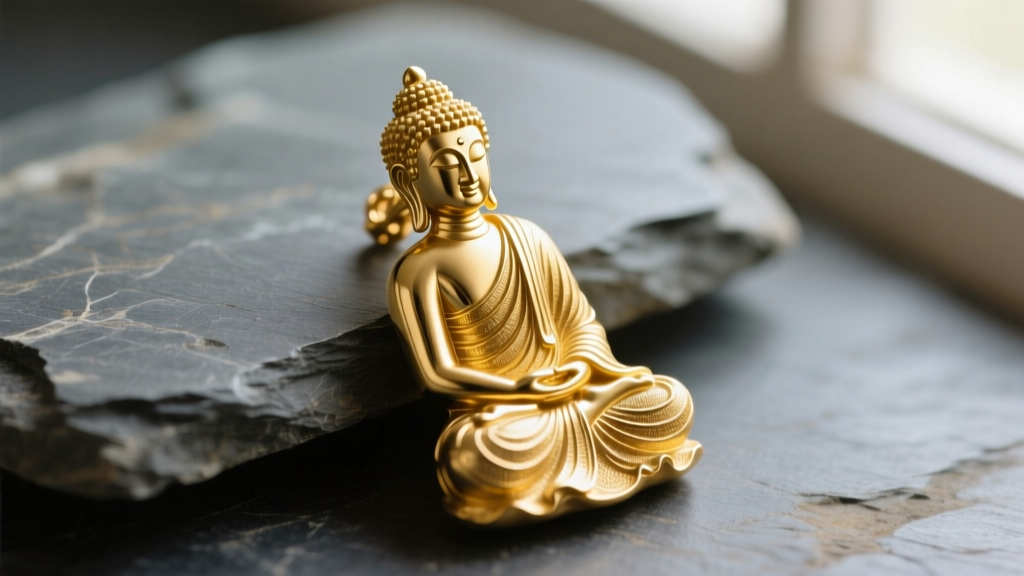
The Metallurgy of Devotion: Choosing the Right Gold Karat
When investing in a buddha necklace gold pendant, the karat weight dictates not only the color and cultural resonance of the piece but also its structural longevity. Gold in its purest form (24k) is exceptionally malleable, registering a mere 25-30 on the Vickers Hardness (HV) scale. While 24k gold holds deep spiritual significance in many Eastern traditions, it is entirely unsuitable for intricate pendant work; the delicate features of the Buddha’s face, the ushnisha (cranial bump), and the elongated earlobes would easily bend or warp under daily wear.
To understand the mechanical realities of gold alloys, we must look at the metallurgical data. According to the Gemological Institute of America (GIA), alloying gold with metals like copper, silver, and zinc drastically alters its crystalline structure and tensile strength. Here is how the most common karatages perform when cast into intricate spiritual motifs:
| Karat | Gold Purity | Vickers Hardness (HV) | Structural Integrity for Pendants |
|---|---|---|---|
| 22k | 91.6% | 40 - 50 HV | Rich, traditional yellow hue. Prone to micro-bending on thin protrusions like the monastic robe folds. Best for heavy, solid castings worn on special occasions. |
| 18k | 75.0% | 120 - 150 HV | The optimal balance. Retains a deep, warm yellow color while providing enough rigidity to hold sharp, intricate lost-wax casting details without deformation. |
| 14k | 58.3% | 140 - 170 HV | Highly durable for daily wear, but the higher alloy content (often copper-heavy) results in a paler, sometimes slightly rosier yellow that lacks traditional Eastern aesthetic warmth. |
For the discerning collector, 18k yellow gold remains the undisputed champion for a buddha necklace gold pendant. It offers the structural rigidity required to protect the micro-engravings of the urna (the dot on the forehead) while maintaining the luminous, saturated yellow that symbolizes purity and enlightenment in Buddhist iconography.
Lost-Wax Casting vs. Hand Engraving: Manufacturing Deep Dive
The method used to create your pendant fundamentally impacts its surface finish, weight distribution, and long-term durability. The vast majority of commercial gold Buddha pendants are produced via investment casting, commonly known as lost-wax casting. In this process, a master wax model is encased in a plaster-like investment material, burned out in a kiln, and replaced with molten gold.

While lost-wax casting allows for breathtaking three-dimensional complexity, it introduces specific vulnerabilities that buyers must inspect. The most common manufacturing defect in cast gold pendants is shrinkage porosity. As the molten gold cools and solidifies within the mold, it contracts. If the cooling rate is not perfectly controlled by the jeweler's sprue design, microscopic gas bubbles can become trapped just beneath the surface. In a Buddha pendant, this porosity often manifests as tiny pits in the deep folds of the monastic robes or the smooth planes of the face. Over time, these pits trap skin oils and environmental grime, leading to localized tarnishing of the alloy metals.
Conversely, high-end artisanal pendants may be hand-carved from solid gold blanks or heavily hand-finished post-casting. Hand-engraving compresses the surface molecules of the gold, creating a work-hardened exterior that is highly resistant to scratching. When examining a premium piece, look for crisp, sharp transitions between the polished planes of the face and the matte, stippled textures of the lotus throne—hallmarks of expert hand-finishing that machines cannot replicate.
Bail Engineering and Mudra-Specific Weight Distribution
A frequently overlooked aspect of pendant design is the bail—the loop that connects the pendant to the chain. In a buddha necklace gold piece, the bail must be engineered to accommodate the specific center of gravity dictated by the Buddha's mudra (hand gesture) and posture.
- Bhumisparsha Mudra (Earth-Touching): In this seated posture, the right hand reaches down to touch the earth. This creates an asymmetrical weight distribution, pulling the pendant slightly to the right. A standard top-drilled bail will cause the pendant to sit crookedly on the chest. Expert jewelers counter this by casting an integrated, tapered bail slightly offset to the left, or by utilizing a hidden bail that distributes the chain's tension across a wider surface area of the pendant's halo.
- Dhyana Mudra (Meditation): The hands rest symmetrically in the lap. This creates a perfectly balanced, bottom-heavy center of gravity. A heavy, diamond-cut V-bail works exceptionally well here, allowing the pendant to sit flat and plumb against the sternum.
- Standing or Walking Buddha: These elongated, vertical designs are highly susceptible to torque and flipping. They require a heavy, cast-integral loop rather than a soldered jump ring, which can easily snap under the pendulum-like swinging motion of a vertical pendant.
Always inspect the solder joints on the bail. Laser-welded bails offer superior tensile strength compared to traditional torch-soldered joints, which can suffer from heat-induced brittleness if the jeweler uses a solder with a significantly lower melting point than the pendant's karatage.
Chain Pairing: Matching Tensile Strength to Pendant Mass
A solid 18k gold Buddha pendant of respectable proportions typically weighs between 8 and 15 grams. Pairing this mass with an inadequate chain is a recipe for catastrophic failure. The World Gold Council notes that the tensile strength of gold chains varies wildly based on their link geometry and whether they are solid or hollow. Never pair a heavy solid gold pendant with a hollow rope chain; the internal hollow spaces will crush under the dynamic load of the pendant swinging against the chest.
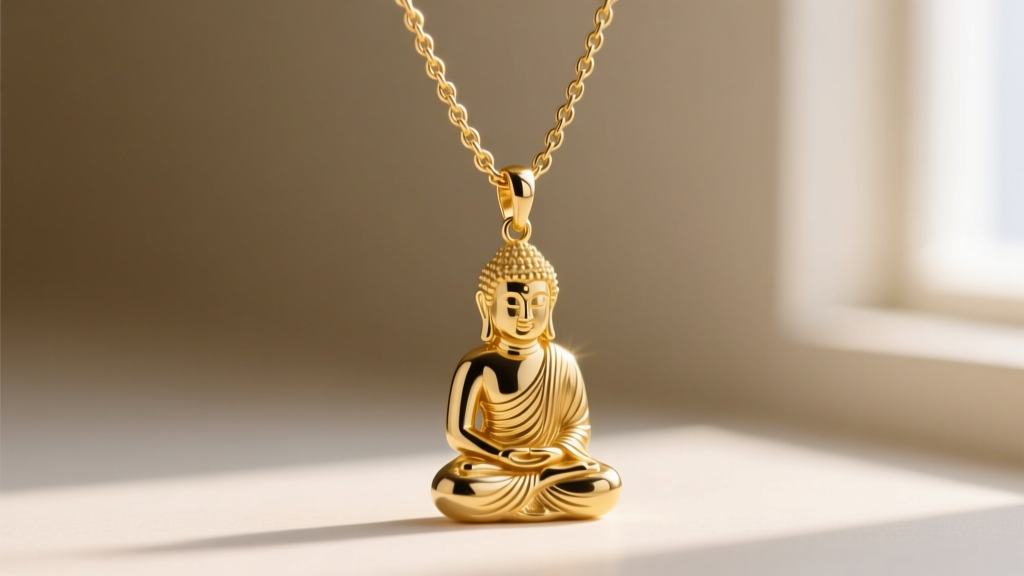
For pendants in the 8-15 gram range, the following chain architectures provide the necessary mechanical support while complementing the spiritual aesthetic:
- Wheat (Spiga) Chain (2.0mm - 2.5mm): Composed of interlocking, V-shaped links woven in the same direction, wheat chains offer exceptional tensile strength and a fluid, fabric-like drape. The continuous woven pattern visually echoes the intricate folds of the Buddha’s robes, making it a highly cohesive aesthetic choice.
- Box Chain (1.5mm - 2.0mm): Made of square, interlocking links, box chains are incredibly rigid and resistant to kinking. They provide a modern, geometric contrast to the organic curves of the Buddha figure, though they can occasionally pull chest hair if the links are not perfectly flush.
- Foxtail Chain (2.5mm+): Featuring two rows of slanted, V-shaped links connected by a central spine, foxtail chains are virtually indestructible under normal pendant loads. Their heavy, luxurious appearance is best reserved for substantial 22k or 18k pendants weighing over 12 grams.
Sourcing, Hallmarking, and Long-Term Care
Because spiritual jewelry carries deep personal and cultural significance, ensuring the authenticity and ethical sourcing of your buddha necklace gold piece is paramount. Always demand a hallmark or an independent XRF (X-ray fluorescence) test report from the retailer. XRF testing is a non-destructive method that verifies the exact elemental composition of the alloy, ensuring you are not purchasing a heavily depleted surface that masks a lower-karat or base-metal core.
Maintenance of high-karat gold requires a gentle touch. Avoid ultrasonic cleaners, especially if your Buddha pendant features micro-pave diamond accents or delicate enamel work on the lotus base. The high-frequency vibrations can loosen friction-set stones and fracture vitreous enamel. Instead, clean your pendant weekly using a solution of warm distilled water and a few drops of pH-neutral dish soap. Agitate gently with a soft-bristled baby toothbrush, paying special attention to the deep crevices of the casting where sebum and environmental dust accumulate. Rinse thoroughly and dry with a lint-free microfiber cloth to prevent water spots from dulling the high-polish planes of the face and hands.
By understanding the metallurgy, manufacturing nuances, and mechanical requirements of your jewelry, you elevate your purchase from a simple accessory to a lasting, structurally sound artifact of devotion and artisanal mastery.


