Expert Guide to Buying an Authentic Buddhist Jade Necklace
Discover how to authenticate, grade, and style a genuine Buddhist jade necklace. Learn about Type A jadeite, carving symbolism, and proper cord mounting.

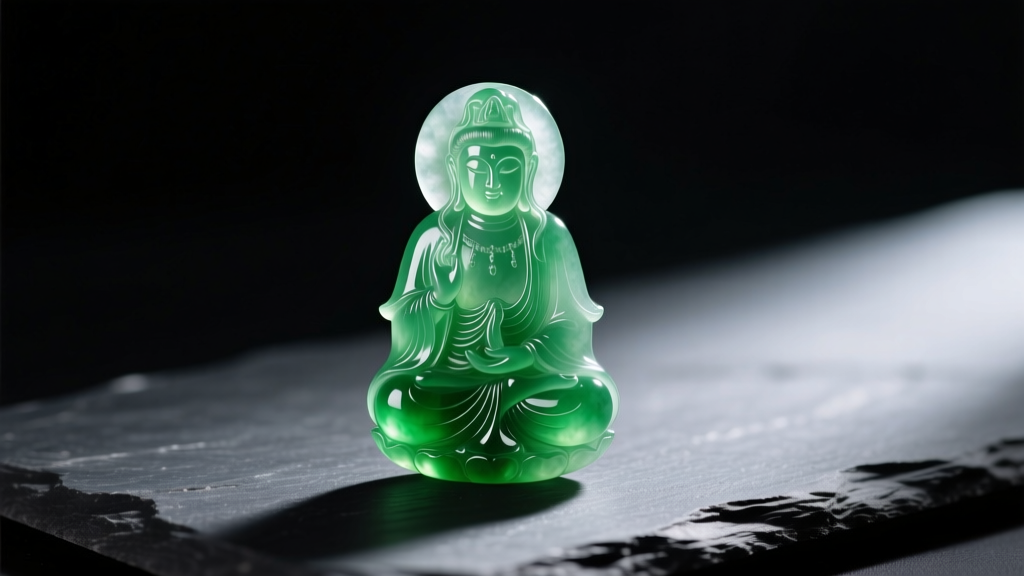
The Gemological Reality of Buddhist Jade
When collectors and spiritual practitioners seek a buddhist jade necklace, they are often navigating a market saturated with treated stones, synthetic imitations, and misrepresented origins. True jade is not a single mineral, but rather a gemological term encompassing two distinct silicate minerals: jadeite (NaAlSi2O6) and nephrite (Ca2(Mg,Fe)5Si8O22(OH)2). In the context of Buddhist artifacts and pendants, jadeite—known in Chinese as Feicui—is the most highly prized due to its vitreous luster and vibrant color saturation, while nephrite is revered for its historical significance and buttery, waxy luster.
As an expert appraiser, I cannot stress enough that purchasing a Buddhist jade pendant requires looking past the spiritual motif and deeply into the crystallography and lapidary treatments of the stone. In the 2026 market, advanced polymer resins and laser-dyeing techniques can easily fool the naked eye, making gemological literacy your most valuable tool.
Jadeite vs. Nephrite: A Mineralogical Breakdown
Understanding the physical properties of the stone is the first step in authentication. Jadeite is a pyroxene mineral, forming under high-pressure, low-temperature metamorphic conditions. Nephrite is an amphibole, characterized by a felted, interlocking fibrous structure that makes it incredibly tough, though slightly softer than jadeite.
| Property | Jadeite (Feicui) | Nephrite |
|---|---|---|
| Chemical Formula | NaAlSi2O6 | Ca2(Mg,Fe)5Si8O22(OH)2 |
| Mohs Hardness | 6.5 - 7.0 | 6.0 - 6.5 |
| Specific Gravity (SG) | 3.30 - 3.36 | 2.90 - 3.03 |
| Refractive Index (RI) | 1.66 (point method) | 1.61 (point method) |
| Luster | Vitreous to Sub-vitreous | Waxy to Greasy |
When evaluating a Buddhist pendant, the specific gravity test is highly revealing. A heavy, dense feel in the hand is characteristic of genuine Type A jadeite. If the pendant feels surprisingly light for its volume, it may be serpentine, aventurine, or a polymer-impregnated composite.
The A, B, and C Grading System: Spotting Treated Jade
The commercial jade trade categorizes jadeite into three primary treatment grades. For a Buddhist necklace intended for spiritual practice or heirloom investment, only Type A is acceptable.
Type A: Completely Untreated
Type A jadeite has only been cut, carved, and polished using traditional lapidary methods (often with diamond or carborundum abrasives) and finished with a natural beeswax or mild plum juice polish. It retains its original crystal lattice and structural integrity.
Type B: Acid-Bleached and Polymer-Impregnated
Type B jade is submerged in hydrochloric or nitric acid to dissolve brown and yellow oxidation stains. This process destroys the interlocking crystal boundaries, leaving the stone porous and brittle. It is then placed in a vacuum chamber and impregnated with Opticon or epoxy resin. Under a long-wave UV flashlight (365nm), the polymer in Type B jade will often exhibit a chalky blue or greenish-white fluorescence.
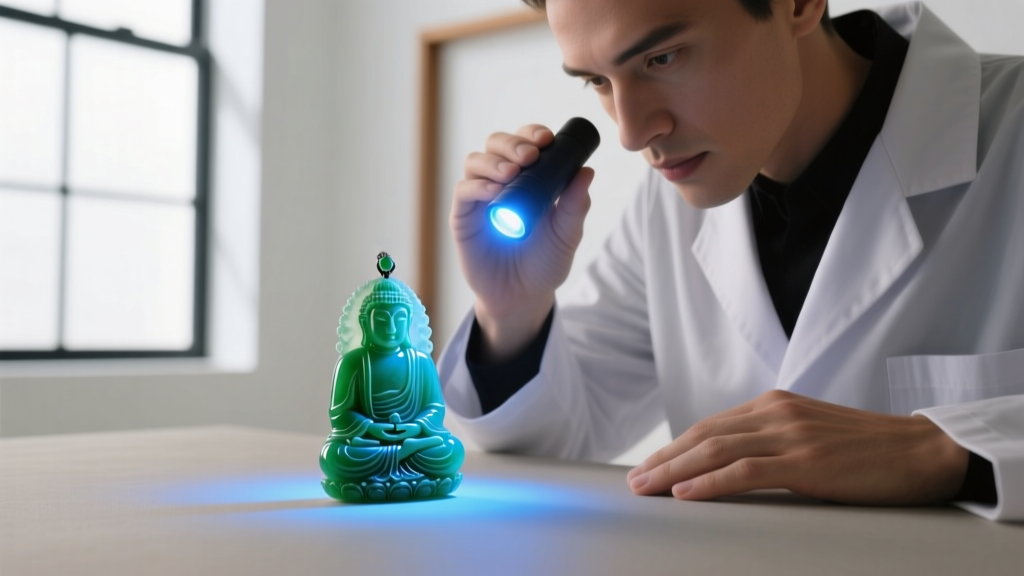
Type C: Dyed
Type C jade is artificially colored using aniline dyes, often heated to penetrate the crystal lattice. The dye concentrates in the micro-fractures and grain boundaries, creating a visible 'web' or 'spiderweb' effect under 10x magnification. Over time, exposure to sunlight and sweat will cause Type C jade to fade significantly.
Expert Tip: Always carry a 10x triplet loupe and a 365nm UV flashlight when inspecting jade in markets. If the green color pools in the surface-reaching fractures, walk away.
For definitive verification, rely on the Gemological Institute of America (GIA) or the National Gemstone Testing Center (NGTC). In the current market, an NGTC certificate is considered the gold standard for Feicui, as their spectroscopic analysis is highly calibrated to detect the latest generations of colorless polymer resins that evade older FTIR (Fourier Transform Infrared) spectrometers.
Decoding Buddhist Carving Motifs and Lapidary Quality
The spiritual efficacy and cultural value of a Buddhist jade necklace are deeply tied to its carving motif. Master carvers utilize the natural color variations (the 'rind' or 'skin') of the jade boulder to create multi-tonal reliefs.
- Guanyin (Avalokiteshvara): The Bodhisattva of Compassion. High-quality carvings will feature fluid, undercut drapery and serene, perfectly symmetrical facial proportions. Asymmetry in the eyes or mouth drastically reduces the value.
- Budai (The Laughing Buddha): Symbolizing abundance and contentment. Carvers often use the vibrant green 'apple green' or 'imperial' sections of the stone for the belly or the coin he holds, leaving the paler sections for the robes.
- Ruyi and Lotus: Often incorporated into the base or halo of the deity. The lotus represents purity rising from the mud. Look for sharp, crisp petal edges; muddy or rounded edges indicate mass-production via ultrasonic CNC milling rather than hand-carving.
True master carvings exhibit 'undercutting,' where the jade is carved away beneath the surface layer to create three-dimensional depth. This requires immense skill, as jade's tectonic grain can shatter if the lapidary applies pressure at the wrong angle.
Mounting Mechanics: Silk Cord vs. Metal Chains
A critical, yet frequently overlooked, aspect of wearing a buddhist jade necklace is the mounting hardware. Jade is exceptionally tough due to its interlocking grain, but it lacks true cleavage planes, meaning it is susceptible to shock fractures and point-stress.
The Danger of Metal Bails
Mounting a heavy jadeite Buddha pendant on a rigid 14k or 18k gold chain using a tight metal bail creates a fulcrum point. Every time the pendant swings and hits the chest, the kinetic energy transfers directly into the drilled hole of the jade. Over years of wear, this micro-trauma leads to 'hairline' fractures radiating from the drill hole, eventually causing the pendant to snap and shatter.
Traditional Chinese Macrame Knotting
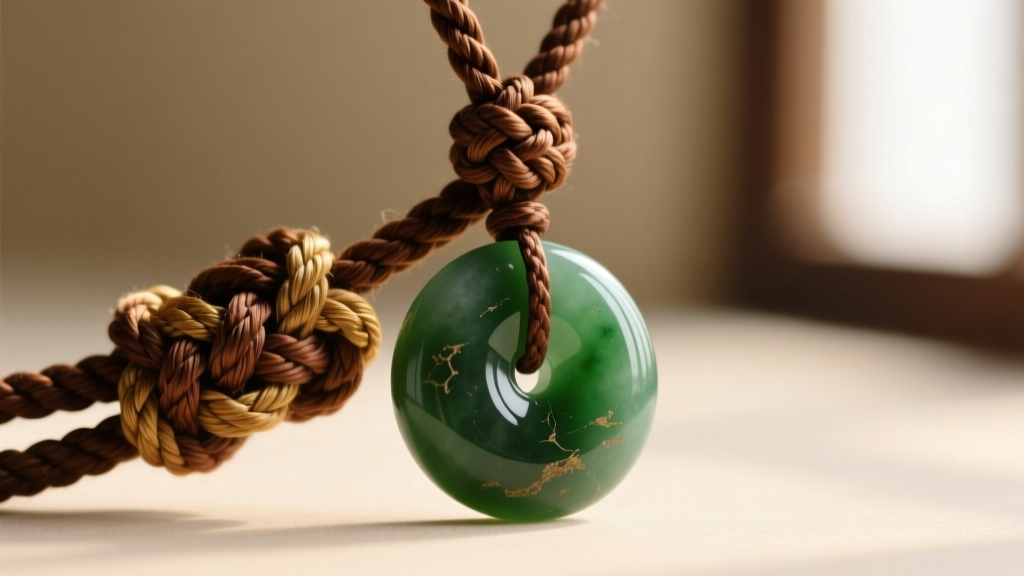
The industry standard for premium Buddhist jade necklaces is traditional hand-braided silk or nylon macrame cord.
- Cord Thickness: For pendants weighing over 15 grams, use a 1.5mm to 2.0mm braided nylon cord. Nylon is preferred over pure silk for its superior tensile strength and resistance to sweat degradation.
- The Slipknot Bail: Instead of a metal loop, master knot-tiers use a complex slipknot (often the 'Pan Chang' or endless knot) that wraps around the top ridge of the carving. This distributes the weight evenly across a wider surface area of the stone and acts as a natural shock absorber.
- Adjustability: A proper jade necklace cord should feature sliding macrame knots at the nape of the neck, allowing the wearer to adjust the drop length from a 16-inch choker to a 24-inch sweater length without introducing weak metal clasps.
Market Pricing and Provenance in 2026
Pricing a Buddhist jade necklace requires evaluating the intersection of gemological quality, carving artistry, and provenance. The market has bifurcated sharply between commercial-grade and investment-grade pieces.
| Grade & Type | Characteristics | Estimated Market Price (USD) |
|---|---|---|
| Investment Type A | Imperial green, high translucency (glassy), master hand-carved, NGTC certified. | $15,000 - $100,000+ |
| Commercial Type A | Spinach green or mottled, opaque to semi-translucent, good hand-carving. | $400 - $2,500 |
| Type B+C Treated | Vibrant but artificial color, polymer-filled, CNC mass-produced motifs. | $30 - $150 |
| Imitations (Quartz/Serpentine) | Dyed quartzite or bowenite masquerading as jade. No gemological value. | $15 - $50 |
When purchasing, always demand an original, verifiable certificate from a tier-one laboratory. In the modern era, QR codes on NGTC and GIA reports link directly to secure digital databases, eliminating the risk of forged paper certificates. A genuine Buddhist jade necklace is not merely an accessory; it is a geological marvel and a vessel of cultural heritage, demanding the utmost respect and rigorous authentication from its wearer.


