Is a Necklace With Stars and Moon Worth It? 2026 Value Guide
Discover the true cost of a necklace with stars and moon. We break down material grades, gemstone values, and pricing tiers for 2026 buyers.

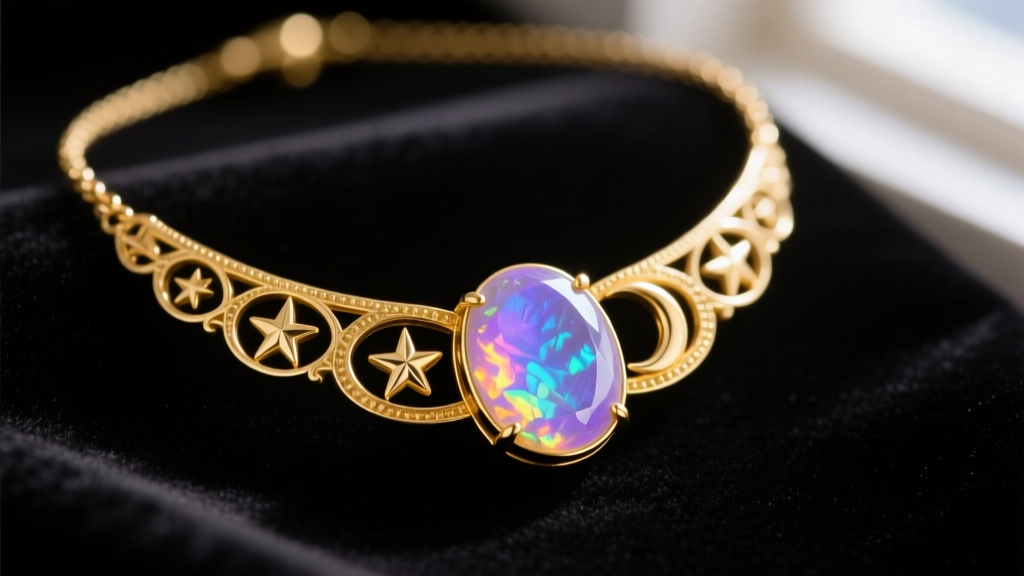
The Celestial Allure and the Markup Trap
Celestial jewelry has transcended seasonal trends to become a permanent staple in modern accessorizing. Among these designs, a necklace with stars and moon motifs remains one of the most searched and gifted items in the market. However, the sheer volume of options available in 2026 creates a massive discrepancy in pricing, quality, and long-term value. Shoppers frequently find themselves caught between $20 fast-fashion trinkets that tarnish within weeks and $2,500 fine jewelry pieces that feel financially out of reach.
As a senior appraiser and style analyst, I often see consumers overpay for heavily marketed boutique brands that use subpar base metals, or conversely, underestimate the craftsmanship required to properly set delicate gemstones into intricate crescent shapes. This comprehensive value assessment will deconstruct the actual cost of materials, labor, and gemstones involved in celestial necklaces, providing you with a definitive framework to determine if the price tag matches the intrinsic and aesthetic value of the piece.
The Material Matrix: What You Are Actually Paying For
The foundation of any necklace dictates its baseline value, skin compatibility, and lifespan. When evaluating a celestial pendant, the metal composition is the first place to look for hidden markups.
Base Metals and Plating Thickness
Many mid-tier brands market their pieces as 'gold dipped' or 'heavy plated,' but these terms are largely unregulated marketing jargon. According to the Federal Trade Commission (FTC) Jewelry Guides, true gold vermeil must consist of a sterling silver base with a gold plating of at least 2.5 microns thick. Anything less is considered standard gold plating (often a mere 0.1 to 0.5 microns), which will wear off rapidly against the friction of the collarbone.
- Zinc Alloy / Brass (Low Value): Common in pieces under $40. Prone to rapid oxidation, turning skin green due to copper content reacting with sweat. Structural integrity is poor; delicate star points easily snap.
- 925 Sterling Silver (Medium Value): The industry standard for mid-tier boutique jewelry. Hypoallergenic and durable. If plated, ensure it is vermeil. Unplated silver requires occasional polishing to remove sulfide tarnish.
- Solid 14k or 18k Gold (High Value): The only choice for generational heirlooms. 14k gold (58.5% pure gold) offers the best balance of rich color and tensile strength, crucial for holding the sharp, intricate points of star motifs without bending.
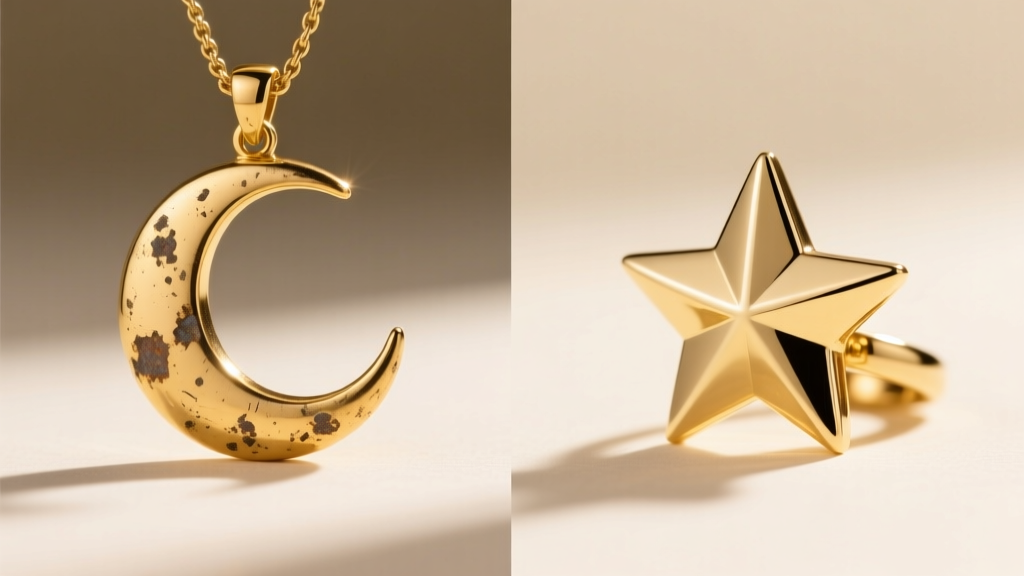
Gemstone Value in Celestial Designs
A necklace with stars and moon motifs frequently incorporates gemstones to represent the night sky. The choice of stone drastically alters the price point and the ethical footprint of the jewelry.
Moonstone vs. Synthetic Opalite
The moon pendant is traditionally anchored by a moonstone. Natural rainbow moonstone (a variety of labradorite) exhibits adularescence—a billowing light effect caused by light scattering between microscopic layers of orthoclase and albite feldspar. According to the Gemological Institute of America (GIA), high-quality natural moonstones with strong blue sheen command premium prices. However, many budget brands substitute natural moonstone with 'opalite,' a synthetic glass that lacks the internal crystalline structure and depth of natural stone. If a pendant is priced under $50 and features a flawless, glowing 'moonstone,' you are almost certainly looking at manufactured glass.
Diamond Melee vs. Cubic Zirconia (CZ)
Star pendants often utilize diamond melee (small diamonds under 0.15 carats) to mimic twinkling light. In fine jewelry, SI1/I1 clarity melee is standard, costing the manufacturer roughly $300-$500 per carat. In budget pieces, CZ is used. While CZ offers higher brilliance and dispersion than diamond, it is softer (8.5 on the Mohs scale vs. 10 for diamond) and will accumulate micro-scratches over time, eventually appearing cloudy. A true value assessment requires verifying if the 'diamonds' are natural, lab-grown, or simulants.
2026 Price Tier Comparison Chart
To contextualize the market, below is a structured breakdown of what you should expect to pay across different retail tiers for a standard 18-inch necklace with stars and moon pendants.
| Retail Tier | Base Metal | Plating / Finish | Gemstones | Price Range | Expected Lifespan |
|---|---|---|---|---|---|
| Fast Fashion | Brass / Zinc | Flash Gold (<0.1µm) | CZ / Opalite Glass | $15 - $45 | 3 - 6 Months |
| Mid-Tier Boutique | 925 Sterling Silver | Gold Vermeil (2.5µm+) | Lab Opal / Low-Grade Moonstone | $85 - $220 | 2 - 5 Years |
| Fine Jewelry | 14k / 18k Solid Gold | N/A (Solid Alloy) | Natural Diamonds / Moonstone | $650 - $2,500+ | Generational |
Appraiser's Note: The 'sweet spot' for value in 2026 is the mid-tier boutique category, provided the brand is transparent about their plating thickness and uses genuine 925 silver cores. You are paying for design and decent longevity without the steep markup of luxury brand names.
Red Flags and Structural Failure Modes
Celestial jewelry presents unique structural challenges. The sharp points of stars and the thin, tapering edges of crescent moons are highly susceptible to specific failure modes that budget manufacturers routinely ignore.
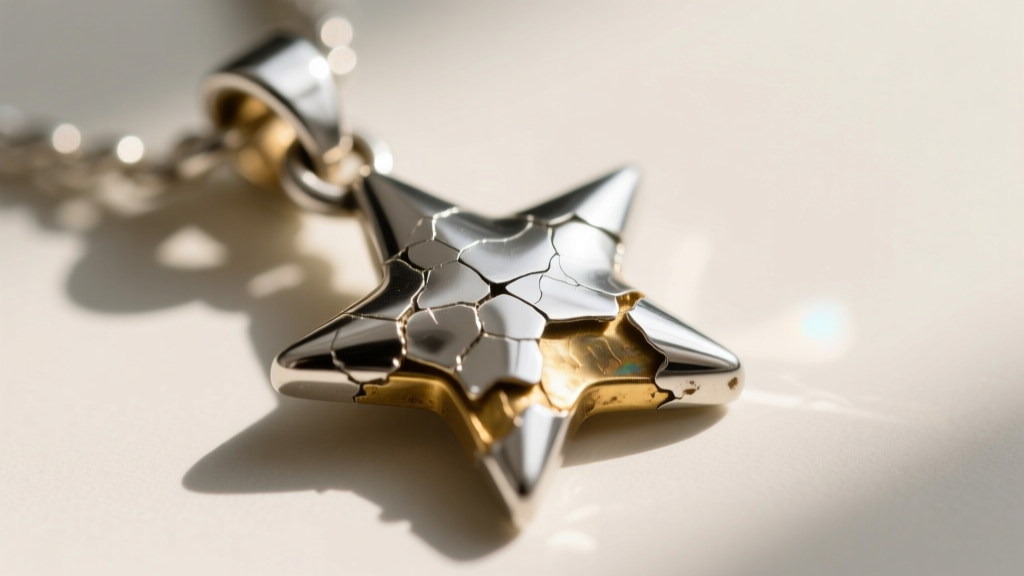
1. Jump Ring Separation
The jump ring connects the delicate chain to the pendant. In cheap manufacturing, jump rings are simply cut and bent shut, leaving a microscopic gap. Over time, the friction of the chain works its way into this gap, eventually slicing through the ring and losing the pendant. High-value pieces feature soldered or laser-welded jump rings, ensuring a seamless, unbreakable loop.
2. Prong Snagging and Gemstone Loss
Star points require precise setting. If a gemstone is set near the tip of a star using standard prongs, the prongs can easily catch on knitwear or hair. This pulling force bends the prong away from the stone, leading to gemstone loss. Value-driven designs utilize bezel settings or flush/gypsy settings for stars, eliminating snag points and securing the stone flush against the metal.
3. Enamel Chipping on Crescents
Black or deep blue enamel is frequently used to fill crescent moons to contrast against gold or silver. In budget pieces, this is often 'cold enamel' (essentially a hardened epoxy resin) which shrinks, cracks, and chips upon impact or exposure to UV light and perfumes. True value requires vitreous enamel, which is glass powder fired at high temperatures, fusing it permanently to the metal base.
How to Assess True Value Before Buying
Before adding a celestial piece to your cart, run it through this rapid value-assessment checklist to ensure your budget is being allocated toward quality rather than marketing.
- Demand the Micron Count: If the piece is gold-plated silver, the retailer must explicitly state the plating thickness (e.g., 2.5 microns). If they only say 'gold plated,' assume it is flash-plated and adjust your willingness to pay accordingly (maximum $40).
- Inspect the Chain Clasp: A heavy, intricate pendant requires a sturdy chain. Lobster clasps should feel springy and secure. Avoid spring-ring clasps on chains thicker than 1.2mm, as the internal springs fail rapidly under the weight of solid metal pendants.
- Verify the Stone Origin: Look for terms like 'natural rainbow moonstone' or 'lab-grown diamond.' Beware of vague descriptors like 'crystal,' 'gemstone,' or 'moonstone simulant,' which are red flags for cheap glass or plastic.
- Check the Bail Construction: The bail (the loop the chain passes through) should be integrated into the pendant casting or securely soldered. Glued bails are a hallmark of mass-produced, low-value inventory.
Final Verdict: Budget vs. Heirloom
A necklace with stars and moon motifs is a beautiful expression of personal style, but its financial value is entirely dependent on its metallurgical and structural reality. If you are buying for a fleeting seasonal trend or a teenager's gift, a $30 gold-plated brass piece serves its purpose—just expect to replace it next year. However, if you are seeking a daily-wear talisman that will not irritate your skin or lose its luster, investing $150-$300 in a solid 14k gold or heavy-vermeil piece with bezel-set natural stones is the ultimate expression of smart, value-driven jewelry curation.


