Beginner Guide to Buying a Turquoise and Silver Necklace
Learn how to spot genuine stones, choose the right silver grade, and care for your turquoise and silver necklace with this beginner guide.

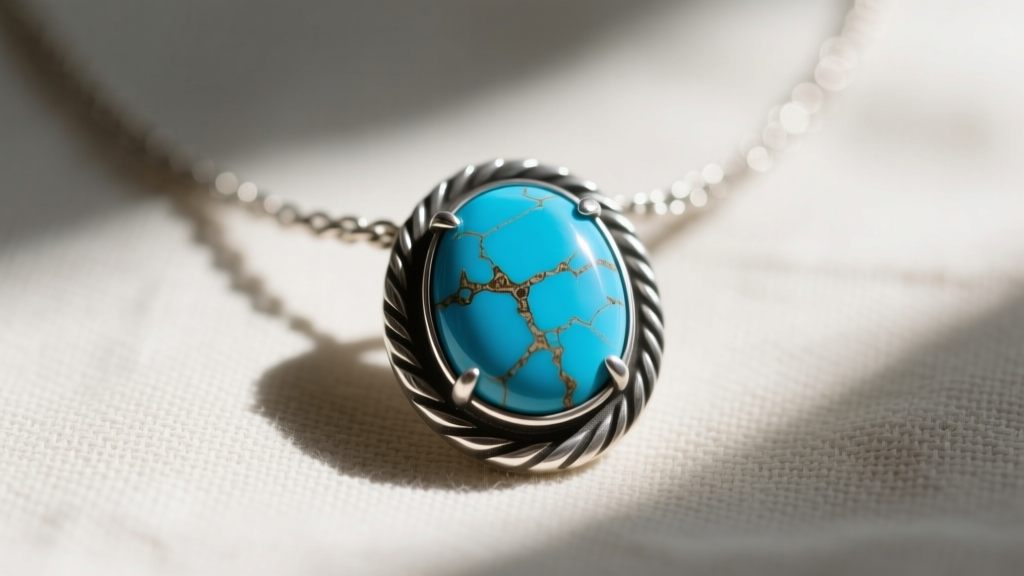
The combination of vibrant blue-green stones and bright white metal has captivated jewelry lovers for centuries. A turquoise and silver necklace is more than just a striking accessory; it is a piece of wearable history that bridges ancient lapidary traditions with modern style. However, for beginners, navigating the market can be incredibly daunting. Between synthetic imitations, confusing silver hallmarks, and varying treatments, it is easy to overpay for a piece that lacks authenticity or durability.
This guide strips away the jargon and provides you with a practical, expert-level framework for evaluating, purchasing, and maintaining your jewelry. Whether you are looking at a contemporary artisan piece or a vintage Native American classic, understanding the material science behind your necklace is the key to making a confident purchase.
The Metallurgy: Why Sterling Silver and Turquoise Work Together
To understand why this pairing is so iconic, you have to look at the chemistry. Pure silver (99.9% fine silver) is far too soft to securely hold a cabochon stone. If a jeweler were to use fine silver for a bezel setting, the metal would warp under light pressure, potentially popping the stone out of its mount.
This is why Sterling Silver (.925) is the industry standard. By alloying 92.5% pure silver with 7.5% copper, the metal gains the structural rigidity required to craft durable bezels, prongs, and heavy chain links. Interestingly, the copper used in sterling silver alloy subtly echoes the natural copper inclusions found in many high-grade turquoise varieties, creating a subconscious visual harmony that makes the two materials look exceptionally natural together.
Decoding Turquoise: Genuine, Stabilized, and Imitation
The most critical skill for any buyer is learning to identify what you are actually looking at. According to the Gemological Institute of America (GIA), natural, untreated turquoise of gem quality accounts for less than 10% of all turquoise mined globally. The vast majority of stones on the market undergo some form of enhancement.
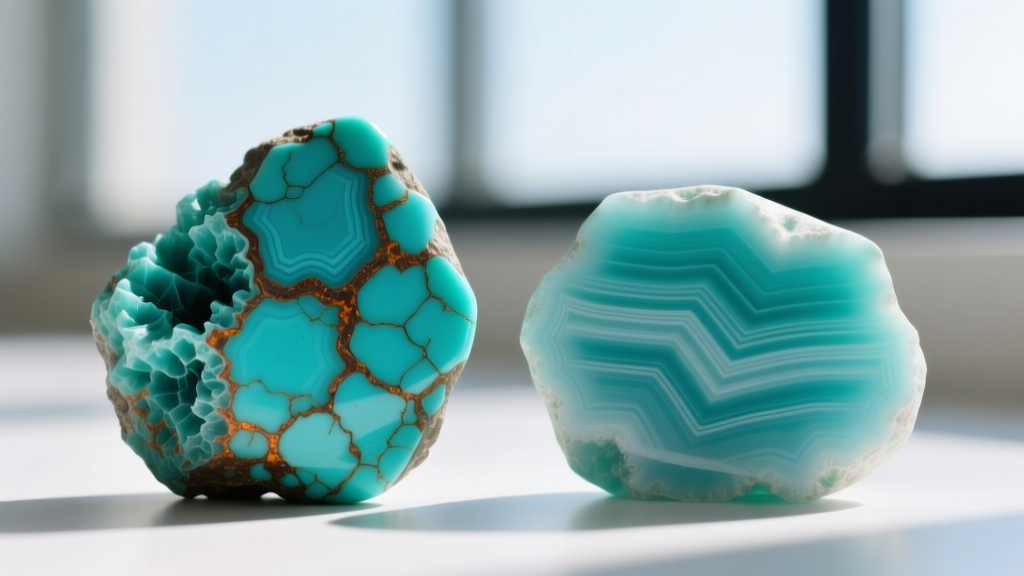
The Matrix and Mine Origins
The 'matrix' refers to the host rock or mineral veining trapped inside the turquoise. Beginners often mistake heavy black webbing for a flaw, but in many cases, it is a marker of authenticity and origin. For example, stones from the famous Kingman mine in Arizona often feature a distinct copper-pyrite matrix, while the now-closed Sleeping Beauty mine produced stones prized for their pure, unwebbed sky-blue color. Imitation stones made from dyed howlite or magnesite often feature unnatural, uniform gray veining that looks 'painted' on under magnification.
Understanding Stabilization vs. Reconstitution
Because lower-grade turquoise is highly porous and chalky, it must be stabilized to survive the jewelry-making process. Stabilization involves submerging the stone in a clear epoxy resin or sodium silicate under a vacuum, forcing the hardening agent into the stone's microscopic pores. This is an accepted industry practice that enhances durability without altering the stone's fundamental chemical structure. Reconstituted turquoise, however, involves grinding turquoise dust into a powder, mixing it with dyes and resins, and pressing it into blocks. This is essentially a composite material and holds very little intrinsic value.
| Turquoise Type | Treatment Level | Durability (Mohs) | Market Value | Visual Clues for Beginners |
|---|---|---|---|---|
| Natural / Untreated | None (Cut and polished only) | 5.0 - 6.0 | High ($5 - $30+ per carat) | Subtle color variations, natural inclusions, feels cool to the touch. |
| Stabilized | Clear resin / Epoxy infusion | 6.0 - 7.0 | Moderate ($1 - $5 per carat) | Glossy finish, vibrant color, widely accepted in commercial jewelry. |
| Reconstituted | Powdered stone + dye + resin | 4.0 - 5.0 | Low (Pennies per carat) | Uniform color, unnatural 'speckled' matrix, lightweight. |
| Imitation (Howlite) | Dyed white mineral | 3.5 - 4.5 | Very Low | Gray/black veining that doesn't penetrate deeply, scratches easily. |
Silver Hallmarks: What You Are Actually Buying
When shopping for a turquoise and silver necklace, always inspect the metal for a hallmark. The Federal Trade Commission (FTC) Jewelry Guides strictly regulate how precious metals can be marketed in the United States. Look for the '.925' or 'Sterling' stamp.
If you are buying vintage Native American jewelry, you may encounter the term 'Coin Silver'. Prior to the widespread availability of sterling silver sheets, indigenous artisans would melt down US silver coins (which were 90% silver and 10% copper) to forge their jewelry. Coin silver (.900) is highly collectible and often features a darker, richer patina than modern sterling.
Warning: Avoid pieces labeled as 'Tibetan Silver', 'Alpaca', or 'Nickel Silver'. These are base metal alloys containing copper, nickel, and zinc. They contain absolutely zero elemental silver, will tarnish to a dull gray, and frequently cause severe contact dermatitis or turn your skin green due to the copper oxidation.
Chain Selection and Bail Sizing
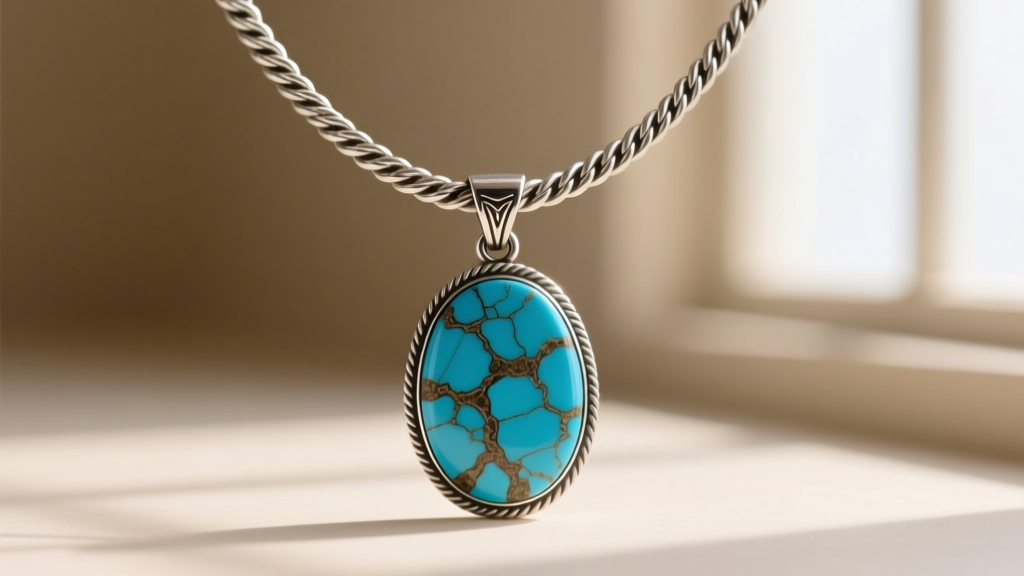
A heavy turquoise cabochon set in a thick silver bezel can easily weigh between 15 and 30 grams. Suspending this weight on a delicate 1mm chain is a recipe for disaster. Over time, the friction of the silver bail rubbing against a thin chain will act like a saw, eventually cutting through the links and resulting in a lost pendant.
For beginners, we recommend pairing heavy turquoise pendants with a 2.5mm to 4mm Sterling Silver Rope Chain. The twisted links of a rope chain provide immense tensile strength and mimic the traditional, hand-stamped silver bead necklaces (like Santo Domingo heishi or Navajo sand-cast beads) historically used in Southwestern jewelry. Additionally, ensure the pendant's bail (the loop that connects the stone to the chain) is soldered shut and thick enough to accommodate the clasp of your chosen chain without bending.
The Porosity Problem: Care and Maintenance
Turquoise is a hydrous phosphate of copper and aluminum, making it inherently porous. On the Mohs scale of hardness, it sits at a relatively soft 5 to 6. This porosity means your necklace acts like a microscopic sponge, absorbing whatever it comes into contact with.
- The 'Last On, First Off' Rule: Always put your necklace on after applying perfumes, hairsprays, and lotions. Chemical exposure can alter the stone's color, turning a bright sky-blue into a muddy green or brown over time.
- Avoid Ultrasonic Cleaners: Never use ultrasonic jewelry cleaners or harsh chemical silver dips on this necklace. The high-frequency vibrations can fracture the stone, and the chemicals will strip the polish and invade the matrix.
- Proper Storage: Store your necklace in a soft, anti-tarnish cloth pouch. Avoid sealing it in an airtight plastic bag; trapped moisture can cause the sterling silver to oxidize rapidly, and that tarnish can transfer into the porous surface of the turquoise, creating permanent dark stains.
- Cleaning the Silver: To clean the silver components, use a dedicated silver polishing cloth, carefully working around the stone's bezel to avoid rubbing the polishing compound into the turquoise.
By understanding the material realities of both the stone and the metal, you can confidently invest in a turquoise and silver necklace that will not only elevate your wardrobe but also stand the test of time as a cherished heirloom.


