Ultimate Care Guide: Cleaning Your 24k Necklace Safely
Discover expert tips to clean, store, and maintain your 24k necklace. Learn how to protect pure gold from stretching, scratches, and daily grime.

The Metallurgy of 24k Gold: Why It Demands Special Care
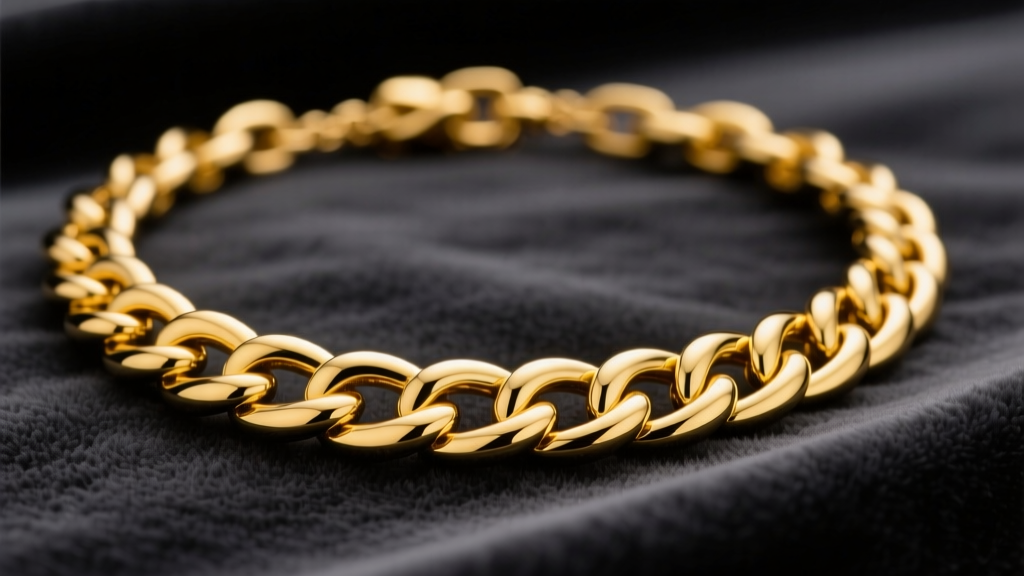
When investing in pure gold jewelry, understanding the metallurgical realities of your 24k necklace is the first step toward preserving its heirloom value. Unlike 14k or 18k gold, which are alloyed with metals like copper, silver, or zinc to increase tensile strength, 24k gold is 99.9% pure. This absolute purity gives it an unmatched, rich yellow luster and complete immunity to traditional tarnishing, but it also introduces significant structural vulnerabilities.
According to the Gemological Institute of America (GIA), pure gold sits at a mere 2.5 to 3 on the Mohs hardness scale. In terms of Vickers hardness (HV), 24k gold measures around 25-30 HV, compared to 140+ HV for standard 14k gold. This extreme malleability means that a 24k necklace is highly susceptible to micro-scratches, link deformation, and gradual stretching. Therefore, the maintenance protocols for pure gold are fundamentally different from those used for alloyed gold. You are not just cleaning the metal; you are actively managing its physical structure to prevent permanent deformation.
The Ultimate 24k Necklace Cleaning Protocol
Because 24k gold does not contain alloy metals, it will not oxidize or develop a dark patina. However, it is highly oleophilic, meaning it easily attracts and holds onto sebum (skin oils), lotions, perfumes, and microscopic environmental dust. This buildup dulls the reflective surface of the gold, making it look matte and lifeless. Follow this exact protocol to restore its mirror finish without inflicting mechanical damage.
Step 1: Formulate the Correct Solution
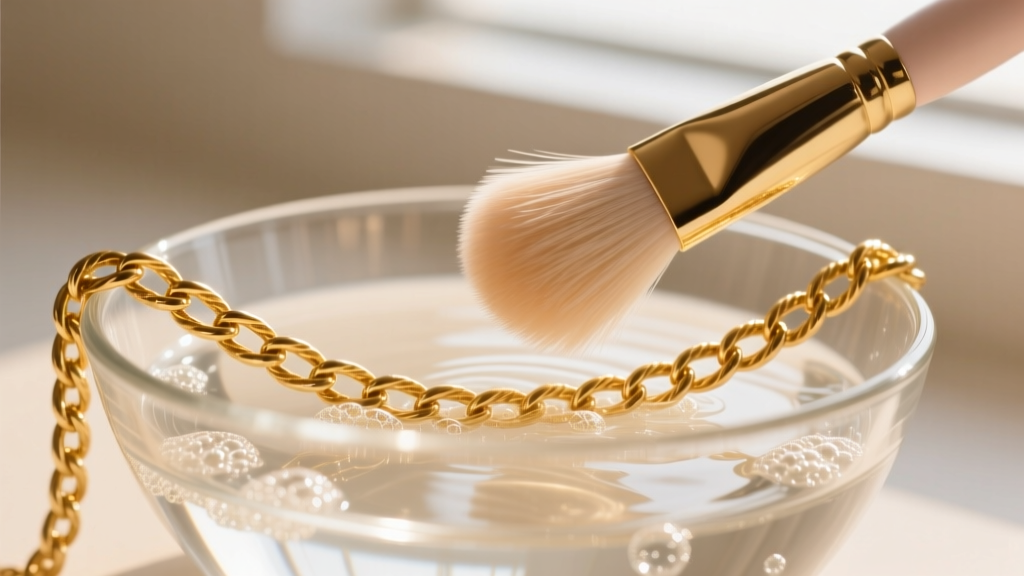
Never use commercial jewelry dips or ultrasonic cleaners on a 24k necklace. Ultrasonic vibrations can weaken the soft links over time, and harsh chemical dips can leave microscopic residues. Instead, fill a glass bowl with distilled water (tap water contains chlorine and fluoride that can cause long-term surface dulling) heated to roughly 90°F (32°C). Add exactly two drops of a phosphate-free, pH-neutral dish soap, such as original Dawn. Avoid soaps with added moisturizers or exfoliating beads.
Step 2: Controlled Agitation
Submerge the necklace and let it soak for precisely 3 to 5 minutes. This allows the surfactants to break down the lipid bonds of skin oils. To agitate the dirt out of the crevices, do not use a standard soft-bristled toothbrush. Nylon toothbrush bristles are often stiff enough to leave micro-scratches on 24k gold. Instead, use a specialized baby-hair brush or an extra-soft goat-hair makeup brush. Gently sweep the bristles along the chain links in the direction of the metal grain, paying special attention to the areas near the clasp where debris accumulates most heavily.
Step 3: The Rinse and Dry Technique
Rinse the necklace under a gentle stream of lukewarm distilled water. Never plug the sink drain without a catch-net, as wet 24k chains are incredibly slippery and heavy. To dry, lay the necklace flat on a lint-free microfiber cloth. Pat it dry; never rub. Rubbing a soft 24k chain against a textile, even a soft one, can cause friction scratches and pull on delicate links. Allow it to air-dry completely on a flat mesh surface before storing.
Storage Mechanics: Preventing Gravity Stretch
The most common failure mode for a heavy 24k necklace is not chemical damage, but mechanical "creep." In metallurgy, creep is the tendency of a solid material to move slowly or deform permanently under the influence of mechanical stresses. When you hang a heavy pure gold chain—like a thick Cuban link or rope chain—on a jewelry stand, the constant pull of gravity will slowly elongate the bottom links over months and years. This results in a permanently stretched, uneven chain that requires professional jeweler intervention to fix.
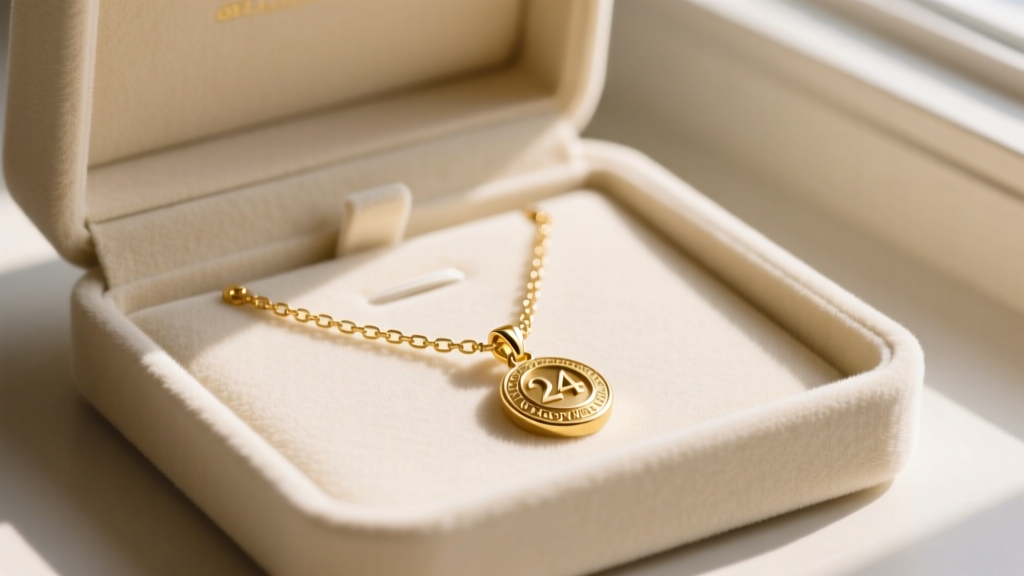
The Golden Rule of 24k Storage: Always store your pure gold necklaces completely flat. Lay them out in a velvet-lined or suede-lined drawer insert. If you must travel with the piece, coil it loosely in a circular shape inside a hard-shell jewelry pouch to prevent kinking, but never hang it by the clasp.
The Galvanic Clasp Conundrum
It is physically impossible to manufacture a functional spring-loaded clasp (like a lobster clasp or spring ring) out of 24k gold; the metal is simply too soft to hold tension. Therefore, the internal spring mechanism is always made of stainless steel, and the outer lever is often 14k or 18k gold. This creates a multi-metal environment. If exposed to salt water or heavy sweat, galvanic corrosion can occur between the steel spring and the pure gold chain, leading to rust transfer and clasp failure. Always wipe the clasp area meticulously after wearing your necklace in humid or coastal environments.
Maintenance Comparison: 24k vs. Alloyed Gold
Understanding how pure gold stacks up against standard jewelry alloys helps contextualize why your care routine must be so rigorous. The World Gold Council highlights that while gold is eternal, its physical form changes drastically based on its purity.
| Metric | 24k Pure Gold | 18k Gold (75% Pure) | 14k Gold (58.3% Pure) |
|---|---|---|---|
| Vickers Hardness | 25 - 30 HV | 120 - 150 HV | 140 - 180 HV |
| Scratch Resistance | Extremely Low | Moderate | High |
| Tarnish Risk | None (Immune) | Low | Moderate |
| Primary Hazard | Deformation & Stretching | Surface Scratches | Oxidation & Tarnish |
| Ultrasonic Safe? | No (Link weakening) | Yes (with caution) | Yes |
Chemical Hazards: What Destroys Pure Gold?
While 24k gold is famously unreactive to most acids and alkalis, it has a few致命 (fatal) weaknesses that every owner must know. The most dangerous is mercury. Gold and mercury undergo a process called amalgamation at room temperature. If your 24k necklace comes into contact with even a microscopic amount of mercury (sometimes found in older thermometers, certain industrial settings, or trace amounts in some fluorescent bulbs), the gold will instantly turn silvery-white and become brittle, effectively destroying the structural integrity of the chain.
Another hazard is chlorine. While pure gold itself does not react with chlorine, the microscopic solder joints used to attach the clasp or repair links are almost always lower-karat gold alloys. Repeated exposure to chlorinated pool water or hot tubs will cause "stress corrosion cracking" in these solder joints, leading to sudden, catastrophic chain breakage without any prior warning signs.
Restoring Shape and Professional Servicing
If your 24k necklace has already suffered from link stretching or minor kinks, do not attempt to bend it back into shape with your fingers or household pliers. Pure gold work-hardens when bent at room temperature, meaning repeated bending will cause the metal to become brittle and eventually snap.
Instead, take the piece to a master jeweler who specializes in high-purity gold. They will use a process called annealing, which involves heating the gold to a specific temperature with a specialized torch to relax the crystalline structure of the metal, making it perfectly malleable again. Once annealed, the jeweler can safely reshape the links, compress any stretched areas, and restore the chain to its original factory geometry. For heavily worn pieces, professional polishing should be done sparingly—no more than once every few years—as polishing removes a microscopic layer of the pure gold, gradually reducing the overall weight and value of your investment.
By respecting the unique metallurgical properties of pure gold and adhering to these strict cleaning and storage protocols, your 24k necklace will retain its breathtaking luster and structural integrity for generations to come.


