The Ultimate Cartouche Necklace Material Comparison Guide
Compare metals for your custom cartouche necklace. We analyze 14k gold, sterling silver, and platinum for engraving depth, durability, and price.

The Metallurgy of Personalization
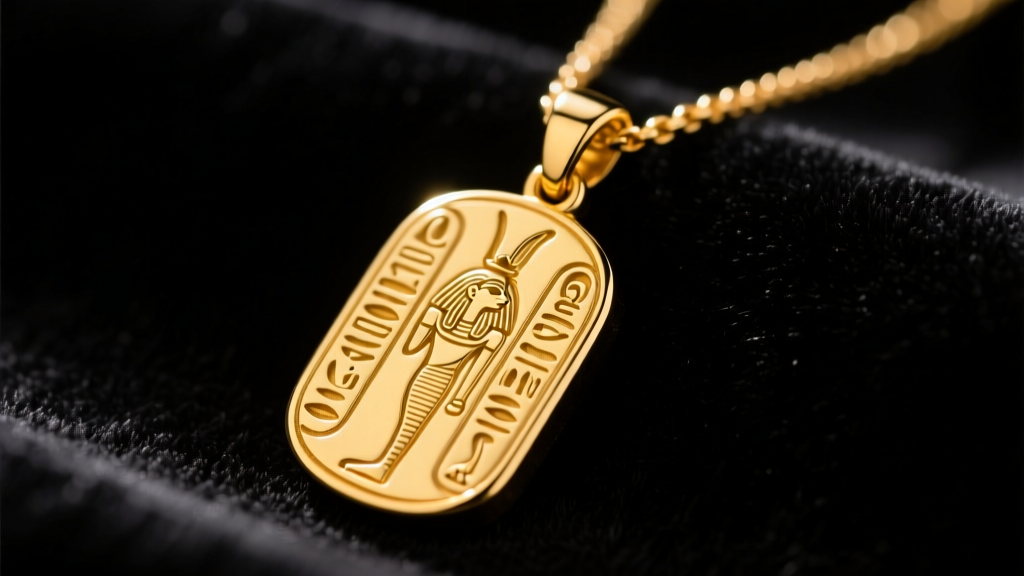
The cartouche is one of the most historically significant pendants in jewelry design. Originally known as the shen ring in ancient Egypt, it was elongated to accommodate royal names and symbolized the sun's circuit around the universe. According to Britannica, the cartouche represented protection and infinite existence. Today, it serves as the ultimate canvas for personalized nameplate jewelry. However, because a cartouche necklace relies entirely on surface engraving—whether ancient hieroglyphs or modern English script—the metallurgical properties of the chosen alloy dictate not just its longevity, but the very legibility and depth of the engraving itself.
As we evaluate jewelry trends in 2026, consumers are moving away from fast-fashion, hollow-stamped pendants toward solid, heirloom-grade metals. Choosing the right material for a cartouche requires a deep understanding of Vickers hardness (HV), alloy composition, and how different metals react to both laser and hand engraving techniques. Below, we break down the exact properties of the most common precious metals used in cartouche manufacturing.
Precious Metal Breakdown: Gold, Silver, and Platinum
14k vs. 18k Yellow Gold: The Traditionalist's Dilemma
Gold remains the most authentic choice for an Egyptian-style cartouche. However, pure 24k gold is far too soft (HV 25-30) for daily wear; it would warp and scratch, obliterating the engraved lines within months. Therefore, jewelers rely on gold alloys. According to the Gemological Institute of America (GIA), the karat system defines the ratio of pure gold to strengthening alloys like copper, silver, and zinc.
- 18k Yellow Gold (75% Gold): With a Vickers hardness of roughly 120-130 HV, 18k gold offers a rich, buttery yellow hue that closely mimics ancient artifacts. Its relative softness makes it the absolute best candidate for hand engraving. A master graver can push a burin through 18k gold with ease, creating deep, sweeping, reflective cuts that catch the light beautifully. However, it is more prone to surface scratching.
- 14k Yellow Gold (58.5% Gold): Harder and more durable (approx. 140-160 HV), 14k gold is the workhorse of American jewelry. It resists dents and dings far better than 18k. The trade-off is a slightly paler yellow color and a bit more resistance to hand engraving tools, though it yields incredibly crisp edges for laser engraving. For a cartouche worn daily against the skin, 14k gold offers the best balance of structural integrity and legibility.
Sterling Silver and Rhodium Plating: The Budget-Conscious Option
Sterling silver (92.5% silver, 7.5% copper) is highly accessible and takes laser engraving exceptionally well due to its high thermal conductivity. The copper alloy provides a hardness of about 60-70 HV, making it very easy to work with. The primary failure mode of sterling silver, however, is oxidation. The copper reacts with sulfur and moisture in the air (and on your skin), creating a dark tarnish that can quickly fill in and muddy the engraved letters of your cartouche.
To combat this, modern silver cartouches are often plated with rhodium (a platinum-group metal) at a thickness of 0.5 to 1.0 microns. While this provides a brilliant, tarnish-resistant white finish, it presents a structural issue: if the jeweler hand-engraves the cartouche after plating, they cut through the rhodium layer, exposing the raw silver underneath to immediate tarnishing. Always ensure your silver cartouche is engraved before the final rhodium bath, or opt for an unplated, high-polish oxidized finish where the tarnish is intentionally darkened in the grooves to provide contrast.
Platinum: The Heirloom-Grade Investment
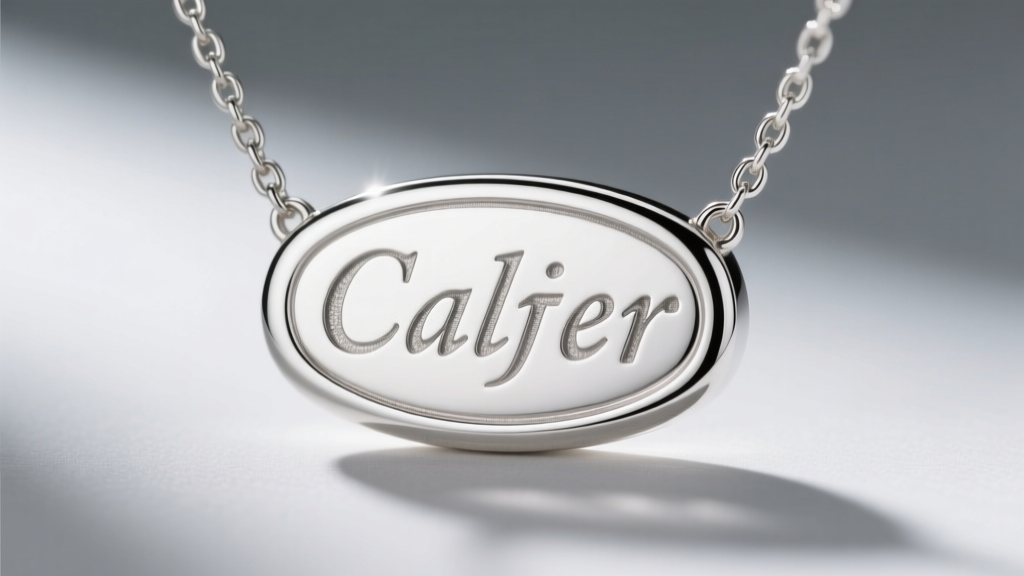
Platinum (typically 95% Pt, 5% Ruthenium or Iridium) is incredibly dense (21.45 g/cm³) and heavy. With a Vickers hardness of 110-135 HV, it might seem soft, but platinum possesses a unique property: malleability without material loss. When platinum scratches, the metal is merely displaced, not lost. Over time, a platinum cartouche develops a satiny patina that many collectors covet. Because of its high melting point and density, platinum is rarely hand-engraved in the traditional sense; it requires immense physical force. Most platinum cartouches are either laser-engraved or cast with raised, three-dimensional relief lettering. It is the most expensive option, but it will outlast the wearer without ever wearing thin.
Material Properties & Pricing Matrix
When commissioning or purchasing a custom cartouche necklace, use this matrix to align your budget with your expectations for longevity and engraving style.
| Metal Alloy | Vickers Hardness (HV) | Best Engraving Method | Tarnish Risk | Est. Price (1-Inch Oval) |
|---|---|---|---|---|
| 14k Yellow Gold | 140 - 160 | Laser or Hand | None | $350 - $550 |
| 18k Yellow Gold | 120 - 130 | Hand (Preferred) | None | $500 - $800 |
| Sterling Silver | 60 - 70 | Laser | High (if unplated) | $60 - $120 |
| Platinum 950 | 110 - 135 | Laser or Cast Relief | None (Patina forms) | $900 - $1,500+ |
Engraving Techniques: Laser vs. Hand
The metal you choose must match the engraving technique. In 2026, fiber laser engravers operating at 1064nm wavelengths are the industry standard for commercial cartouches. Lasers vaporize the metal surface, leaving a dark, highly legible mark. This works flawlessly on silver, 14k gold, and platinum.
'A laser burns the metal, leaving a flat, matte contrast. Hand engraving, however, physically removes a ribbon of metal, creating angled walls that reflect light like a mirror. For a traditional cartouche, the light-play of a hand-cut V-groove in 18k gold is irreplaceable.' - Master Jeweler & Engraver
If you are commissioning a high-end 18k gold or platinum cartouche and want hand engraving, expect to pay a premium of $150 to $300 just for the artisan's labor. The depth of a hand-cut groove (often 0.2mm to 0.5mm deep) ensures the design will remain legible even after decades of polishing and wear, whereas laser engravings are typically only 0.05mm deep and can be polished away over time.
Structural Failure Modes and Chain Pairing
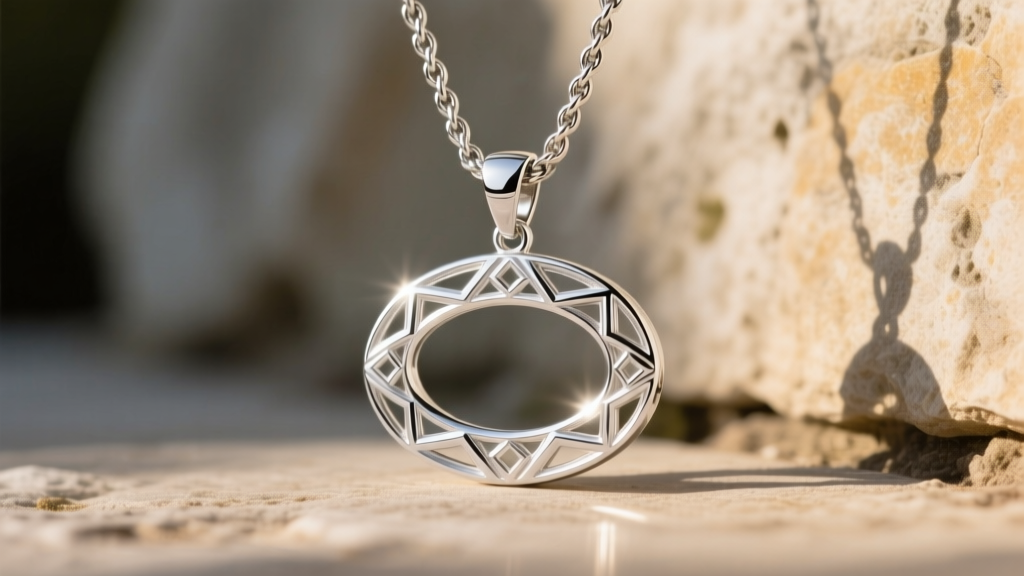
A cartouche is a solid, flat plate of metal, making it surprisingly heavy compared to hollow or wireframe pendants. The most common failure mode in cartouche necklaces is not the pendant itself, but the bail (the loop connecting the pendant to the chain) sawing through the chain links due to friction.
To prevent catastrophic loss of your jewelry, adhere to the 3:1 Weight Ratio Rule. The chain must weigh at least one-third of the pendant's total weight. Furthermore, avoid pairing heavy cartouches with delicate chains like 1mm box chains or thin cable chains. The sharp inner edges of the cartouche bail will act like a file against soft gold or silver links.
Recommended Chain Pairings by Metal
- For 14k/18k Gold Cartouches (Avg 4-6 grams): Pair with a 2.0mm to 2.5mm solid rope chain or a 2.5mm Figaro chain. The twisted grooves of a rope chain hide friction marks well and provide immense tensile strength.
- For Sterling Silver Cartouches (Avg 3-5 grams): A 2.0mm Cuban link chain offers a wide surface area that distributes the weight of the pendant bail evenly, preventing localized wear.
- For Platinum Cartouches (Avg 8-12 grams): Platinum is exceptionally heavy. You must use a minimum 3.0mm solid chain, preferably a heavy-duty curb or a reinforced wheat chain, secured with a lobster clasp rated for at least 15 pounds of tensile pressure.
Final Verdict: Which Metal Should You Choose?
Your choice of material for a cartouche necklace ultimately depends on your budget, your desired aesthetic, and how you plan to wear it. If you are seeking an authentic, historically resonant piece that will feature deep, reflective hand-engraved hieroglyphs, 18k Yellow Gold is the undisputed champion. It offers the perfect balance of malleability for the engraver and durability for the wearer.
If you require a daily-wear piece that can withstand harsh environments, gym sessions, and frequent travel without showing scratches, a 14k Gold cartouche on a sturdy rope chain is your most pragmatic choice. For those on a budget who still want high-contrast, modern typography, Rhodium-Plated Sterling Silver provides brilliant shine and excellent laser-engraving results, provided you manage the inevitable tarnishing in the crevices. Finally, if you are commissioning a true generational heirloom and budget is of no concern, Platinum offers unmatched density and a permanent, heavy luxury that no other metal can replicate.


