The Catholic Necklace Name Guide: Meanings & 2026 Trends
Discover every Catholic necklace name, from Scapulars to Miraculous Medals. Explore material grades, chain pairings, and 2026 layering trends.

Decoding the Catholic Necklace Name: Beyond the Crucifix
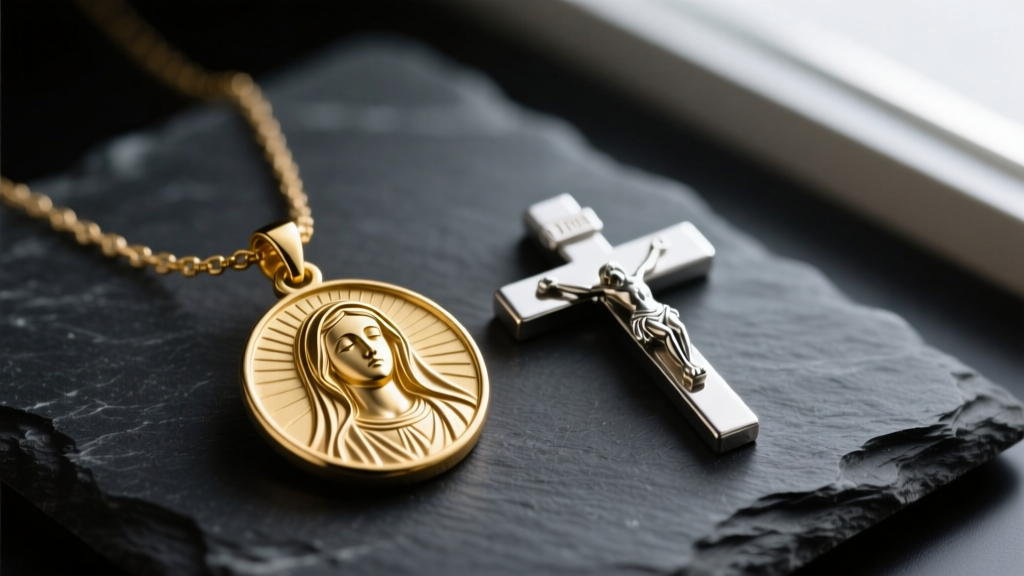
When searching for a specific catholic necklace name, buyers and collectors are often trying to identify a piece of sacred jewelry they have seen, inherited, or wish to gift. While the crucifix is the most universally recognized symbol of the faith, the world of Catholic sacramentals encompasses a rich lexicon of specific pendants, medals, and devotional chains. Understanding the exact terminology not only helps in sourcing authentic pieces but also ensures the jewelry aligns with its intended theological purpose. In 2026, the intersection of traditional devotion and modern minimalist aesthetics has brought these sacred pieces into the mainstream fashion consciousness, making it essential to know the difference between a standard saint medal and a canonical scapular.
The Core Catholic Necklace Names & Iconography
To accurately identify or request these pieces, one must understand their formal designations and the iconography that defines them.
The Miraculous Medal (Médaille Miraculeuse)
Originally known as the Medal of the Immaculate Conception, this is one of the most searched Catholic necklace names globally. Based on the 1830 apparitions of the Virgin Mary to Saint Catherine Labouré, the front features Mary standing on a globe, crushing a serpent, with rays of light emanating from her hands. The reverse displays an 'M' surmounted by a cross, with the two hearts (the Sacred Heart of Jesus and the Immaculate Heart of Mary) below. Authentic replicas must maintain this exact reverse iconography to be considered true Miraculous Medals.
The Scapular Medal
A common point of confusion is the term "Scapular Necklace." The traditional Brown Scapular is made of woven cloth. However, in 1910, Pope Pius X granted permission to replace the cloth scapular with a metal medal for practical reasons (such as in tropical climates or for soldiers). This medal must bear the image of the Sacred Heart on one side and the Virgin Mary on the other. According to the United States Conference of Catholic Bishops (USCCB), the scapular medal is a valid substitute, though the cloth version remains the traditional ideal.
"The Scapular Medal is not merely a pendant; it is a canonical substitute for the cloth scapular, requiring the same enrollment and carrying the same spiritual promises, provided it is worn continually."
Patron Saint Medals
These are categorized by the specific saint depicted. The Saint Christopher Medal (depicting the saint carrying the Christ child across a river) is the definitive Catholic necklace name for travelers. The Saint Jude Medal (featuring the saint with a flame above his head and holding a medallion) is sought for desperate causes, while the Saint Michael Medal (showing the archangel defeating Satan) is worn for spiritual and physical protection.
Metallurgy & Material Grades for Sacred Jewelry
Because Catholic necklaces are often worn 24/7 as sacramentals, the metallurgy must withstand constant friction, sweat, and environmental exposure. Choosing the right material grade is critical for longevity.
Gold Alloys: 14k vs. 18k
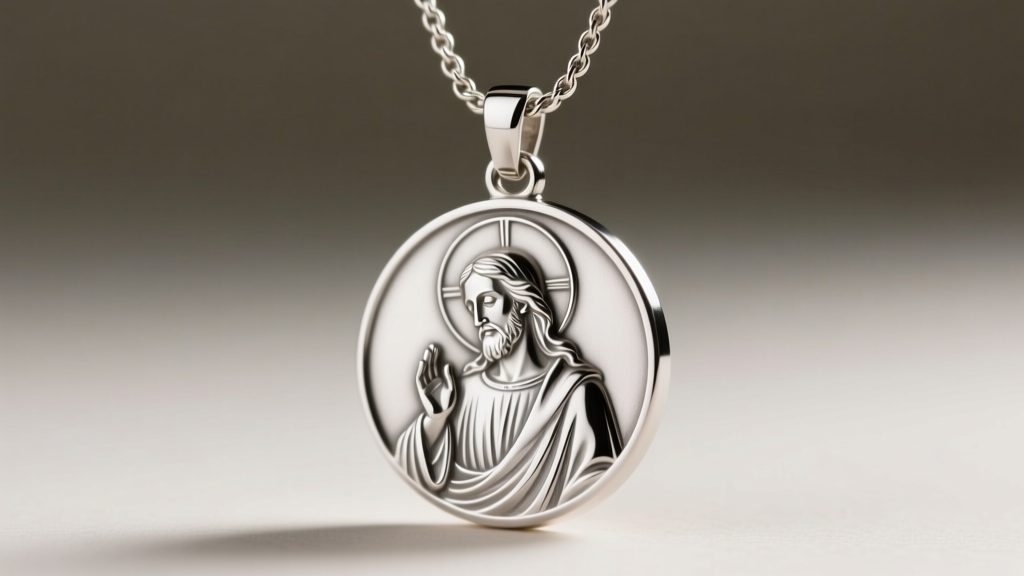
While 18k gold (75% pure gold) offers a richer, warmer yellow hue, it is too soft for daily-wear items like the Scapular Medal. The constant rubbing against the chest and clothing will wear down the high-relief engraving and enamel details over a few years. 14k gold (58.5% pure gold) is the industry standard for devotional jewelry. Its higher alloy content (mixed with copper, silver, or zinc) provides the necessary tensile strength and scratch resistance to preserve the sacred iconography for decades.
Sterling Silver & Rhodium Plating
Sterling silver (92.5% silver, 7.5% copper) is highly susceptible to tarnishing when exposed to the sulfur compounds in human sweat and skin oils, forming silver sulfide. For a Catholic necklace meant to be worn in the shower or during physical labor, ensure the sterling silver is heavily rhodium-plated. Rhodium, a platinum-group metal, creates an inert, brilliant white barrier that prevents tarnish and reduces allergic reactions to the copper alloy.
Enamel: Vitreous vs. Epoxy
Many Miraculous Medals feature blue enamel on the reverse. Cheap mass-market pieces use epoxy resin, which yellows, chips, and degrades within 5 to 7 years of UV and sweat exposure. High-end liturgical jewelers use vitreous enamel (fused glass powder fired at over 1400°F). Vitreous enamel is impervious to water, sweat, and UV light, ensuring the blue detailing remains vibrant for a lifetime, though it can shatter if struck directly against a hard surface.
2026 Trend Analysis: The Devotional Layering Stack
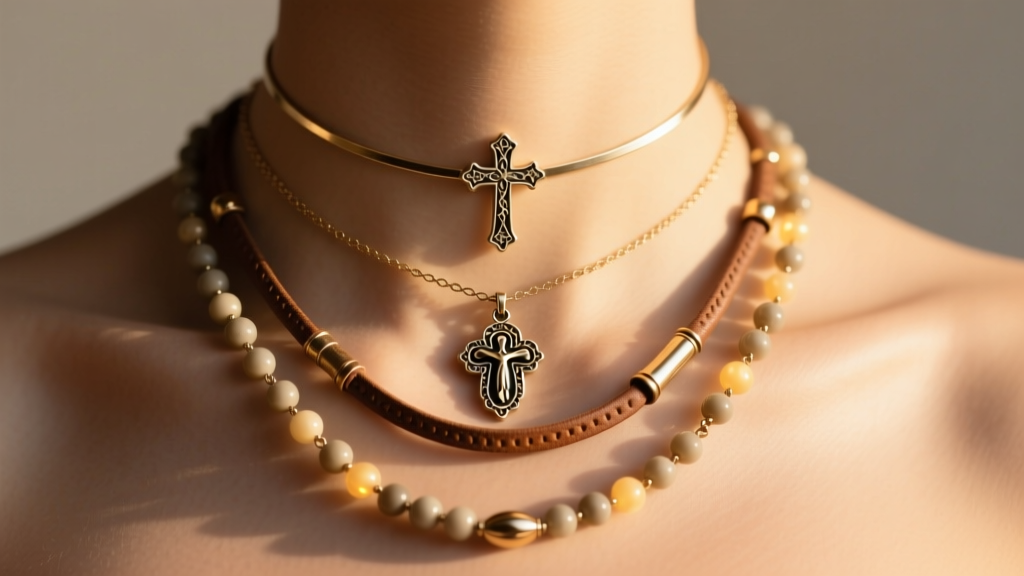
As documented by Eternal Word Television Network (EWTN) and observed in contemporary liturgical fashion, the modern approach to wearing sacramentals embraces the "devotional stack." Rather than hiding a single piece beneath a shirt, 2026 trends favor intentional, visible layering of multiple Catholic necklace names, combining spiritual significance with aesthetic balance.
To execute a layered stack without the chains tangling into a knotted mess, follow these structural rules:
- The 16-Inch Anchor: Start with a 16-inch choker-length chain featuring a minimalist, bare Latin cross or a small 10mm crucifix. Use a delicate 1.0mm cable chain.
- The 18-Inch Core: The middle layer should be the primary devotional piece, such as an 18-inch Miraculous Medal. Opt for a 1.5mm rope chain; the twisted links catch the light and visually separate the layer from the others.
- The 20-to-22-Inch Drop: The longest layer is reserved for heavier pendants like a two-sided Scapular Medal or a Rosary pendant. A 22-inch box chain provides the necessary structural integrity to support the heavier weight of a dual-sided pendant without stretching.
Pro-Tip: Never layer chains of the exact same link style and thickness. A cable chain and a rope chain of different gauges will glide past one another, whereas identical chains will interlock and tangle within minutes.
Quick Reference Chart: Catholic Necklace Names & Meanings
| Necklace Name | Primary Iconography | Spiritual / Traditional Purpose | Ideal Chain Length |
|---|---|---|---|
| Miraculous Medal | Virgin Mary, Sacred & Immaculate Hearts | Grace, protection, and conversion | 18" - 20" |
| Scapular Medal | Sacred Heart (Front), Virgin Mary (Back) | Devotion to Mary, salvation promises | 20" - 24" |
| St. Christopher Medal | Saint carrying Christ child across water | Safe travels and physical protection | 18" - 22" |
| Crucifix (Corpus Christi) | Cross with the body of Christ | Remembrance of the Passion and sacrifice | 16" - 18" |
| St. Jude Medal | Saint with flame and medallion | Intercession for desperate or lost causes | 18" - 20" |
Chain Mechanics, Bails, and Failure Points
The most exquisite 14k gold Miraculous Medal is useless if the chain hardware fails. When evaluating any Catholic necklace name for daily wear, inspect the mechanical failure points.
The Bail and Jump Ring
The bail is the loop connecting the pendant to the chain. For two-sided medals like the Scapular, a tube bail or a wide European bail is required so the medal can flip freely to display both sides. The jump ring (the small circle connecting the bail to the chain) must be soldered shut. If you see a split in the jump ring, it will eventually catch on clothing and pull apart, resulting in the loss of the sacred medal.
Clasp Integrity
Avoid spring ring clasps at all costs for devotional jewelry. The internal tension spring in a spring ring is prone to fatigue and failure, especially when exposed to hot shower water which expands the metal. Always upgrade to a solid lobster clasp or a secure bolt ring. A lobster clasp features a heavier internal spring and a solid body that resists crushing if you happen to sleep on it.
Chain Gauge and Tensile Strength
For pendants weighing under 5 grams, a 1.2mm to 1.5mm chain is sufficient. However, avoid "hollow" chains. Hollow rope or box chains are manufactured by wrapping thin sheets of gold over a base metal core or leaving the center empty to save on material costs. They are notoriously fragile; a simple snag will crush the links, making them impossible to repair. Always verify with the jeweler that the chain is solid-core, ensuring it can withstand the daily rigors of an active, faithful lifestyle.


